816 posters, 24 topics, 3,314 authors, 1,012 institutions
ePostersLive by SciGen Technologies S.A. All rights reserved.
SAGES 2026 Annual Meeting Emerging Technology Session
March 25-28, 2026 | Tampa, FL, USA

P552
COMPARATIVE EFFECTIVENESS OF GASTRIC PERORAL ENDOSCOPIC MYOTOMY (G-POEM) FOR GASTROPARESIS AFTER ESOPHAGECTOMY VERSUS OTHER SURGICAL CAUSES
Poster Presenter
Part of Topic
Flexible Endoscopy
Title: Comparative Effectiveness of G-POEM for Post-Esophagectomy Gastroparesis Versus Other Post-Surgical Etiologies
Authors: Andrew Conner MD, Monisha Sudarshan MD, Sudish C Murthy MD, PhD, Siva Raja MD, PhD Department of Thoracic and Cardiovascular Surgery, Cleveland Clinic
Background
- Gastroparesis affects 10–50% of patients after esophagectomy, driven by multifactorial and incompletely understood mechanisms including vagal denervation & functional pyloric obstruction
- Most perform prophylactic pyloric drainage at esophagectomy; no consensus on optimal approach — pyloroplasty, pyloromyotomy, and Botox each carry distinct tradeoffs
- G-POEM is an effective treatment for refractory post-surgical gastroparesis, serving as a rescue option for post-esophagectomy patients who fail prophylactic drainage
- Outcomes of G-POEM in this physiologically distinct population remain poorly defined
Methods
- Single-center retrospective cohort, Cleveland Clinic, January 2017–April 2024
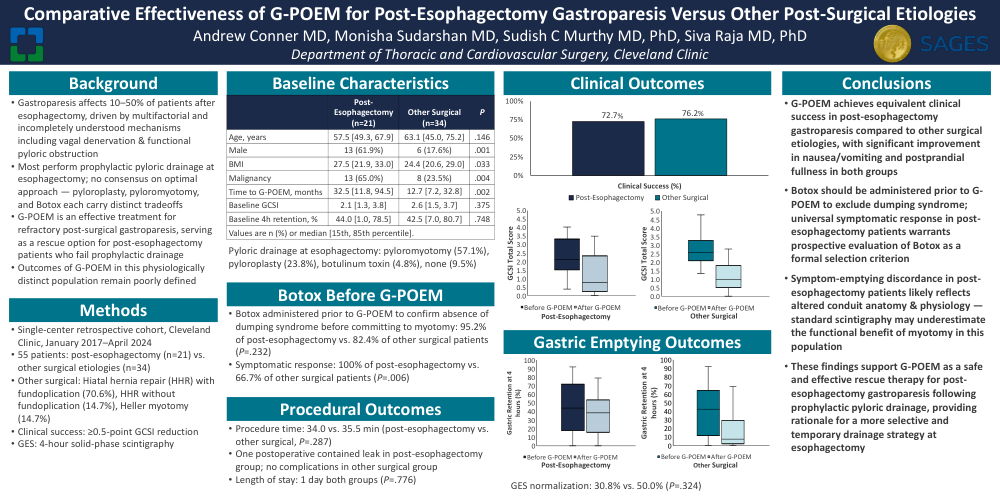
- 55 patients: post-esophagectomy (n=21) vs. other surgical etiologies (n=34)
- Other surgical: Hiatal hernia repair (HHR) with fundoplication (70.6%), HHR without fundoplication (14.7%), Heller myotomy (14.7%)
- Clinical success: ≥0.5-point GCSI reduction
- GES: 4-hour solid-phase scintigraphy
Baseline Characteristics
Pyloric drainage at esophagectomy: pyloromyotomy (57.1%), pyloroplasty (23.8%), botulinum toxin (4.8%), none (9.5%)
Botox Before G-POEM
- Botox administered prior to G-POEM to confirm absence of dumping syndrome before committing to myotomy: 95.2% of post-esophagectomy vs. 82.4% of other surgical patients (P=.232)
- Symptomatic response: 100% of post-esophagectomy vs. 66.7% of other surgical patients (P=.006)
Procedural Outcomes
- Procedure time: 34.0 vs. 35.5 min (post-esophagectomy vs. other surgical, P=.287)
- One postoperative contained leak in post-esophagectomy group; no complications in other surgical group
- Length of stay: 1 day both groups (P=.776)
Clinical Outcomes
- Clinical success: 72.7% post-esophagectomy vs. 76.2% other surgical
- GCSI Total Score (before vs. after G-POEM): Post-esophagectomy 2.1 → 0.9; Other surgical 2.6 → 1.1
Gastric Emptying Outcomes
- Gastric retention at 4 hours (before vs. after G-POEM): Post-esophagectomy 44.0% → 35.0%; Other surgical 42.5% → 9.5%
- GES normalization: 30.8% vs. 50.0% (P=.324)
Conclusions
- G-POEM achieves equivalent clinical success in post-esophagectomy gastroparesis compared to other surgical etiologies, with significant improvement in nausea/vomiting and postprandial fullness in both groups
- Botox should be administered prior to G-POEM to exclude dumping syndrome; universal symptomatic response in post-esophagectomy patients warrants prospective evaluation of Botox as a formal selection criterion
- Symptom-emptying discordance in post-esophagectomy patients likely reflects altered conduit anatomy & physiology — standard scintigraphy may underestimate the functional benefit of myotomy in this population
- These findings support G-POEM as a safe and effective rescue therapy for post-esophagectomy gastroparesis following prophylactic pyloric drainage, providing rationale for a more selective and temporary drainage strategy at esophagectomy