816 posters, 24 topics, 3,314 authors, 1,012 institutions
ePostersLive by SciGen Technologies S.A. All rights reserved.
SAGES 2026 Annual Meeting Emerging Technology Session
March 25-28, 2026 | Tampa, FL, USA

P531
Characterizing the Learning Curve for Performing Surgical Airway Management
Poster Presenter
Part of Topic
Education / Simulation
Characterizing the Learning Curve for Performing Surgical Airway Management
Changyun Ma1, Gabriel Gazetta1, Paul Raj Reddipogu1, Kaori Tanaka2, Matthew Hackett3, Jack Norfleet3, Rahul4, Steven Schwaitzberg5, Suvranu De6, Lora Cavuoto1*
1Department of Industrial and System Engineering, University at Buffalo, Buffalo, New York
2Department of Emergency Medicine, Jacobs School of Medicine and Biomedical Sciences, University at Buffalo, Buffalo, New York
3U.S. Army Futures Command, Combat Capabilities Development Command Soldier Center STTC, Orlando Florida
4Department of Biomedical Engineering, Rensselaer Polytechnic Institution, Troy, New York
5Department of Surgery, Jacobs School of Medicine and Biomedical Sciences, University at Buffalo, Buffalo, New York
6FAMU-FSU College of Engineering, Tallahassee, Florida
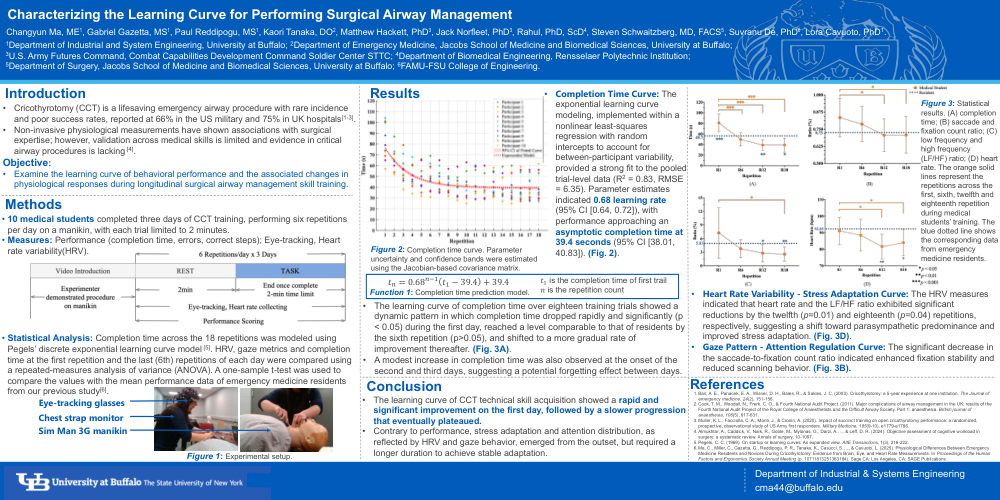
Introduction: This study investigated the learning curve of behavioral performance and associated physiological changes during cricothyrotomy (CCT) skill training. CCT is a lifesaving emergency airway procedure with a rare incidence, required in only 1% of critical airway cases in the emergency department. This rarity poses significant challenges for training and retainingexpertise, as opportunities to observe and practice in real-world settings are limited, leading to the poor success rate of 66% in the US military and 75% in UK hospitals. [1-3] To address the limited evidence on CCT skill training, this study integrated multimodal measures to characterize the learning curve of skill acquisition and changes in psychophysiological activities across a longitudinal training process.
Methods: Ten medical students completed three days of CCT training, performing six repetitions per day on a SimMan 3G manikin. Each trial was limited to two minutes, and was separated by a two-minute rest period. Heart rate was recorded as inter-beat intervals (IBI) using a Polar H10 chest strap and gaze data was collected via Tobii Pro Glasses 2. Completion time across the 18 repetitions was modeled using Pegels’ discrete exponential learning curve model[4]. Heart rate variability (HRV) and gaze metrics were analyzed for the first repetition and the last repetitions of each day using repeated-measures ANOVA. They were further compared, through a one sample t-test, with data of emergency medicine program residents from our prior study[5] conducted under the same protocol.
Results: The statistical results are summarized in Figure 1.The learning curve of completion time over eighteen training trials showed a dynamic pattern in which completion time dropped rapidly and significantly (p < 0.05) during the first day, reached a level comparable to that of residents by the sixth repetition (p>0.05), and shifted to a more gradual rate of improvement thereafter. Additionally, a modest increase in completion time was observed at the onset of the second and third days, suggesting a potential forgetting effect between days. The exponential learning curve modeling, implemented within a nonlinear mixed-effects framework with random intercepts, provided a strong fit to the pooled trial-level data (R2 = 0.83, RMSE = 6.35). Parameter estimates indicated a learning rate parameter at 0.68 (95% CI [0.64, 0.72]), with performance approaching an asymptotic completion time at 39.4 seconds (95% CI [38.01, 40.83]).
The HRV measures indicated that heart rate and the LF/HF ratio exhibited significant reductions by the twelfth (p=0.01) and eighteenth (p=0.04) repetitions, respectively, suggesting a shift toward parasympathetic predominance and improved stress adaptation. The significant decrease in the saccade-to-fixation count ratio indicated enhanced fixation stability and reduced scanning behavior. No significant differences were observed in pupil diameter or in the root mean square of successive differences (RMSSD).
Conclusion: The learning curve of CCT technical skill acquisition showed a rapid and significant improvement on the first day, followed by a slower progression that eventually plateaued. In contrast, stress adaptation and attentional control, as reflected by HRV and gaze behavior, emerged from the outset but required a longer duration to achieve stable adaptation. These insights can inform the design of evidence-based training programs for emergency procedures, addressing the limitations of traditional behavioral metrics in capturing psychological and cognitive factors, and providing a more comprehensive perspective that ultimately enhances clinician preparedness and patient safety.
Reference: