816 posters, 24 topics, 3,314 authors, 1,012 institutions
ePostersLive by SciGen Technologies S.A. All rights reserved.
SAGES 2026 Annual Meeting Emerging Technology Session
March 25-28, 2026 | Tampa, FL, USA

P510
Assessing General Surgery Resident Proficiency in Robotic Surgery
Poster Presenter
Authors
Cameron Jackson, Jason Zheng, Melissa Easley, Richard Aldan, Lisa Hilton, Jaine McKenzie, Aaron Bolduc
Affiliations
Part of Topic
Education / Simulation
Assessing General Surgery Resident Proficiency in Robotic Surgery
Cameron Jackson BA, Jason Zheng BS, Melissa Easley MD, Richard Aldan MD, Lisa Hilton MD, Jaine McKenzie MD, Aaron Buldoc MD
Medical College of Georgia, Augusta University, Augusta, Georgia
Introduction
•Robotic surgery (RS), though increasing in popularity, has not been uniformly adopted across general surgery (GS) residency programs¹.
•Literature identifying factors which increase RS curriculum efficacy, and quantitatively evaluating performance are limited.
•This study aims to evaluate resident-physician self-perceived proficiency in RS, investigate which aspects of RS training residents perceive to be most beneficial, and quantify console time across GS residency at our institution.
Methods:
•A survey was administered to all GS residents.
•Our survey evaluated current and future self-perceived confidence and proficiency in RS, and specific aspects of training found most helpful.
•User-specific active console time was obtained via an integrated tracking app, with increased active time used as a surrogate for increased proficiency.
Results:
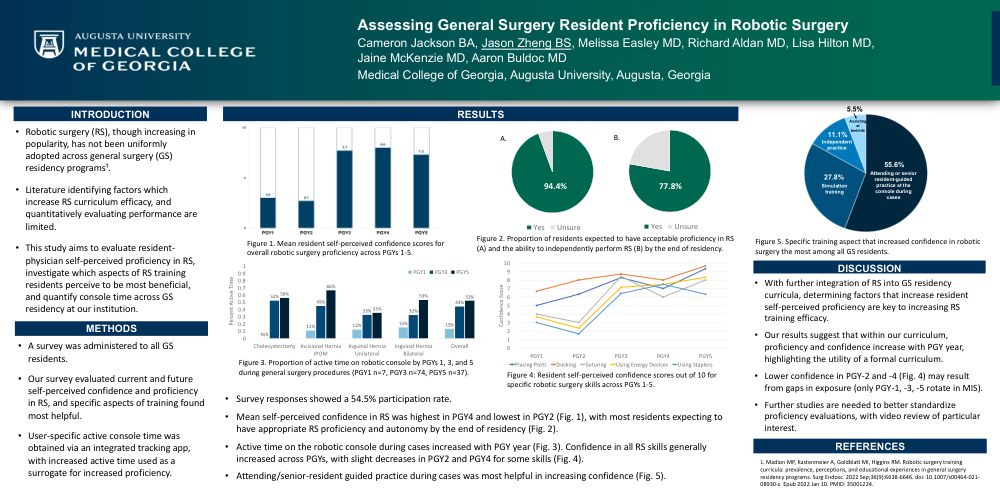
•Survey responses showed a 54.5% participation rate.
•Mean self-perceived confidence in RS was highest in PGY4 and lowest in PGY2 (Fig. 1), with most residents expecting to have appropriate RS proficiency and autonomy by the end of residency (Fig. 2).
•Active time on the robotic console during cases increased with PGY year (Fig. 3). Confidence in all RS skills generally increased across PGYs, with slight decreases in PGY2 and PGY4 for some skills (Fig. 4).
•Attending/senior-resident guided practice during cases was most helpful in increasing confidence (Fig. 5).
Discussion:
•With further integration of RS into GS residency curricula, determining factors that increase resident self-perceived proficiency are key to increasing RS training efficacy.
•Our results suggest that within our curriculum, proficiency and confidence increase with PGY year, highlighting the utility of a formal curriculum.
•Lower confidence in PGY-2 and -4 (Fig. 4) may result from gaps in exposure (only PGY-1, -3, -5 rotate in MIS).
•Further studies are needed to better standardize proficiency evaluations, with video review of particular interest.