816 posters, 24 topics, 3,314 authors, 1,012 institutions
ePostersLive by SciGen Technologies S.A. All rights reserved.
SAGES 2026 Annual Meeting Emerging Technology Session
March 25-28, 2026 | Tampa, FL, USA

P049
Robotic vs Open Parastomal Hernia Repair: A Hernia Center of Excellence Retrospective Review
Poster Presenter
Authors
Baraa Mohamed, Nathaniel Grabill, Nicole Redenius, Shane Robinson, Jake Slaton, Chad Copper
Affiliations
Part of Topic
Abdominal Wall Hernias
Robotic vs Open Parastomal Hernia Repair: A Hernia Center of Excellence Retrospective Review
Background
•Parastomal hernias remain a significant problem with high recurrence and long-term complications.
•In the United States, an estimated 120,000 new stomas are created annually with a prevalence of up to 800,000 patients. Approximately, 40–60% of these ostomies will never be reversed.
•Historically, these hernias have been managed via open surgical repair but minimally invasive approaches to parastomal hernia repair have been introduced over the past 20 years with variable results and no definitive optimal technique.
Objective
•Therefore, this study describes a single institution's eight-year retrospective experience of parastomal hernia repair and compares open to robotic approaches.
Methods
•This is a retrospective chart review of all parastomal hernia repairs at Northeast Georgia Medical Center from October 1, 2017, to April 1, 2025.
•All repairs were categorized into Robotic and traditional Open repairs, and data on OR logistics, overall length of stay, cost, and recurrence was collected to determine if robotic repairs improve the quality of care and performance of the hospital.
Results
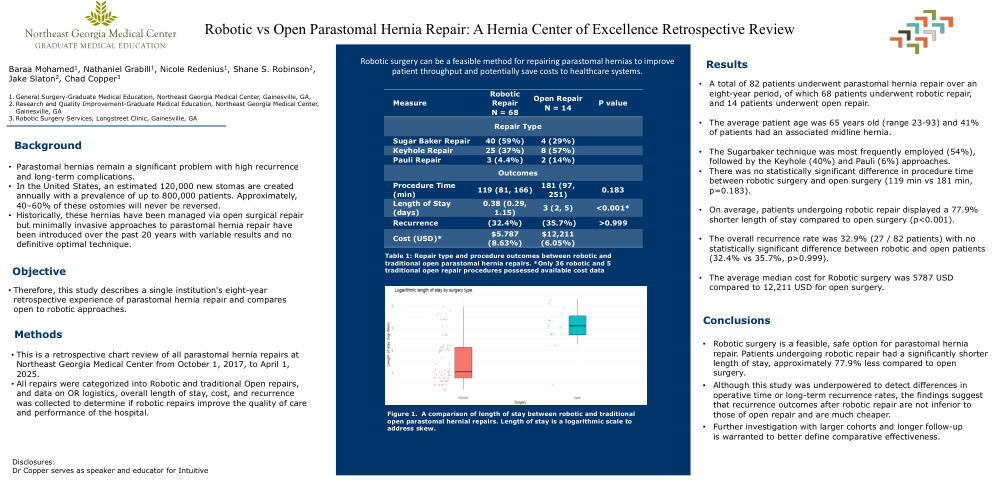
•A total of 82 patients underwent parastomal hernia repair over an eight-year period, of which 68 patients underwent robotic repair, and 14 patients underwent open repair.
•The average patient age was 65 years old (range 23-93) and 41% of patients had an associated midline hernia.
•The Sugarbaker technique was most frequently employed (54%), followed by the Keyhole (40%) and Pauli (6%) approaches.
•There was no statistically significant difference in procedure time between robotic surgery and open surgery (119 min vs 181 min, p=0.183).
•On average, patients undergoing robotic repair displayed a 77.9% shorter length of stay compared to open surgery (p<0.001).
•The overall recurrence rate was 32.9% (27 / 82 patients) with no statistically significant difference between robotic and open patients (32.4% vs 35.7%, p>0.999).
•The average median cost for Robotic surgery was 5787 USD compared to 12,211 USD for open surgery.
Conclusions
•Robotic surgery is a feasible, safe option for parastomal hernia repair. Patients undergoing robotic repair had a significantly shorter length of stay, approximately 77.9% less compared to open surgery.
•Although this study was underpowered to detect differences in operative time or long-term recurrence rates, the findings suggest that recurrence outcomes after robotic repair are not inferior to those of open repair and are much cheaper.
•Further investigation with larger cohorts and longer follow-up is warranted to better define comparative effectiveness.