816 posters, 24 topics, 3,314 authors, 1,012 institutions
ePostersLive by SciGen Technologies S.A. All rights reserved.
SAGES 2026 Annual Meeting Emerging Technology Session
March 25-28, 2026 | Tampa, FL, USA

P036
EXPERIENCE OF GIANT INCISIONAL HERNIA REPAIR OVER A DECADE AT A TERTIARY CARE CENTER IN INDIA
Poster Presenter
Authors
U Rohit, Ankita Bajpai, Sanjeet K Rai, Arun Anand, Omprakash Prajapati, Virinder K Bansal
Affiliations
Part of Topic
Abdominal Wall Hernias
EXPERIENCE OF GIANT INCISIONAL HERNIA REPAIR OVER A DECADE AT A TERTIARY CARE CENTER IN INDIA
U Rohit, MBBS; Ankita Bajpai, MBBS, MS;
Sanjeet K Rai; Arun Anand, MBBS, MS;
Omprakash Prajapati, MBBS, MS, FCLS, FACS;
Virinder K Bansal, MBBS, MS, FACS, FCLS;
AIIMS New Delhi
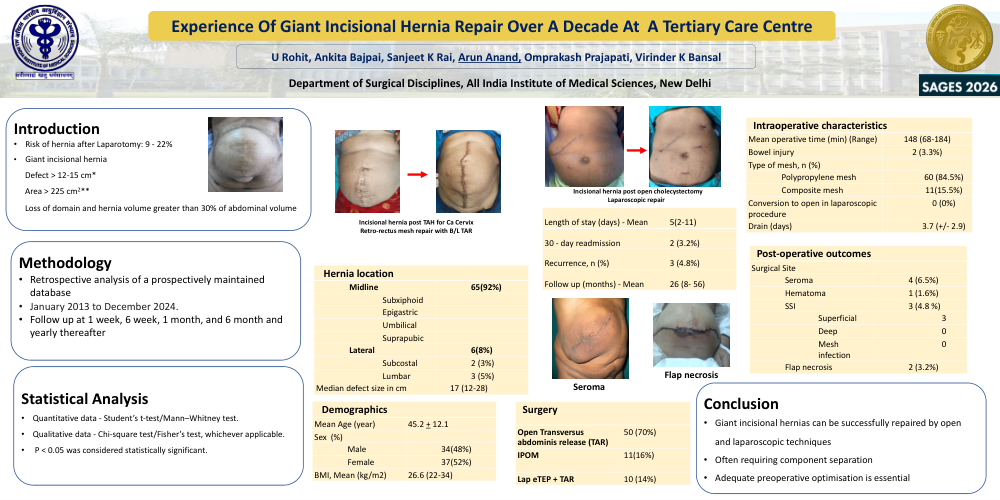
Introduction: Giant incisional hernias present a significant surgical challenge due to their complexity and the need for advanced repair techniques. They are defined as hernias with a defect size greater than 12 cm, an area greater than 225 cm², or loss of domain with a hernia volume exceeding 30% of the abdominal volume. This study presents a decade-long experience in managing giant incisional hernias at a tertiary care center in India.
Materials and Methods: A retrospective analysis of a prospectively maintained database of patients who underwent surgical repair for giant incisional hernias between January 2013 and December 2024. Patients’ demographic details, clinical evaluation, and laboratory parameters were recorded in a structured proforma. Preoperative optimization, including pulmonary function assessment, was performed before surgery. All procedures were conducted by a dedicated team of experienced hernia surgeons.
Results: A total of 71 patients underwent surgical repair, with a mean age of 45.2 ± 12.1 years. The majority were female (52%), with a median BMI of 26.6 kg/m² (range: 22–34). The hernia was midline in 92% of cases, with a median defect size of 17 cm (range: 12–28 cm). Open repair was the predominant approach, performed in 63 patients (89%). The most common technique was bilateral transversus abdominis release (TAR) with retrorectus mesh placement in 50 patients (70%). Laparoscopic repair was performed in the remaining cases, including intraperitoneal onlay mesh (IPOM) repair in 11 patients and extended totally extraperitoneal (eTEP) repair with TAR in 10 patients. Polypropylene mesh was used in 90% of procedures. The mean operative time was 148 minutes.
Postoperative complications included seroma formation in 6.5% of cases and surgical site infection in 4.8%, with no reported mesh infections. The mean hospital stay was 5 days (range: 2–11). Recurrence occurred in 4.8% of patients over a median follow-up period of 26 months (range: 8–56 months).
Conclusion: Giant incisional hernias can be effectively managed using both open and laparoscopic techniques, with component separation often required for tension-free closure. Proper preoperative optimization is crucial for improving postoperative outcomes and minimizing complications.