816 posters, 24 topics, 3,314 authors, 1,012 institutions
ePostersLive by SciGen Technologies S.A. All rights reserved.
SAGES 2026 Annual Meeting Emerging Technology Session
March 25-28, 2026 | Tampa, FL, USA

P029
Defect Area as a Predictor of Morbidity after Incisional Hernia Repair in Transplant Recipients
Poster Presenter
Part of Topic
Abdominal Wall Hernias
Defect Area as a Predictor of Morbidity after Incisional Hernia Repair in Transplant Recipients
Introduction:
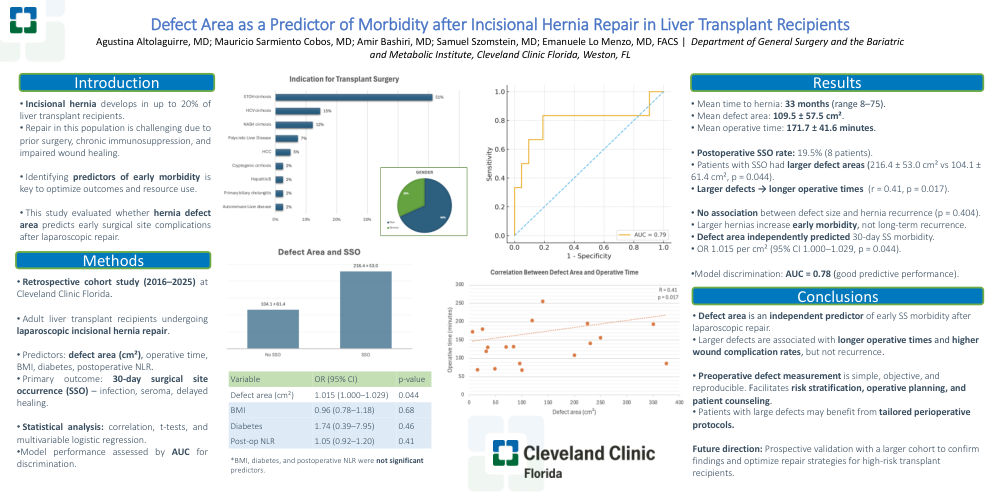
Incisional hernia (IH) is a frequent complication following liver transplantation, affecting up to 20% of recipients and often requiring complex surgical repair. The combination of prior extensive abdominal surgery, chronic immunosuppression, and impaired wound healing creates a unique surgical challenge. Identifying predictors of early postoperative morbidity, particularly surgical site occurrences (SSOs), is crucial for optimizing outcomes in this high-risk population.
Methods:
We performed a retrospective cohort study of adult liver transplant recipients who underwent laparoscopic IH repair between 2016 and 2025 at Cleveland Clinic Florida. Predictive variables included hernia defect area (cm²), operative time (minutes), body mass index (BMI), diabetes, and postoperative neutrophil-to-lymphocyte ratio (NLR). The primary outcome was 30-day SSO (infection, seroma, or delayed wound healing). Recurrence was also evaluated. Pearson correlation tested the relationship between defect area and operative time; independent t-tests compared defect size in patients with and without complications. A multivariable logistic regression model identified independent predictors of SSO, and discrimination was assessed using area under the ROC curve (AUC).
Results:
Forty-one patients were included. The mean defect area was 109.5 ± 57.5 cm², and the mean operative time was 171.7 ± 41.6 minutes. Larger defects correlated with longer procedures (r = 0.41, p = 0.017). Postoperative complications occurred in 35% of patients and were associated with larger hernia defects (116.4 ± 53.0 cm² vs. 104.1 ± 61.4 cm², p = 0.044). No significant association was observed between defect size and recurrence (p = 0.404). On multivariable analysis, defect area was independently associated with SSO at 30 days (OR 1.015 per cm²; 95% CI 1.000–1.029; p = 0.044), while BMI, diabetes, and postoperative NLR were not significant predictors. The model showed good discrimination (AUC 0.78).
Conclusion:
Defect area is an independent predictor of surgical site morbidity in liver transplant recipients undergoing IH repair and is also associated with operative time and overall morbidity, though not recurrence. Preoperative assessment of defect size provides a simple, reproducible tool to anticipate surgical complexity, optimize resource allocation, and improve risk stratification and counseling. These findings underscore the importance of tailored perioperative protocols for patients with large hernias, given their susceptibility to wound-related complications. Further prospective studies are warranted to validate these observations and to determine whether modified repair strategies may improve outcomes in this vulnerable cohort.