816 posters, 24 topics, 3,314 authors, 1,012 institutions
ePostersLive by SciGen Technologies S.A. All rights reserved.
SAGES 2026 Annual Meeting Emerging Technology Session
March 25-28, 2026 | Tampa, FL, USA

P020
DEFINING THE FELLOW LEARNING CURVE FOR RETRORECTUS HERNIA REPAIR USING ETEP: INSIGHTS FROM A DESIGNATED ABDOMINAL WALL FELLOWSHIP
Poster Presenter
Authors
Sara Saymuah, Carina McGuire, Griffin Feinberg, Jessiel Castillo, Julia Winschel, Christina Raker, Andrew Luhrs, Marcoandrea Giorgi
Affiliations
The Miriam Hospital, Comprehensive Hernia Center, Brown University Warren Alpert School of Medicine, Brown University Biostatistics, Epidemiology, and Research Design Core
Part of Topic
Abdominal Wall Hernias
Defining the Fellow Learning Curve for Retrorectus Hernia Repair Using eTEP: Insights from a Designated Abdominal Wall Fellowship
INTRODUCTION
Existing data on robotic retrorectus extended totally extraperitoneal (eTEP) hernia repair learning curves largely track attending progression, with 10–25 cases typically cited for proficiency. Published data for fellows remain sparse, despite the emergence of designated abdominal wall fellowship programs. This study evaluates the learning curve for fellows performing retrorectus repair with eTEP, defining the case volume required to achieve operative proficiency.
METHODS AND PROCEDURES
A retrospective analysis was performed of 129 robotic eTEP abdominal wall hernia repairs performed by minimally invasive surgery fellows between 11/8/2019 and 3/4/2025 at an academic center with a designated abdominal wall fellowship. Linear regression was used to compare first and last case operative time and mesh repair in cm/hr. Analysis was adjusted for concomitant transversus abdominis release (TAR) and lysis of adhesions (LOA).
RESULTS
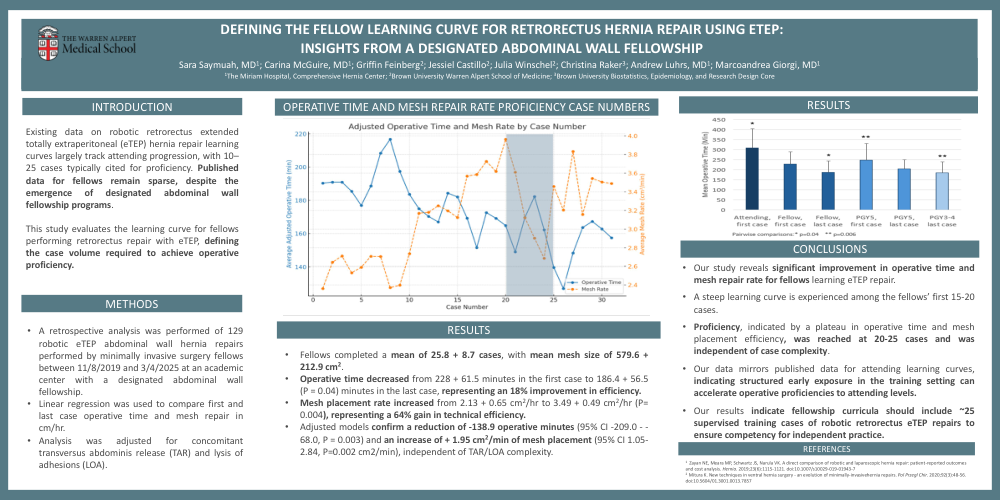
No fellows had previous experience with the procedure as a primary surgeon. Fellows completed a mean of 25.8 + 8.7 cases, with mean mesh size of 579.6 + 212.9 cm2. Operative time decreased from 228 + 61.5 minutes in the first case to 186.4 + 56.5 (P = 0.04) minutes in the last case, representing an 18% improvement in efficiency. Mesh placement rate increased from 2.13 + 0.65 cm2/hr to 3.49 + 0.49 cm2/hr (P= 0.004), representing a 64% gain in technical efficiency. Adjusted models confirm a reduction of -138.9 operative minutes (95% CI -209.0 - -68.0, P = 0.003) and an increase of + 1.95 cm2/min of mesh placement (95% CI 1.05-2.84, P=0.002 cm2/min), independent of TAR/LOA complexity (Figure 1).
CONCLUSION
Our study reveals significant improvement in operative time and mesh repair rate for fellows learning eTEP repair, with a steep learning curve experienced among their first 15-20 cases. Proficiency, indicated by a plateau in operative time and mesh placement efficiency, was reached at 20-25 cases and was independent of case complexity. Our data mirrors published data for attending learning curves, indicating structured early exposure in the training setting can accelerate operative proficiencies to attending levels. Our results indicate fellowship curricula should include ~25 supervised training cases of robotic retrorectus eTEP repairs to ensure competency for independent practice.