816 posters, 24 topics, 3,314 authors, 1,012 institutions
ePostersLive by SciGen Technologies S.A. All rights reserved.
SAGES 2026 Annual Meeting Emerging Technology Session
March 25-28, 2026 | Tampa, FL, USA

P013
Lightening the Load: GLP-1 Therapy and preoperative rehabilitation before Ventral Hernia Repair - A Systematic Review and Meta-Analysis
Part of Topic
Abdominal Wall Hernias
Lightening the Load: GLP-1 Therapy and Outcomes After Hernia Repair – A Systematic Review and Meta-Analysis
Authors:
Maria Clara Morais MD1; Marina Eguchi MD2; Bernardo G. Collaco MD3, Raquel Nogueira MD4; Diego Lima MD MSc4.
Affiliations:
1Department of Surgery, Lenox Hill Hospital, 100 E 77th St, New York, NY 10075, USA.
2Department of Surgery, Federal University of São Paulo, 740 Botucatu St, São Paulo, SP 04023-062, Brazil.
3Division of Plastic Surgery, Mayo Clinic, 4500 San Pablo Rd S, Jacksonville, FL 32224, USA.
4Department of Surgery, Montefiore Medical Center, 1825 Eastchester Rd, Bronx, NY 10461, USA.
ABSTRACT
Introduction: Obesity and type 2 diabetes mellitus (T2DM) are major risk factors for adverse outcomes after hernia repair, including surgical site infections (SSI), wound complications, and recurrence. Glucagon-like peptide-1 receptor agonists (GLP-1 RAs) have shown substantial efficacy in weight loss and glycemic control, making them attractive tools for preoperative optimization. This systematic review and meta-analysis evaluated the impact of GLP-1 therapy on preoperative weight reduction and subsequent postoperative outcomes in patients undergoing abdominal wall hernia repair.
Material and Methods: Following PRISMA guidelines, we searched PubMed, Embase, and Cochrane through July 2025. Eligible studies included adults undergoing abdominal or inguinal hernia repair with preoperative GLP-1 therapy. Data were synthesized with random-effects meta-analyses for dichotomous outcomes and a generalized linear mixed model (GLMM) to analyze BMI trajectories. Risk of bias was assessed using the ROBINS-I tool.
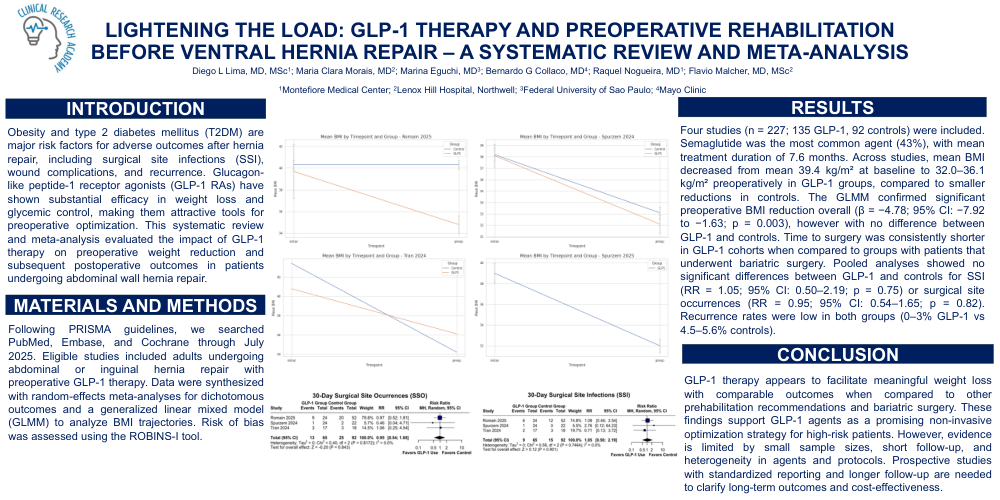
Results: Four studies (n = 227; 135 GLP-1, 92 controls) were included. Semaglutide was the most common agent (43%), with mean treatment duration of 7.6 months. Across studies, mean BMI decreased from ~39.4 kg/m² at baseline to 32.0–36.1 kg/m² preoperatively in GLP-1 groups, compared to smaller reductions in controls. The GLMM confirmed significant preoperative BMI reduction overall (β = −4.78; 95% CI: −7.92 to −1.63; p = 0.003), though the interaction for GLP-1 versus controls was not statistically significant. Time to surgery was consistently shorter in GLP-1 cohorts than in bariatric surgery comparators. Pooled analyses showed no significant differences between GLP-1 and controls for SSI (RR = 1.05; 95% CI: 0.50–2.19; p = 0.75) or surgical site occurrences (RR = 0.95; 95% CI: 0.54–1.65; p = 0.82). Recurrence rates were low in both groups (0–3% GLP-1 vs 4.5–5.6% controls).
Conclusion: GLP-1 therapy appears to facilitate meaningful weight loss with comparable outcomes when compared to other prehabilitation recommendations and bariatric surgery. These findings support GLP-1 agents as a promising non-invasive optimization strategy for high-risk patients. However, evidence is limited by small sample sizes, short follow-up, and heterogeneity in agents and protocols. Prospective studies with standardized reporting and longer follow-up are needed to clarify long-term outcomes and cost-effectiveness.