816 posters, 24 topics, 3,314 authors, 1,012 institutions
ePostersLive by SciGen Technologies S.A. All rights reserved.
SAGES 2026 Annual Meeting Emerging Technology Session
March 25-28, 2026 | Tampa, FL, USA

P011
Applications of Artificial Intelligence in Groin Hernia Surgery: A Scoping Review
Poster Presenter
Authors
Mehak Mahipal, Sean Lee, Lynette Loo, Davide Lomanto, Sujith Wijerathne
Affiliations
Part of Topic
Abdominal Wall Hernias
Applications of Artificial Intelligence in Groin Hernia Surgery: A Scoping Review
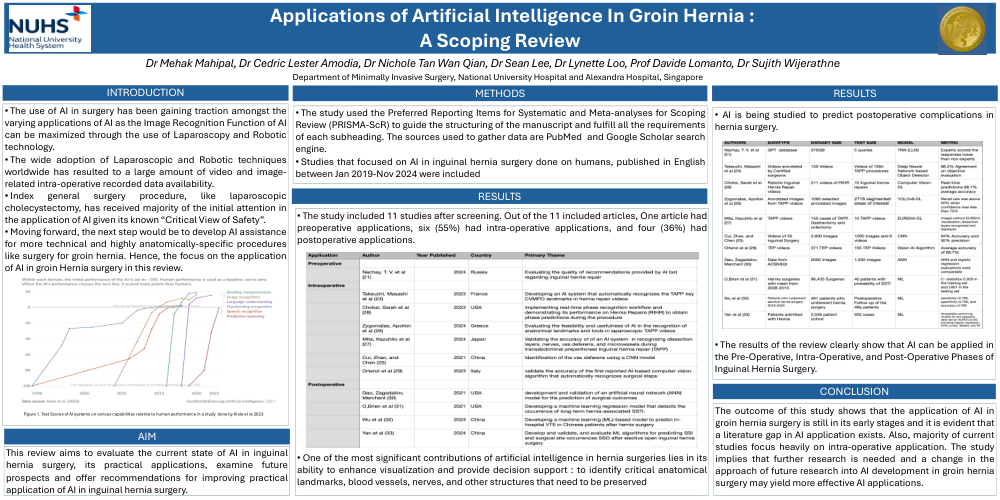
Background: The use of AI in surgery has been gaining traction amongst the varying applications of AI as the Image Recognition Function of AI can be maximized through the use of Laparoscopy and Robotic technology. The wide adoption of Laparoscopic and Robotic techniques worldwide has resulted to a large amount of video and image-related intra-operative recorded data availability.Index general surgery procedure, like laparoscopic cholecystectomy, has received majority of the initial attention in the application of AI given its known “Critical View of Safety”. Moving forward, the next step would be to develop AI assistance for more technical and highly anatomically-specific procedures like surgery for groin hernia. Hence, the focus on the application of AI in groin Hernia surgery in this review. This review aims to evaluate the current state of AI in inguinal hernia surgery, its practical applications, and examine future prospects.
Methods: The study used the Preferred Reporting Items for Systematic and Meta-analyses for Scoping Review (PRISMA-ScR) to guide the structuring of the manuscript and fulfill all the requirements of each subheading. The sources used to gather data are PubMed and Google Scholar search engine.
Results: The study included 11 studies after screening. Out of the 11 included articles, One article had preoperative applications, six (55%) had intra-operative applications, and four (36%) had postoperative applications.
Conclusion: The outcome of this study shows that the application of AI in groin hernia surgery is still in its early stages and it is evident that a literature gap in AI application exists. Also, majority of current studies focus heavily on intra-operative application. The study implies that further research is needed and a change in the approach of future research into AI development in groin hernia surgery may yield more effective AI applications.