Loading...

816 posters, 24 topics, 3,314 authors, 1,012 institutions

ePostersLive by SciGen Technologies S.A. All rights reserved.

P099

30-DAY OUTCOMES IN OBESE PATIENTS UNDERGOING OPEN VS LAPAROSCOPIC INGUINAL HERNIA REPAIR: A NSQIP STUDY 2015-2023
Part of Topic

Abdominal Wall Hernias

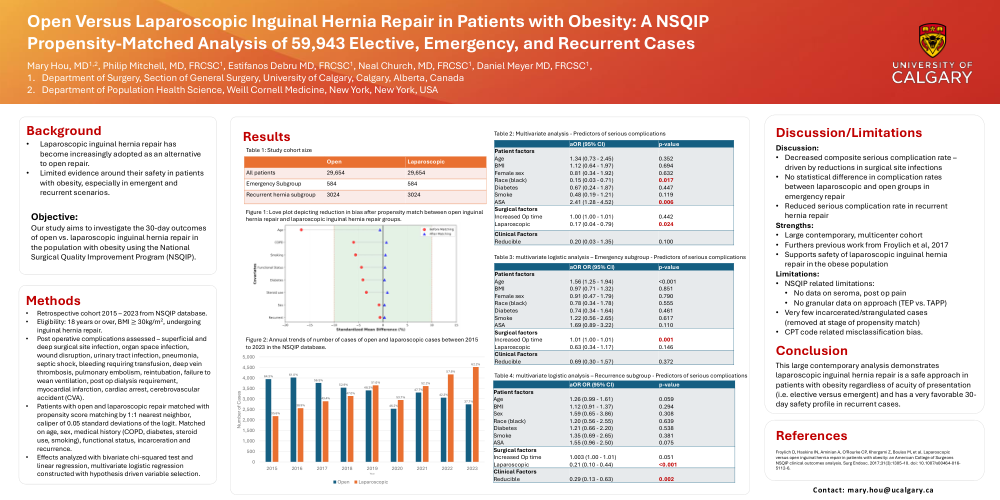
Open Versus Laparoscopic Inguinal Hernia Repair in Patients with Obesity: A NSQIP Propensity-Matched Analysis of 59,943 Elective, Emergency, and Recurrent Cases

Background:

Laparoscopic inguinal hernia repair has become increasingly adopted as an alternative to open repair. 

Limited evidence around their safety in patients with obesity, especially in emergent and recurrent scenarios. 

Objective:

Our study aims to investigate the 30-day outcomes of open vs. laparoscopic inguinal hernia repair in the population with obesity using the National Surgical Quality Improvement Program (NSQIP). 


Methods:

Retrospective cohort 2015 – 2023 from NSQIP database.
Eligibility: 18 years or over, BMI ≥ 30kg/m2, undergoing inguinal hernia repair.
Post operative complications assessed – superficial and deep surgical site infection, organ space infection, wound disruption, urinary tract infection, pneumonia, septic shock, bleeding requiring transfusion, deep vein thrombosis, pulmonary embolism, reintubation, failure to wean ventilation, post op dialysis requirement, myocardial infarction, cardiac arrest, cerebrovascular accident (CVA).
Patients with open and laparoscopic repair matched with propensity score matching by 1:1 nearest neighbor, caliper of 0.05 standard deviations of the logit. Matched on age, sex, medical history (COPD, diabetes, steroid use, smoking), functional status, incarceration and recurrence. 
Effects analyzed with bivariate chi-squared test and linear regression, multivariate logistic regression constructed with hypothesis driven variable selection. 

Discussion:
Decreased composite serious complication rate – driven by reductions in surgical site infections
No statistical difference in complication rates between laparoscopic and open groups in emergency repair
Reduced serious complication rate in recurrent hernia repair

Strengths:

Large contemporary, multicenter cohort
Furthers previous work from Froylich et al, 2017
Supports safety of laparoscopic inguinal hernia repair in the obese population

Limitations:

NSQIP related limitations:
No data on seroma, post op pain
No granular data on approach (TEP vs. TAPP)
Very few incarcerated/strangulated cases (removed at stage of propensity match)
CPT code related misclassification bias.

Conclusion:

This large contemporary analysis demonstrates laparoscopic inguinal hernia repair is a safe approach in patients with obesity regardless of acuity of presentation (i.e. elective versus emergent) and has a very favorable 30-day safety profile in recurrent cases. 

sages2026 banner
Copyright © 2015-2026, ePostersLive® SciGen is a registered trademark of SciGen Technologies S.A. Patent pending.

This website and third-party tools we use rely on cookies for the best user experience. By selecting "I agree", you agree to cookie usage as described in our Privacy Policy.
