119 posters, 6 topics, 524 authors, 243 institutions
ePostersLive by SciGen Technologies S.A. All rights reserved.
RCR Global AI Conference 2026
29-30 June, 2026 | QEII Centre, Westminster

80
<p>Large Language Models to Improve Understanding of Radiology Reports -</p> <p>A Systematic Review and Meta-Analysis of Patient, Public, and Clinician Evaluations</p>
Poster Presenter
Authors
Samer Alabed, Abigail Anderson, Ahmed Maiter, Anthony Hughes, Niamh McAnenly, Mahan Salehi, Michael Sharkey, Krit Dwivedi, Alireza Hokmabadi, Fares Alahdab, Mark Stevenson, Ning Ma, Robert Gaizauskas, Tim Chico, Andy Swift, Jessy Li, Jens Kleesiek, Curtis Langlotz
Affiliations
University of Sheffield, University of Missouri, University of Texas at Austin, University Medicine Essen, Stanford University
Part of Topic
Transforming practice and leadership: pilot or test data on implementation of AI into clinical practice, clinical feedback or patient perspectives
Large Language Models to Improve Understanding of Radiology Reports
A Systematic Review and Meta-Analysis of Patient, Public, and Clinician Evaluations
Background
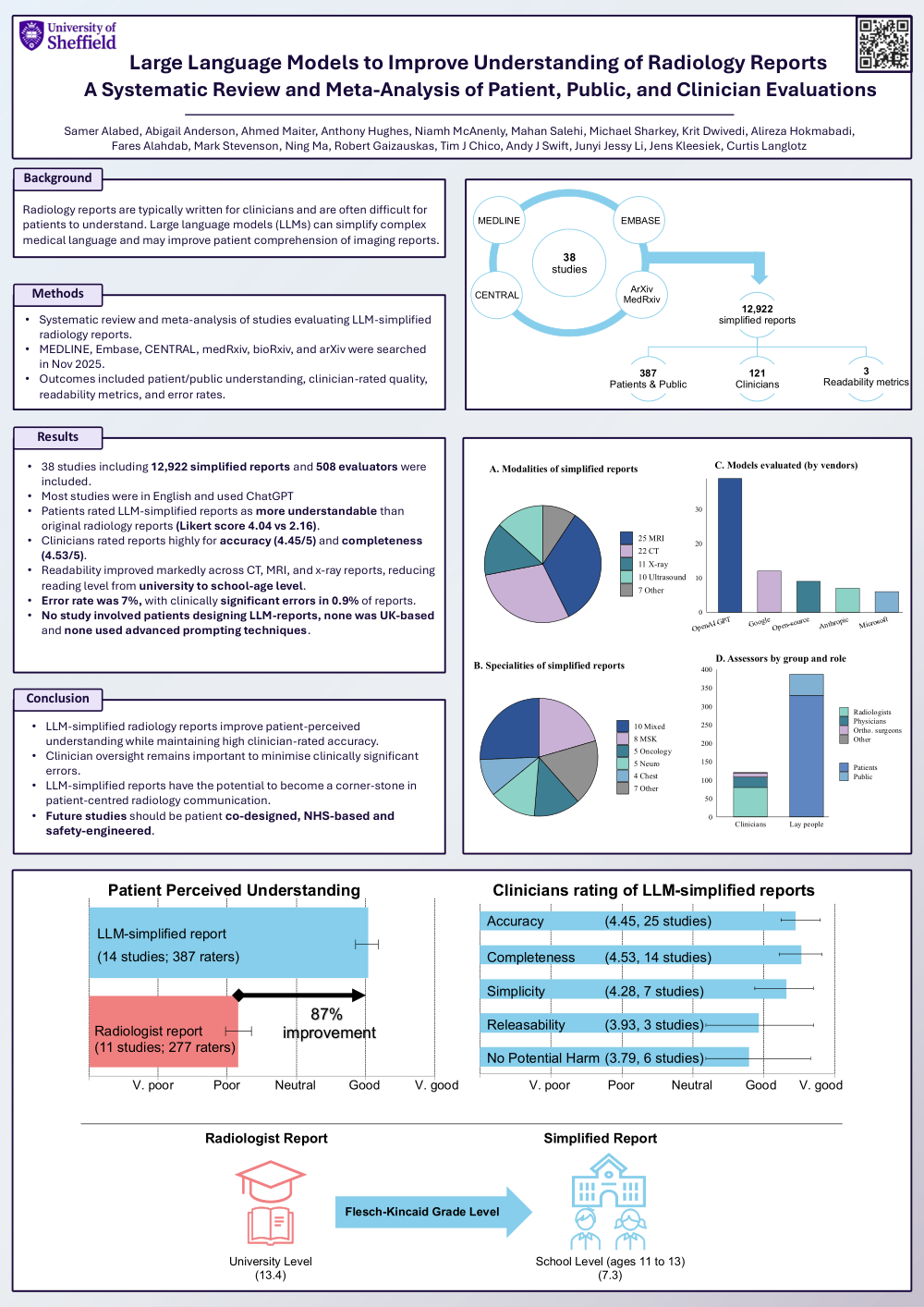
Radiology reports are typically written for clinicians and are often difficult for patients to understand. Large language models (LLMs) can simplify complex medical language and may improve patient comprehension of imaging reports.
•Systematic review and meta-analysis of studies evaluating LLM-simplified radiology reports.
Results
•38 studies including 12,922 simplified reports and 508 evaluators were included.
•Patients rated LLM-simplified reports as substantially more understandable than original radiology reports (Likert score 4.04 vs 2.16).
•Clinicians rated reports highly for accuracy (4.45/5) and completeness (4.53/5).
•Readability improved markedly across CT, MRI, and x-ray reports, reducing reading level from university to school-age level.
•Error rate was 7%, with clinically significant errors occurring in 0.9% of reports.
•No study included patient preferences, was UK-based, or used advanced prompting techniques.