119 posters, 6 topics, 524 authors, 243 institutions
ePostersLive by SciGen Technologies S.A. All rights reserved.
RCR Global AI Conference 2026
29-30 June, 2026 | QEII Centre, Westminster

66
Evaluating sensitivity and specificity of Gleamer BoneView AI for fracture detection
Poster Presenter
Authors
Lin Ling Xu , William Verrier, Kumaresh Skanthabalan, Madhavi Venumbaka
Affiliations
Part of Topic
AI vigilance – Post-implementation monitoring, real world performance evaluation, health economic evaluation
East Suffolk and North Essex NHS Foundation Trust
2nd Annual Global AI Conference 2024
Evaluating the sensitivity and specificity of Gleamer BoneView AI for fracture detection
Dr. L Xu, W. Verrier, Dr. K Skanthabalan, Dr. M Venumbaka
East Suffolk and North Essex NHS Foundation Trust
BACKGROUND
Gleamer BoneView is an AI-powered software designed to assist clinicians in interpreting trauma musculoskeletal (MSK) radiography specifically for the detection of fractures, dislocations, effusions and lesions across various anatomical regions³. The software has been in use at our district general hospital (DGH) since June 2024. Literature suggests that BoneView can:
- Enhance diagnostic accuracy
- Increase sensitivity
- Reduce missed fractures²
AIMS + OBJECTIVES
In this audit, we aimed to measure the sensitivity and specificity of the Gleamer BoneView software in detecting MSK abnormalities on radiographs. These results helped inform us of the clinical impact of BoneView errors.
METHODS
Study Population
- Retrospective data search on CNS of adult and paediatric radiography for MSK trauma, working back from June 2024 to August 2025
- Sample size calculation* n = 460
Excluded Cases
- No imaging available = 39
- Follow up e.g. post reacquisition = 28
- Out of scope (age <2y, facial bones, s spine) = 14
- BoneView not applied = 1
Complete Case Set
- Reporting practitioner compare a BoneView interpretation to verified report (AI assisted)
- Patient metric: oral T9/TN/F9/FN marked
- Discrepancies reviewed by an arbiter (MSK consultant radiologist) to determine clinical significance of error
- Statistical analysis: Excel n = 377
n = 82
The sample size was determined using an appropriate calculator⁴ for a single-test design, assuming an expected AI sensitivity of 92%⁵ and a disease prevalence of 30%⁶,⁷. This sample size ensures sufficient statistical power to reliably evaluate AI performance, meaning the study is adequately powered to demonstrate statistically significant results for fracture detection. The assumptions used allow for precise estimation of sensitivity and specificity within an acceptable confidence interval.
RESULTS
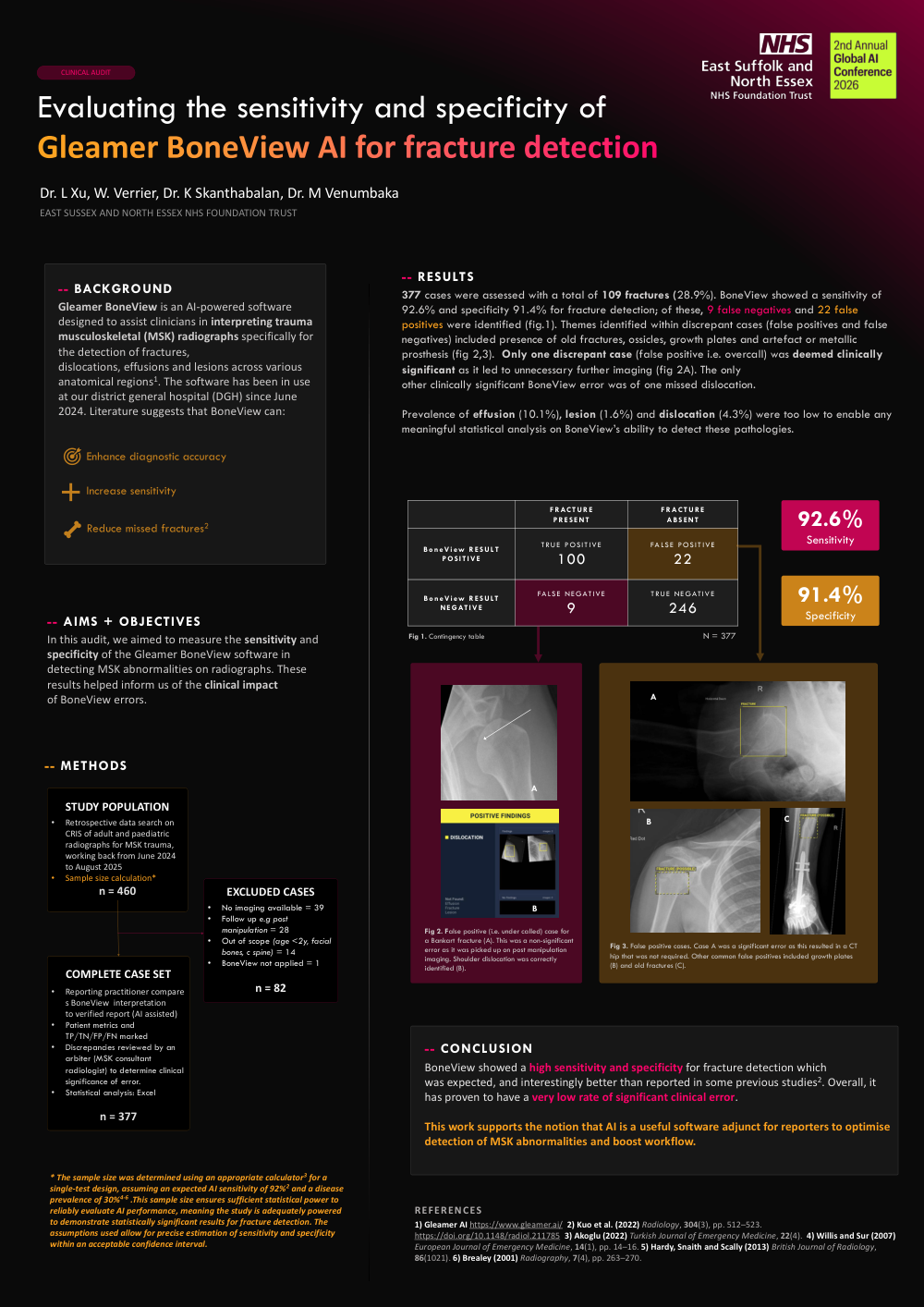
377 cases were assessed with a total of 109 fractures (28.9%). BoneView showed a sensitivity of 92.6% and specificity of 91.4% for fracture detection; of these, 9 false negatives and 22 false positives were identified (fig.1). The ones identified within discrepant cases (false positives and false negatives) included presence of old fractures, ossicles, growth plates and artefact or metallic prosthesis (fig 2,3). Only one discrepant case (false positive i.e. overcall) was deemed clinically significant as it led to unnecessary further imaging (fig 2A). The only other clinically significant BoneView error was of one missed dislocation.
Prevalence of effusion (10.1%), lesion (1.6%) and dislocation (4.3%) were too low to enable any meaningful statistical analysis on BoneView's ability to detect these pathologies.
Fig. 1. Contingency Table
| Fracture Present | Fracture Absent | |
|---|---|---|
| BoneView Result Positive | True Positive = 100 | False Positive = 22 |
| BoneView Result Negative | False Negative = 9 | True Negative = 246 |
N = 377
Sensitivity: 92.6%
Specificity: 91.4%
Fig. 2. False positive (an under-called case for a landmark fracture (A). This error is non-significant since it was picked up on post-manipulation imaging. Shoulder dislocation was correctly identified (B).
Fig. 3. False positive cases. Case A was a significant error as this resulted in a CT that was not required. Other common false positives included growth plates (B) and user hardware (C).
CONCLUSION
BoneView showed a high sensitivity and specificity for fracture detection which was expected, and interestingly better than reported in some previous studies⁷. Overall, it has proven to have a very low rate of significant clinical error.
This work supports the notion that AI is a useful software adjunct for reporters to optimise detection of MSK abnormalities and boost workflow.
REFERENCES
- Gleamer AI: gleamer.ai
- Xun et al. (2022) Radiology, 304(3), pp. 532–523. doi.org
- Pingfu (2022) Turkish Journal of Emergency Medicine, 22(4).
- Wills and Sur (2007) European Journal of Emergency Medicine, 34(1), pp. 34–56.
- Hardy, Snaith and Scally (2013) British Journal of Radiology, 86(1021).
- Srealey (2001) Radiography, 7(4), pp. 263–270.