119 posters, 6 topics, 524 authors, 243 institutions
ePostersLive by SciGen Technologies S.A. All rights reserved.
RCR Global AI Conference 2026
29-30 June, 2026 | QEII Centre, Westminster

43
Clinician Perceptions of AI-Assisted Abdominal Ultrasound
Poster Presenter
Authors
Affiliations
Part of Topic
Transforming practice and leadership: pilot or test data on implementation of AI into clinical practice, clinical feedback or patient perspectives
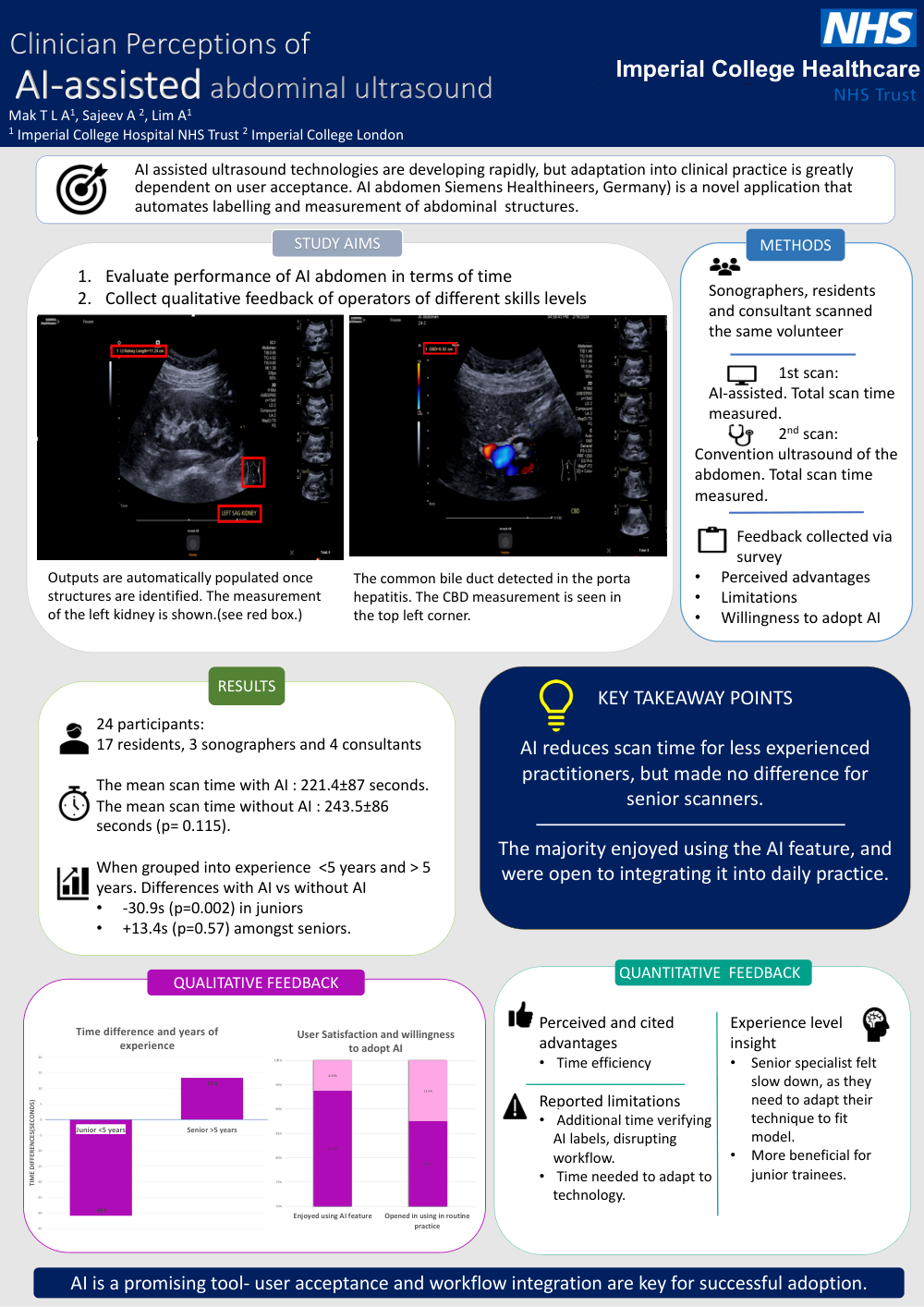
AI-assisted ultrasound technologies are developing rapidly, but adoption into clinical practice is greatly dependent on user acceptance. AI Abdomen (Siemens Healthineers, Germany) is a novel application that automates labeling and measurement of abdominal structures. We aimed to evaluate the performance of AI abdomen and collect qualitative feedback of operators of differing skill levels to identify the perceived advantages, limitations and practical barriers to implementing AI in routine abdominal scans.
Methods and materials
Sonographers, residents, and consultant radiologists scanned the same healthy volunteer using both the AI Abdomen system and conventional techniques to capture standard abdominal images. Automated measurement and labeling of the common bile duct, spleen, and kidneys by the AI system preceded manual measurement and labeling by the radiology specialists.
An auditor verified satisfactory identification, labeling, and measurement before permitting the operator to proceed. Total scan duration was recorded for each examination. Qualitative feedback was then collected from participants.
Results
17 residents, 3 sonographers and 4 consultants participated. The mean scan time with AI was 221.4±87s and without AI was 243.5±86s (p= 0.115). However, when grouped into junior (experience <5 years, n=19) and senior (>5 years, n=5), the mean difference in time with and without AI was -30.9s (p=0.002) in juniors and +13.4s (p=0.57) amongst seniors.
Of the scanners who responded to the feedback survey, 15/16 enjoyed using the AI feature and 14/16 were open to using it in routine practice. The main cited advantage was time-efficiency although, conversely, the limitation for others was time lost in becoming accustomed to the technology and verifying that the AI label was correct, resulting in no net effect in efficacy. Some senior specialists felt that the AI slowed themdown as they had to adapt their technique to fit the model, but did feel that the technology would be more useful for those with less experience.
Conclusion
AI-assisted abdominal ultrasound has been shown to reduce scanning time, particularly in those with less experience. Qualitative feedback showed that AI assistance was well received among operators, although some senior practitioners reported that it can occasionally disrupt workflow. These findings suggest that successful integration of AI-assisted ultrasound into routine practice may depend on users’ experience levels and adaptability.