119 posters, 6 topics, 524 authors, 243 institutions
ePostersLive by SciGen Technologies S.A. All rights reserved.
RCR Global AI Conference 2026
29-30 June, 2026 | QEII Centre, Westminster

222
Mapping the AI Landscape: A review of Radiology AI registries in Europe, USA and the UK
Part of Topic
General / other that does not fit into the above
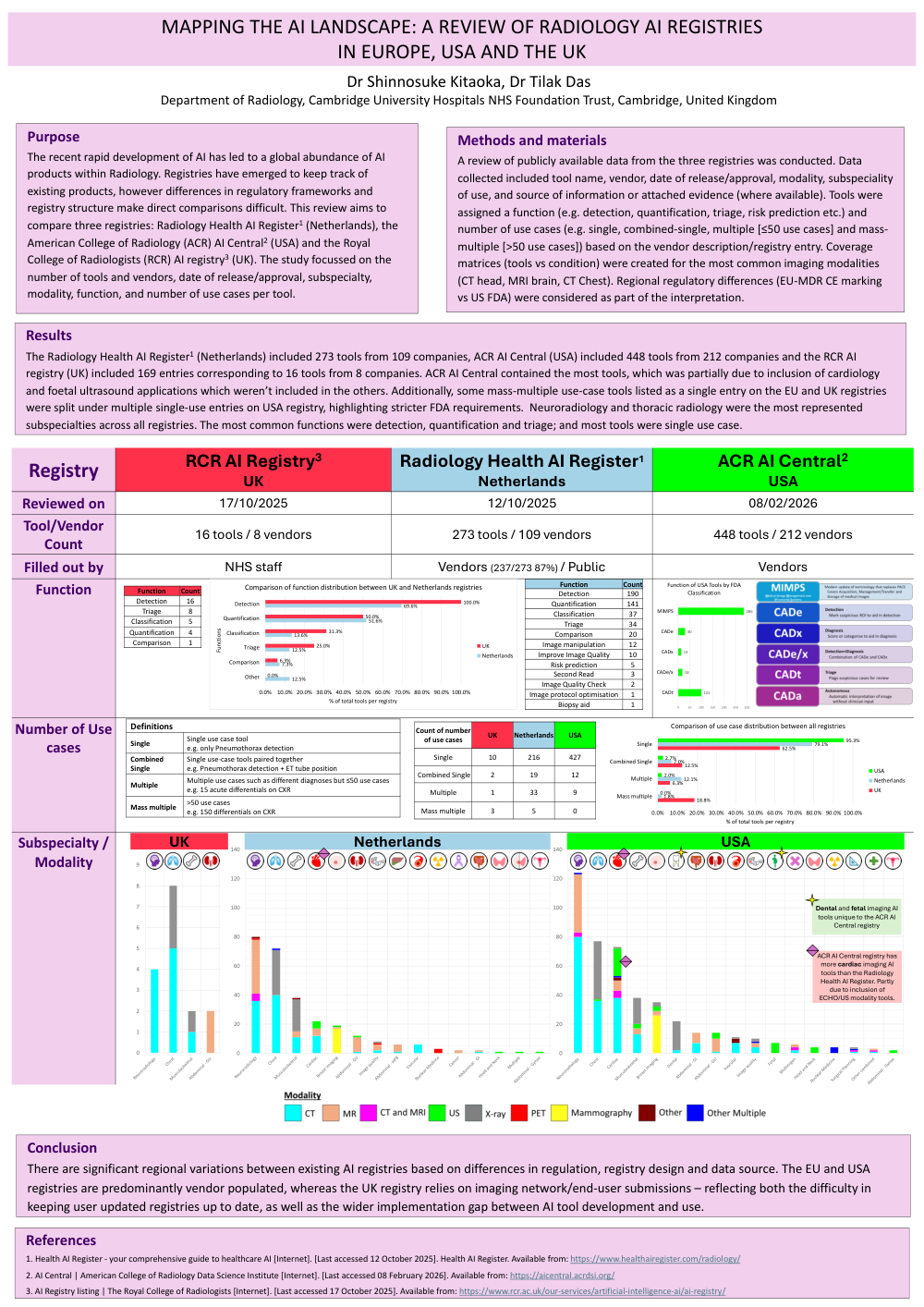
Mapping the AI Landscape: A review of Radiology AI registries in Europe, USA and the UK
Dr Shinnosuke Kitaoka, Dr Tilak Das
Department of Radiology, Cambridge University Hospitals NHS Foundation Trust, Cambridge, United Kingdom
Purpose
The recent rapid development of AI has led to a global abundance of AI products within Radiology. Registries have emerged to keep track of existing products, however differences in regulatory frameworks and registry structure make direct comparisons difficult. This review aims to compare three registries: Radiology Health AI Register1 (Netherlands), the American College of Radiology (ACR) AI Central2 (USA) and the Royal College of Radiologists (RCR) AI registry3 (UK). The study focussed on the number of tools and vendors, date of release/approval, subspecialty, modality, function, and number of use cases per tool.
Methods and materials
A review of publicly available data from the three registries was conducted. Data collected included tool name, vendor, date of release/approval, modality, subspeciality of use, and source of information or attached evidence (where available). Tools were assigned a function (e.g. detection, quantification, triage, risk prediction etc.) and number of use cases (e.g. single, combined-single, multiple [≤50 use cases] and mass-multiple [>50 use cases]) based on the vendor description/registry entry. Coverage matrices (tools vs condition) were created for the most common imaging modalities (CT head, MRI brain, CT Chest). Regional regulatory differences (EU-MDR CE marking vs US FDA) were considered as part of the interpretation.
Results
The Radiology Health AI Register (Netherlands) included 273 tools from 109 companies, ACR AI Central (USA) included 448 tools from 212 companies and the RCR AI registry (UK) included 169 entries corresponding to 16 tools from 8 companies. ACR AI Central contained the most tools, which was partially due to inclusion of cardiology and foetal ultrasound applications which weren’t included in the others. Additionally, some mass-multiple use-case tools listed as a single entry on the EU and UK registries were split under multiple single-use entries on USA registry, highlighting stricter FDA requirements. Neuroradiology and thoracic radiology were the most represented subspecialties across all registries. The most common functions were detection, quantification and triage; and most tools were single use case.
Conclusion
There are significant regional variations between existing AI registries based on differences in regulation, registry design and data source. The EU and USA registries are predominantly vendor populated, whereas the UK registry relies on imaging network/end-user submissions – reflecting both the difficulty in keeping user updated registries up to date, as well as the wider implementation gap between AI tool development and use.
References
1. Health AI Register - your comprehensive guide to healthcare AI [Internet]. [Last accessed 12 October 2025]. Health AI Register. Available from: https://www.healthairegister.com/radiology/
2. AI Central | American College of Radiology Data Science Institute [Internet]. [Last accessed 08 February 2026]. Available from: https://aicentral.acrdsi.org/
3. AI Registry listing | The Royal College of Radiologists [Internet]. [Last accessed 17 October 2025]. Available from: https://www.rcr.ac.uk/our-services/artificial-intelligence-ai/ai-registry/