119 posters, 6 topics, 524 authors, 243 institutions
ePostersLive by SciGen Technologies S.A. All rights reserved.
RCR Global AI Conference 2026
29-30 June, 2026 | QEII Centre, Westminster

217
Does AI Speed Up Chest X-ray Reporting by Radiographers? Real-World Impact of AI Decision Support on Reporting Efficiency
Poster Presenter
Part of Topic
Transforming practice and leadership: pilot or test data on implementation of AI into clinical practice, clinical feedback or patient perspectives
Does AI Speed Up Chest X-ray Reporting by Radiographers?
Real-World Impact of AI Decision Support on Reporting Efficiency
Andy Creeden1, Thomas Patterson2, Mel Ryan3
1 University Hospitals of Leicester NHS Trust, UK 2 United Lincolnshire Teaching Hospitals NHS Trust, UK 3 Harrison.ai, Australia
PURPOSE & AIM
Background
AI decision-support tools are increasingly being deployed in clinical radiology, yet evidence for their impact on reporting efficiency in real-world NHS practice remains limited.
Aim
To evaluate the effect of a commercial AI decision-support system on chest X-ray (CXR) reporting time for reporting radiographers across a large acute NHS hospital trust.
METHODS & MATERIALS
Study Design
Retrospective pre / post service evaluation conducted at United Lincolnshire Teaching Hospitals NHS Trust.
Study Population
Adult (≥16 years) CXR reports authored by reporting radiographers across two 12-week periods: immediately pre-implementation and beginning two weeks post-implementation of a commercial AI decision-support system (Harrison.ai, Australia).
Outcome Measure
Reporting time, defined as the time interval between dictation start and report verification.
Statistical Analysis
Descriptive statistics and non-parametric comparisons were performed, with outliers above the 95th percentile excluded. A multivariable linear mixed-effects regression model evaluated the association between AI use and reporting time while adjusting for admission source and AI triage rank (used as proxy for case complexity), with reporting radiographer included as a random effect. Spearman's rank correlation was used to assess the relationship between reporter's baseline median reporting time and their change in reporting time following AI implementation.
RESULTS
Study Population
32,152 CXRs were analysed (14,473 pre-implementation; 17,679 post-implementation) across 13 radiographers.
Reporting Times
After excluding values above the 95th percentile (>488 seconds), median reporting time was 69 seconds pre-AI and 71 seconds post-AI.
Mixed-Effects Regression
After adjusting for case complexity and reporter, AI-supported reporting was associated with a statistically significant reduction in reporting time of 6.9 seconds (10% of baseline median, p<0.001).
Reporter-Level Analysis
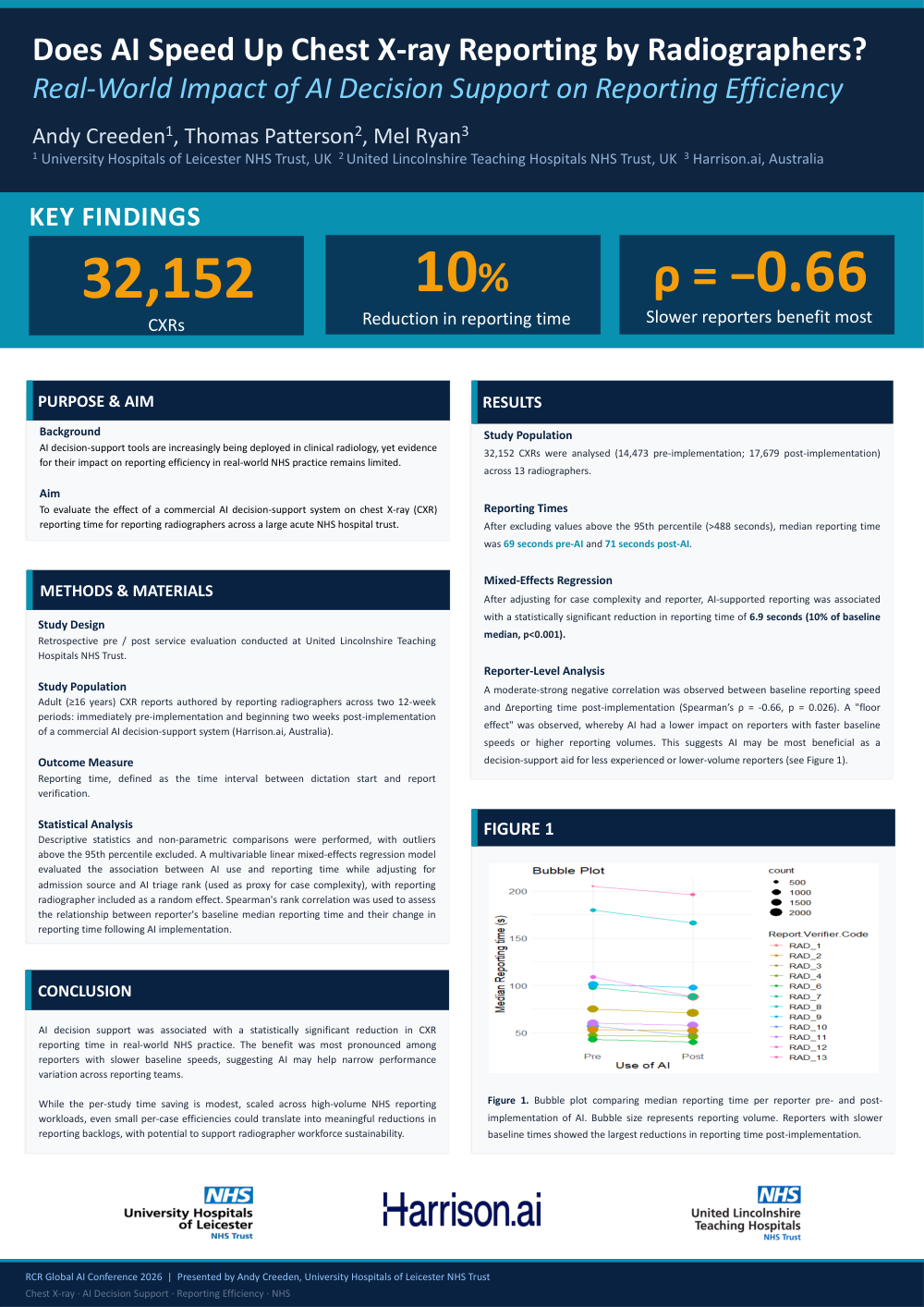
A moderate-strong negative correlation was observed between baseline reporting speed and ∆reporting time post-implementation (Spearman’s ρ = -0.66, p = 0.026). A "floor effect" was observed, whereby AI had a lower impact on reporters with faster baseline speeds or higher reporting volumes. This suggests AI may be most beneficial as a decision-support aid for less experienced or lower-volume reporters (see Figure 1).
CONCLUSION
AI decision support was associated with a statistically significant reduction in CXR reporting time in real-world NHS practice. The benefit was most pronounced among reporters with slower baseline speeds, suggesting AI may help narrow performance variation across reporting teams.
While the per-study time saving is modest, scaled across high-volume NHS reporting workloads, even small per-case efficiencies could translate into meaningful reductions in reporting backlogs, with potential to support radiographer workforce sustainability.