119 posters, 6 topics, 524 authors, 243 institutions
ePostersLive by SciGen Technologies S.A. All rights reserved.
RCR Global AI Conference 2026
29-30 June, 2026 | QEII Centre, Westminster

182
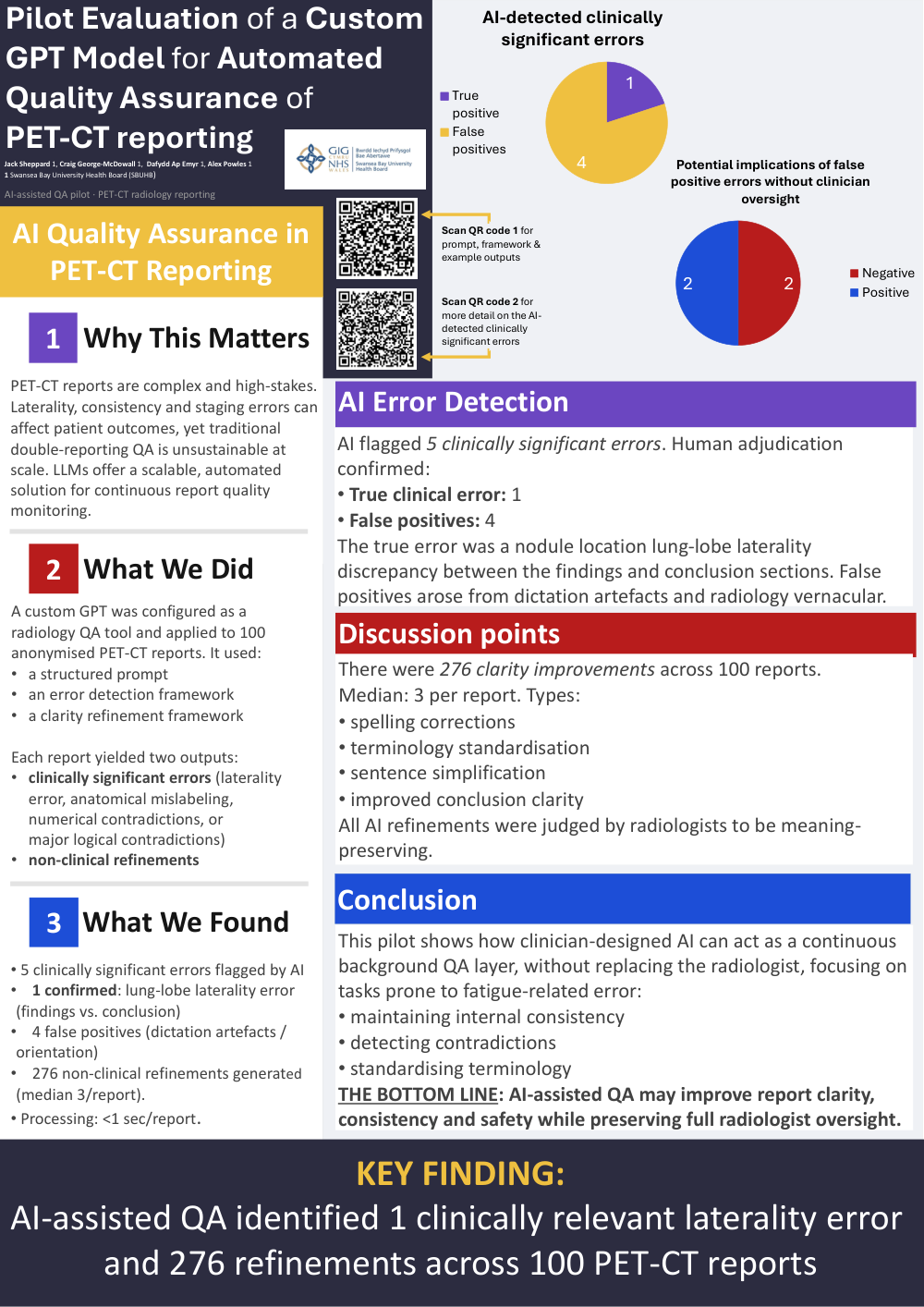
Pilot Evaluation of a Custom GPT Model for Automated Quality Assurance of PET-CT Reporting
Part of Topic
Transforming practice and leadership: pilot or test data on implementation of AI into clinical practice, clinical feedback or patient perspectives
ABSTRACT:
TITLE
Pilot Evaluation of a Custom GPT Model for Automated Quality Assurance of PET-CT Reporting
PURPOSE
To evaluate the feasibility of using a custom GPT-based large language model to support quality assurance (QA) in PET-CT reporting. The study assessed the model’s ability to highlight potential clinically significant errors and provide stylistic and structural refinements across a heterogeneous sample of real-world PET-CT reports.
METHODS AND MATERIALS
A bespoke GPT model was developed using a structured PET-CT QA prompt and two reference documents outlining reporting conventions and error definitions. 100 real PET-CT reports, authored by multiple specialist PET-CT radiologists, were exported in fully anonymised plain-text format (findings and conclusions only, no identifiers).
The model analysed each report for:
- Potential clinically significant errors (laterality inconsistencies, anatomical mislabelling, numerical contradictions, or internal logical conflicts).
- Non-clinical refinements (spelling, hyphenation, terminology standardisation, restructuring long sentences, and improving impression clarity).
Radiologists performed adjudication of only the AI-flagged potential errors; the entire dataset was not independently reviewed by humans.
RESULTS
The model flagged 5 potential clinically significant errors across the 100 reports. Subsequent human review determined that 4 of the 5 were false positives, each attributable to specific model or dictation limitations:
- One involved a correct anatomical description falsely flagged as inconsistent.
- Two were dictation artefacts (“lilac” → “iliac”; “colonostomy” → “colonoscopy”), judged unlikely to affect interpretation.
- One related to the model misinterpreting axial imaging orientation, incorrectly suggesting a laterality discrepancy.
One flagged case was confirmed to contain a genuine clinical error: a lung lobe laterality mismatch between the findings and conclusion.
Beyond error detection, the model generated 276 stylistic refinements (median 3 per report), addressing recurring typographical issues, harmonising terminology (e.g., “FDG-avid”, “ground-glass”), and improving clarity by restructuring overly complex sentences.
CONCLUSION
A custom GPT model can be safely applied to anonymised PET-CT reports to support QA by highlighting potential issues and enhancing clarity and consistency. While several AI-generated alerts reflected false positives, the tool demonstrated potential as a useful adjunct to radiologist oversight. Further prospective validation, including full human ground-truth review, is required before considering clinical deployment.