119 posters, 6 topics, 524 authors, 243 institutions
ePostersLive by SciGen Technologies S.A. All rights reserved.
RCR Global AI Conference 2026
29-30 June, 2026 | QEII Centre, Westminster

151
Integrating an Institutional Large Language Model into Magnetic Resonance Imaging Requests
Poster Presenter
Authors
James Hallinan, Naomi Leow, YiXian Low, Aric Lee, Wilson Ong, Matthew Chan, Ganakirthana Devi, Stephanie He, Daniel Loh, Desmond Lim, Xi Zhen Low, Mei Chin Lim, Clement Yong, Jonathan Sng, Ee Chin Teo, Jiong Hao Tan, Naresh Kumar, Andrew Makmur, Yonghan Ting
Affiliations
National University Hospital, Singapore, AIO Innovation Office, National University Health System
Part of Topic
Transforming practice and leadership: pilot or test data on implementation of AI into clinical practice, clinical feedback or patient perspectives
Background
Objectives
Initial Insights Into a Secure Large Language Model for MRI Examination Requests: A Retrospective Study
James Thomas Patrick Decourcy Hallinan¹˒², MBChB; Naomi Wenxin Leow³, BComp, MComp; Yi Xian Low¹, MBBS; Aric Lee¹, MBBS; Wilson Ong¹, MBBS; Matthew Ding Zhou Chan¹, BmedSc, MD; Gordan Toh Cheong Zheng⁵, Diploma in Biomedical Science; Ganakirthana Kalpenya Devi¹, MbBchBao; Stephanie Shengjie He¹, MBBS; Daniel De-Liang Loh¹, MBBS, MRCS; Desmond Shi Wei Lim¹, MBBS; Xi Zhen Low¹, MBBS; Mei Chin Lim¹, MBBS; Clement Yong¹, MBBS; Weizhong Jonathan Sng¹, MBBS; Ee Chin Teo¹, MMRT; Jiong Hao Tan⁴, MBBS, MMed, MRCS; Naresh Kumar⁴, MBBS, MS, DNB, DM; Andrew Makmur¹˒³, BmedSc, MBBS, MMed; Yonghan Ting¹, MBBS
¹ Dept. of Diagnostic Imaging, NUH, Singapore
² Dept. of Diagnostic Radiology, YLL School of Medicine, NUS, Singapore
³ AI Office, NUHS, Singapore
⁴ National University Spine Institute, NUH, Singapore
⁵ Republic Polytechnic, Singapore
For all MRI subspecialty modalities (Musculoskeletal, Neuroradiology, body):
- Does sLLM augmentation improve clinical information quality of MRI examination requests?
- Can sLLM match radiologist-level MRI protocol accuracy?
Main Findings
Discussion
Materials and Methods
Limitations
Conclusion
Rule-Based Protocol Assignment
Maps extracted elements → MRI region, coverage & contrast using institutional protocol library
Institutional sLLM based on Claude 3.5 · Temp 0
RI-RADS graded [1] · Retrospective
Sept 2023 – Jul 2024
n= 608 MRIs · 528 patients
| Grade | Description | Information included in the requisition |
| RI-RADS A | Adequate | All key categories of information included. |
| RI-RADS B | Barely adequate | All key categories of information included, some clinical findings missing. |
| RI-RADS C | Considerably limited | Two categories of information included. |
| RI-RADS D | Deficient | One or no category of information included. |
- Incomplete Magnetic Resonance Imaging (MRI) requests lead to suboptimal protocols, repeat studies & reduced accuracy.
- LLMs can interpret clinical text at scale, but privacy constraints limit direct clinical use
- Institutional sLLMs operate behind firewalls, protecting patient data while enabling augmentation
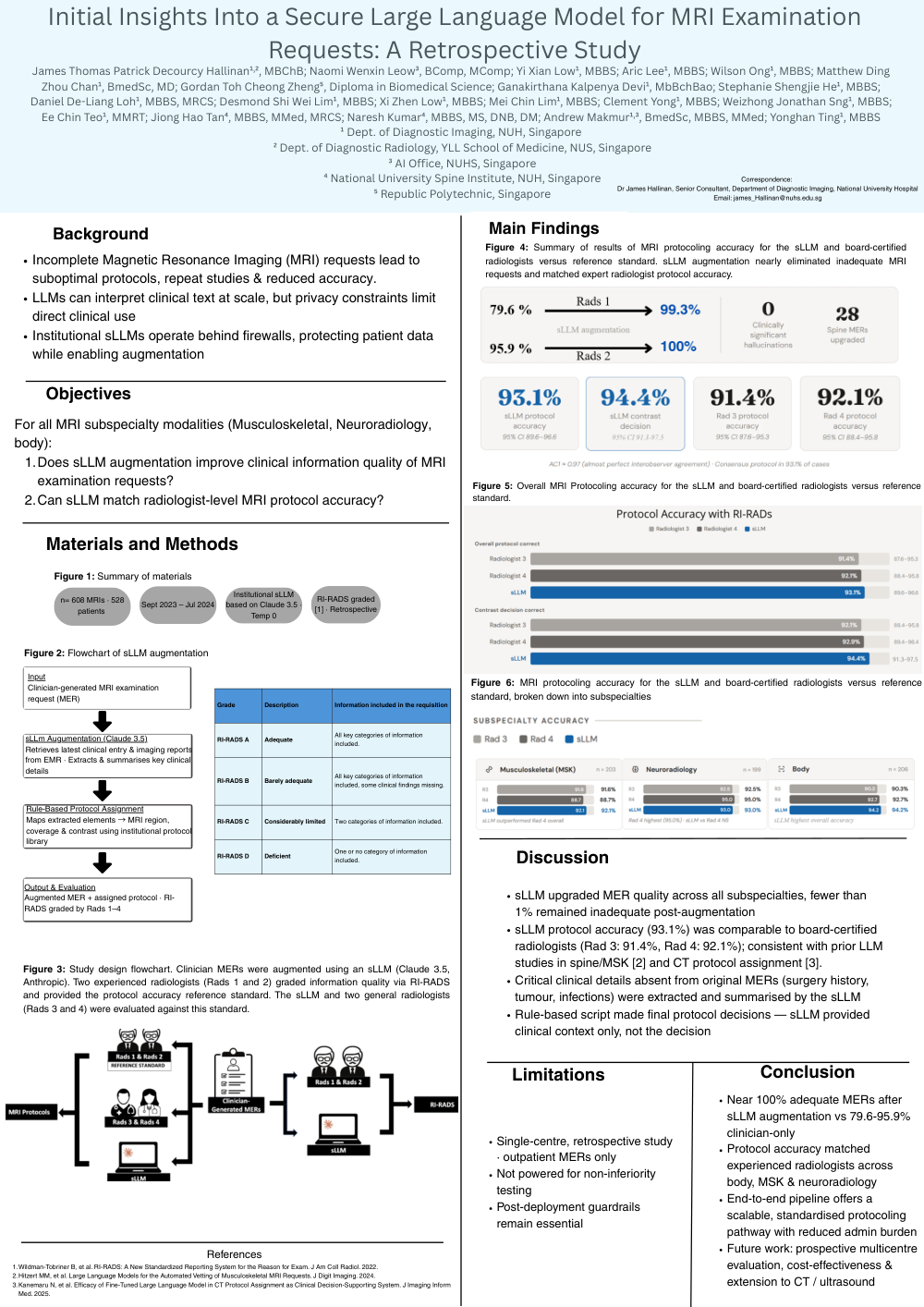
- sLLM upgraded MER quality across all subspecialties, fewer than 1% remained inadequate post-augmentation
- sLLM protocol accuracy (93.1%) was comparable to board-certified radiologists (Rad 3: 91.4%, Rad 4: 92.1%); consistent with prior LLM studies in spine/MSK [2] and CT protocol assignment [3].
- Critical clinical details absent from original MERs (surgery history, tumour, infections) were extracted and summarised by the sLLM
- Rule-based script made final protocol decisions — sLLM provided clinical context only, not the decision
- Near 100% adequate MERs after sLLM augmentation vs 79.6-95.9% clinician-only
- Protocol accuracy matched experienced radiologists across body, MSK & neuroradiology
- End-to-end pipeline offers a scalable, standardised protocoling pathway with reduced admin burden
- Future work: prospective multicentre evaluation, cost-effectiveness & extension to CT / ultrasound
- Single-centre, retrospective study · outpatient MERs only
- Not powered for non-inferiority testing
- Post-deployment guardrails remain essential
References
- Wildman-Tobriner B, et al. RI-RADS: A New Standardized Reporting System for the Reason for Exam. J Am Coll Radiol. 2022.
- Hitzert MM, et al. Large Language Models for the Automated Vetting of Musculoskeletal MRI Requests. J Digit Imaging. 2024.
- Kanemaru N, et al. Efficacy of Fine-Tuned Large Language Model in CT Protocol Assignment as Clinical Decision-Supporting System. J Imaging Inform Med. 2025.
Correspondence:
Dr James Hallinan, Senior Consultant, Department of Diagnostic Imaging, National University Hospital
Email: james_Hallinan@nuhs.edu.sg
Input
Clinician-generated MRI examination request (MER)
sLLm Augumentation (Claude 3.5)
Retrieves latest clinical entry & imaging reports from EMR · Extracts & summarises key clinical details
Output & Evaluation
Augmented MER + assigned protocol · RI-RADS graded by Rads 1–4
Figure 1: Summary of materials
Figure 2: Flowchart of sLLM augmentation
Figure 3: Study design flowchart. Clinician MERs were augmented using an sLLM (Claude 3.5, Anthropic). Two experienced radiologists (Rads 1 and 2) graded information quality via RI-RADS and provided the protocol accuracy reference standard. The sLLM and two general radiologists (Rads 3 and 4) were evaluated against this standard.
Figure 4: Summary of results of MRI protocoling accuracy for the sLLM and board-certified radiologists versus reference standard. sLLM augmentation nearly eliminated inadequate MRI requests and matched expert radiologist protocol accuracy.
Figure 5: Overall MRI Protocoling accuracy for the sLLM and board-certified radiologists versus reference standard.
Figure 6: MRI protocoling accuracy for the sLLM and board-certified radiologists versus reference standard, broken down into subspecialties