2,281 posters, 63 videos, 56 audios, 43 topics, 18 sessions, 6,174 authors, 2,323 institutions
ePostersLive by SciGen Technologies S.A. All rights reserved.
RCOG World Congress 2025
June 23 - 25, 2025 | ExCeL London, UK
EP.0079
AI Enhancing Diagnostic Accuracy and Decision-Making in Obstetrics and Gynecology Residents
Part of Topic
AI & digital health
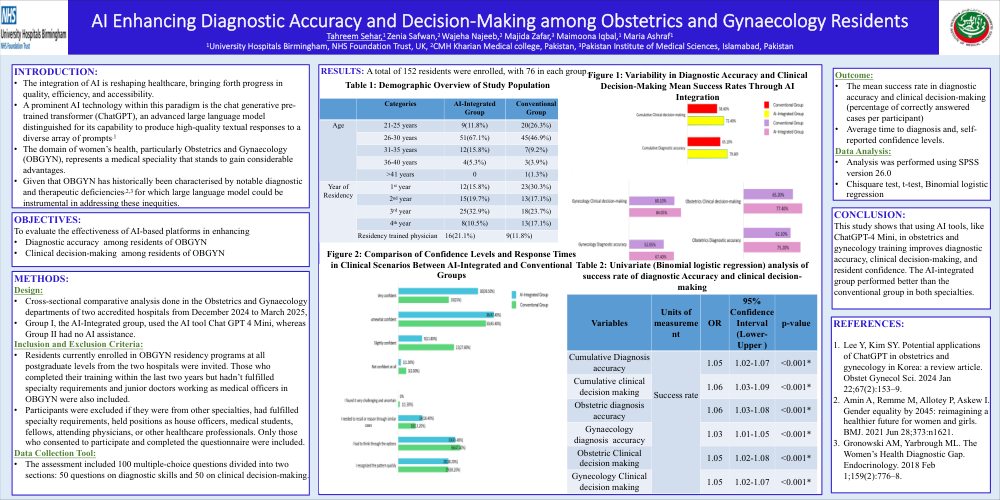
AI Enhancing Diagnostic Accuracy and Decision-Making among Obstetrics and Gynaecology Residents
Tahreem Sehar,1 Zenia Safwan,2 Wajeha Najeeb,2 Majida Zafar,3 Maimoona Iqbal,1 Maria Ashraf1
1University Hospitals Birmingham, NHS Foundation Trust, UK, 2CMH Kharian Medical college, Pakistan, 3Pakistan Institute of Medical Sciences, Islamabad, Pakistan
OBJECTIVES:
To evaluate the effectiveness of AI-based platforms in enhancing
Diagnostic accuracy among residents of OBGYN
Clinical decision-making among residents of OBGYN
METHODS:
Design: Cross-sectional comparative analysis done in the Obstetrics and Gynaecology departments of two accredited hospitals from December 2024 to March 2025, Group I, the AI-Integrated group, used the AI tool Chat GPT 4 Mini, whereas Group II had no AI assistance. Inclusion and Exclusion Criteria: Residents currently enrolled in OBGYN residency programs at all postgraduate levels from the two hospitals were invited. Those who completed their training within the last two years but hadn’t fulfilled specialty requirements and junior doctors working as medical officers in OBGYN were also included. Participants were excluded if they were from other specialties, had fulfilled specialty requirements, held positions as house officers, medical students, fellows, attending physicians, or other healthcare professionals. Only those who consented to participate and completed the questionnaire were included. Data Collection Tool: The assessment included 100 multiple-choice questions divided into two sections: 50 questions on diagnostic skills and 50 on clinical decision-making. Outcome: The mean success rate in diagnostic accuracy and clinical decision-making (percentage of correctly answered cases per participant) Average time to diagnosis and, self-reported confidence levels. Data Analysis: Analysis was performed using SPSS version 26.0 Chisquare test, t-test, Binomial logistic regression
CONCLUSION:
This study shows that using AI tools, like ChatGPT-4 Mini, in obstetrics and gynecology training improves diagnostic accuracy, clinical decision-making, and resident confidence. The AI-integrated group performed better than the conventional group in both specialties.