2,281 posters, 63 videos, 56 audios, 43 topics, 18 sessions, 6,174 authors, 2,323 institutions
ePostersLive by SciGen Technologies S.A. All rights reserved.
RCOG World Congress 2025
June 23 - 25, 2025 | ExCeL London, UK
PP.0001
Data-Driven Personalization of IVF Treatment: A Data Mining Approach
Poster Presenter
Part of Topic
AI & digital health
Data-Driven Personalization of IVF Treatment: A Data Mining Approach
Navin Panchal*(FRCOG, AMPH(ISB)), Kavya Shri, Sumeet Kumar, Janmey Panchal
*BAPS Yogiji Maharah Hospital, Indian School of Business
Objective
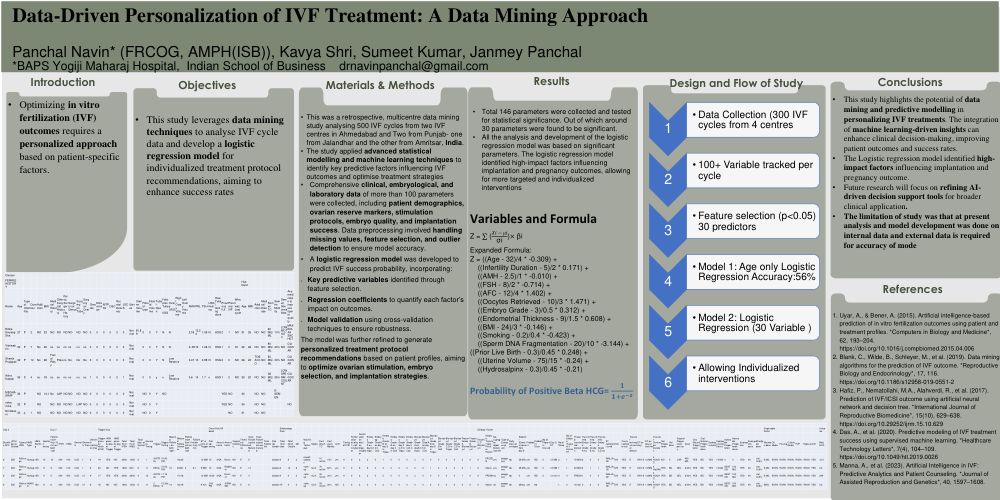
Optimizing in vitro fertilization (IVF) outcomes requires a personalized approach based on patient-specific factors. This study leverages data mining techniques to analyze IVF cycle data and develop a logistic regression model for individualized treatment protocol recommendations, aiming to enhance success rates.
Design
This was a retrospective, multicentre data mining study analysing 500 IVF cycles from two IVF centres in Ahmedabad and Two from Punjab- one from Jalandhar and the other from Amritsar, India. The study applied advanced statistical modelling and machine learning techniques to identify key predictive factors influencing IVF outcomes and optimise treatment strategies.
Methods
Comprehensive clinical, embryological, and laboratory data of more than 100 parameters were collected, including patient demographics, ovarian reserve markers, stimulation protocols, embryo quality, and implantation success. Data preprocessing involved handling missing values, feature selection, and outlier detection to ensure model accuracy.
A logistic regression model was developed to predict IVF success probability, incorporating:
- Key predictive variables identified through feature selection.
- Regression coefficients to quantify each factor’s impact on outcomes.
- Model validation using cross-validation techniques to ensure robustness.
The model was further refined to generate personalized treatment protocol recommendations based on patient profiles, aiming to optimize ovarian stimulation, embryo selection, and implantation strategies.
Results
Total 146 parameters were collected and tested for statistical significance. Out of which around 30 parameters were found to be significant. All the analysis and development of the logistic regression model was based on significant parameters. Preliminary findings demonstrate that data-driven treatment personalization significantly improves IVF success rates. The logistic regression model identified high-impact factors influencing implantation and pregnancy outcomes, allowing for more targeted and individualized interventions.
Conclusion
This study highlights the potential of data mining and predictive modeling in personalizing IVF treatments. The integration of machine learning-driven insights can enhance clinical decision-making, improving patient outcomes and success rates. Future research will focus on refining AI-driven decision support tools for broader clinical application. The limitation of study was that at present analysis and model development was done on internal data and external data is required for accuracy of model.
Total 146 parameters were collected and tested for statistical significance. Out of which around 30 parameters were found to be significant. All the analysis and development of the logistic regression model was based on significant parameters. Preliminary findings demonstrate that data-driven treatment personalization significantly improves IVF success rates. The logistic regression model identified high-impact factors influencing implantation and pregnancy outcomes, allowing for more targeted and individualized interventions