2,281 posters, 63 videos, 56 audios, 43 topics, 18 sessions, 6,174 authors, 2,323 institutions
ePostersLive by SciGen Technologies S.A. All rights reserved.
RCOG World Congress 2025
June 23 - 25, 2025 | ExCeL London, UK
EP.0075
WHI2RL: The Women’s Health Intelligent Information Retrieval LLM
Part of Topic
AI & digital health
WHIRL: The Women’s Health Intelligent Information Retrieval LLM
Ravi Shankar, Beth Albert, Gabriel Davis Jones
Nuffield Department of Women’s and Reproductive Health, University of Oxford, Oxford, UK
BACKGROUND
Diagnostic and treatment inequities in women’s health remain a pressing challenge. Frontline professionals often lack immediate access to trusted clinical guidance. Large language models (LLM) offer a path to reliable clinical guidance. WHIRL is a domain-specific LLM developed to bridge this gap by providing real-time, evidence-based responses grounded in RCOG, NICE, and NHS guidelines.
AIM
To develop an intelligent, evidence-based LLM system for women’s health that delivers fast and accurate answers to clinical queries by referencing official clinical guidelines (RCOG, NICE, NHS) in real time.
METHODS
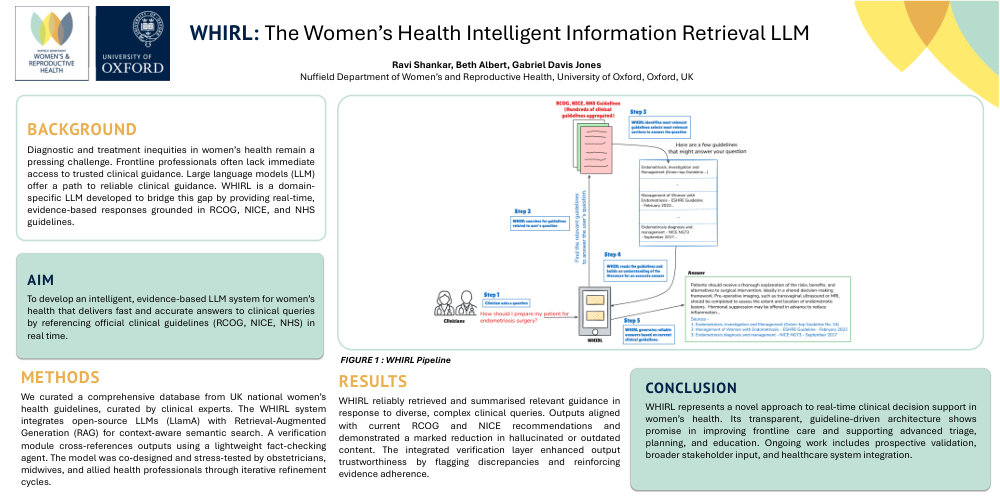
We curated a comprehensive database from UK national women’s health guidelines, curated by clinical experts. The WHIRL system integrates open-source LLMs (LlamA) with Retrieval-Augmented Generation (RAG) for context-aware semantic search. A verification module cross-references outputs using a lightweight fact-checking agent. The model was co-designed and stress-tested by obstetricians, midwives, and allied health professionals through iterative refinement cycles.
RESULTS
WHIRL reliably retrieved and summarised relevant guidance in response to diverse, complex clinical queries. Outputs aligned with current RCOG and NICE recommendations and demonstrated a marked reduction in hallucinated or outdated content. The integrated verification layer enhanced output trustworthiness by flagging discrepancies and reinforcing evidence adherence.
CONCLUSION
WHIRL represents a novel approach to real-time clinical decision support in women’s health. Its transparent, guideline-driven architecture shows promise in improving frontline care and supporting advanced triage, planning, and education. Ongoing work includes prospective validation, broader stakeholder input, and healthcare system integration.