2,281 posters, 63 videos, 56 audios, 43 topics, 18 sessions, 6,174 authors, 2,323 institutions
ePostersLive by SciGen Technologies S.A. All rights reserved.
RCOG World Congress 2025
June 23 - 25, 2025 | ExCeL London, UK
EP.0722
Patient acceptability of endoanal ultrasound scan following obstetric anal sphincter injury
Poster Presenter
Part of Topic
Imaging in gynaecology
Patient acceptability of endoanal ultrasound scan following obstetric anal sphincter injury
Introduction
Endoanal ultrasound scan (EUS) is a valuable tool when assessing healing of obstetric anal sphincter injuries (OASI), with its results being pivotal in counselling on future mode of delivery.
The RCOG recommend that women with OASI should be reviewed postnatally, ideally in a dedicated clinic with access to EUS. Women with abnormal EUS results should be counselled regarding the option of future birth via elective caesarean section.1
At Royal Hampshire County Hospital, patients with 3b, 3c and 4th degree tears are referred to a dedicated perineal clinic, where they are offered EUS during their appointment.
Objectives
This study aimed to assess patient acceptability of EUS and identify potential areas for improvement in our local perineal clinic.
Design
This cross-sectional study evaluated patients’ experiences with EUS and the perineal clinic, involving patients as stakeholders in service improvement.
Method
Data were collected from patients attending perineal clinic over a two-year period via a two-part questionnaire, completed immediately before and after their clinic appointment. The first part gathered quantitative data on patients’ preparedness and preconceptions about the scan, whilst the second part assessed their actual experience. Responses were categorised as ‘not at all’, ‘somewhat’, ‘moderately’ or ‘very’. Pain and embarrassment levels were scored on a scale of 1-10 following the EUS. Qualitative feedback was gathered via free-text responses.
Results
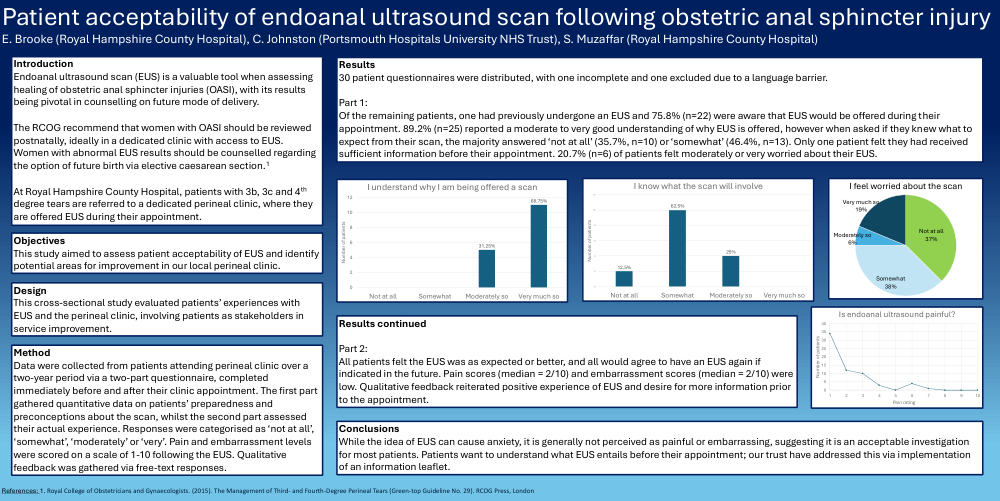
30 patient questionnaires were distributed, with one incomplete and one excluded due to a language barrier.
Part 1:
Of the remaining patients, one had previously undergone an EUS and 75.8% (n=22) were aware that EUS would be offered during their appointment. 89.2% (n=25) reported a moderate to very good understanding of why EUS is offered, however when asked if they knew what to expect from their scan, the majority answered ‘not at all’ (35.7%, n=10) or ‘somewhat’ (46.4%, n=13). Only one patient felt they had received sufficient information before their appointment. 20.7% (n=6) of patients felt moderately or very worried about their EUS.
Results continued
Part 2:
All patients felt the EUS was as expected or better, and all would agree to have an EUS again if indicated in the future. Pain scores (median = 2/10) and embarrassment scores (median = 2/10) were low. Qualitative feedback reiterated positive experience of EUS and desire for more information prior to the appointment.
Conclusions
While the idea of EUS can cause anxiety, it is generally not perceived as painful or embarrassing, suggesting it is an acceptable investigation for most patients. Patients want to understand what EUS entails before their appointment; our trust have addressed this via implementation of an information leaflet.