2,281 posters, 63 videos, 56 audios, 43 topics, 18 sessions, 6,174 authors, 2,323 institutions
ePostersLive by SciGen Technologies S.A. All rights reserved.
RCOG World Congress 2025
June 23 - 25, 2025 | ExCeL London, UK
EP.0070
Usability study of a pregnancy app to improve risk factor awareness
Poster Presenter
Part of Topic
AI & digital health
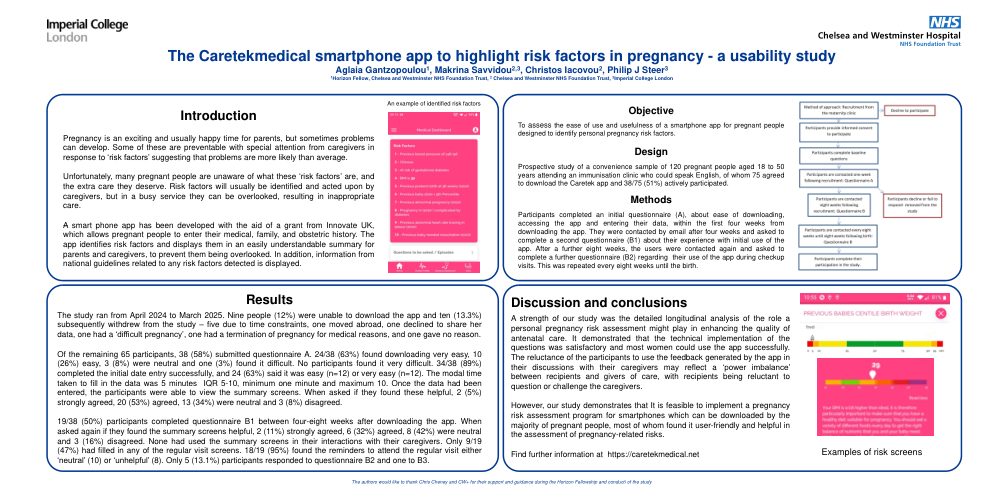
Usability study of a smartphone app designed to enhance pregnant people’s understanding of risk factors and thereby enhance their interaction with healthcare professionals.
Usability study of a pregnancy app to improve risk factor awareness
Gantzopoulou A, Steer PJ, Iacovou C, Hook T and Savvidou MD
Chelsea & Westminster Hospital, Imperial College London, UK
Introduction
In the Cumberlege 2015 National Maternity Review, the chief executive of NHS England Simon Stevens wrote "the NHS could and should raise its game on personalised support for parents and their babies, better team working, better use of technology, and more joined up maternity and mental health services." A 2015 paper from Italy reported that "Only 42% of women correctly knew all the main maternal risk factors in pregnancy". Information about pregnancy on most websites and smart phone apps is largely generic, and not tailored to an individual person’s risk factors. The Caretekmedical pregnancy app was designed to give women feedback on their individual risk factors (derived from national guidelines), with the objective of empowering them to bring this to the attention of their caregivers and encourage discussion.
Method
A convenience sample of 120 consecutive attendees at the Chelsea and Westminster Hospital antenatal clinic were invited to use the Caretek pregnancy app. Participants completed an initial questionnaire about ease of downloading and accessing the app, and entering data. They were contacted by email after 4 weeks and asked to complete a second questionnaire about their initial use of the app.
Results
Of 120 pregnant people invited, 75 agreed to participate and their demographics were recorded. Nine were unable to download the app. 37 of 38 participants completed the initial questionnaire. 24 (63%) found downloading easy, 10 (26%) easy, 3 (8%) were neutral and one (3%) found it difficult. 34/38 (89%) completed the initial data entry successfully, and 24 said it was easy (12) or very easy (12). Once the data had been entered, the participants were presented with risk factor summary screens. When asked if they found these helpful, 2 (5%) strongly agreed, 20 (53%) agreed, 13 (34%) were undecided and 3 (8%) disagreed. Only one participant said she had used the summary screens in interactions with her caregivers.
Conclusions
Self-assessment of risk factors using a smartphone app is possible in many cases, but pregnant people are reluctant spontaneously to share this with their care-givers. Successful deployment of such an app probably requires positive encouragement from caregivers.