2,281 posters, 63 videos, 56 audios, 43 topics, 18 sessions, 6,174 authors, 2,323 institutions
ePostersLive by SciGen Technologies S.A. All rights reserved.
RCOG World Congress 2025
June 23 - 25, 2025 | ExCeL London, UK
EP.0673
Vulval epidermal inclusion cyst after FGM: A case report
Poster Presenter
Authors
Affiliations
Part of Topic
Global health/health policy
Vulval epidermal inclusion cyst after FGM: A case report
Objective
Female genital mutilation (FGM) is a violation of human right, which can result in severe and life-threatening short-term and long-term physical and psychological complications. Although it is illegal in the United Kingdom, due to emigration and globalisation, these patients are routinely encountered in secondary care settings.
Case report
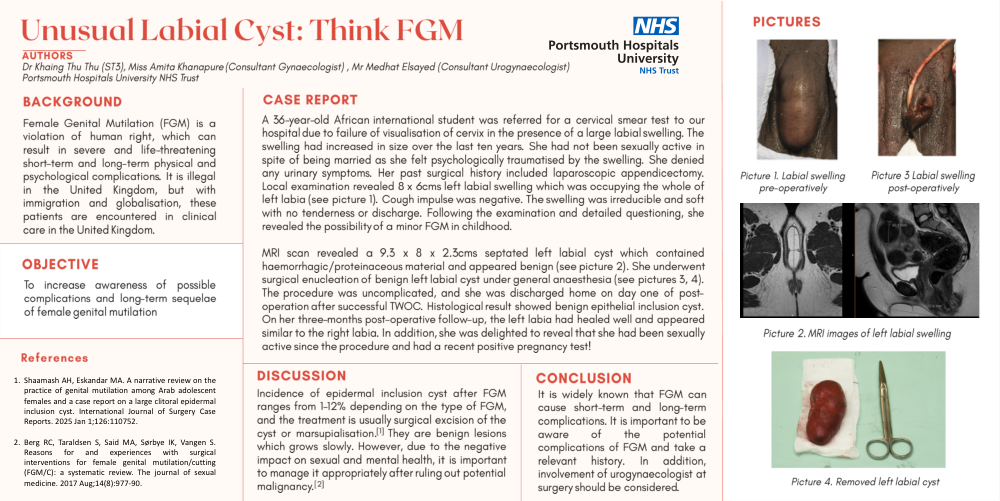
A 36-year-old African lady was referred for a cervical smear test in a secondary care setting as there was limited visualisation of cervix in primary care due to large labial swelling. She has noticed the swelling over the last ten years, and it gradually increased in size. Although she was married, she was reluctant to be sexually active due to the presence of this swelling and as a result, she had not had any children. Her past surgical history included female genital mutilation (FGM) as a child and laparoscopic appendicectomy.
Perineal examination revealed 8 x 6cm left labial swelling which was occupying the whole of left labia. There was negative cough impulse. The swelling was irreducible and soft with no tenderness to touch or discharge. MRI scan showed 9.3 x 8 x 2.3cm septated left labial cyst which contains haemorrhagic/proteinaceous material and appeared benign. Consequently, she underwent excision of the left labial cyst under general anaesthesia. Histological result showed benign epithelial inclusion cyst. The patient was then reviewed in an outpatient setting three months post-procedure and the left labia appeared normal.
Discussion
Epidermal inclusion cysts are known long-term complication of FGM, and the treatment is usually surgical enucleation of the cyst and its capsule or marsupialisation. They are benign lesions which grows slowly. However, due to the possible impact on sexual and mental health, it is important to manage it appropriately after ruling out potential malignancy.
Conclusion
It is widely known that FGM can cause short-term and long-term complications. It is important to become more competent at recognising this as healthcare professionals to provide better care to patients affected by this, as there is increased exposure to FGM worldwide.