2,281 posters, 63 videos, 56 audios, 43 topics, 18 sessions, 6,174 authors, 2,323 institutions
ePostersLive by SciGen Technologies S.A. All rights reserved.
RCOG World Congress 2025
June 23 - 25, 2025 | ExCeL London, UK
EP.0672
Assessing the healthcare needs of women in rural Cambodia.
Poster Presenter
Part of Topic
Global health/health policy
Assessing the healthcare needs of women in rural Cambodia.
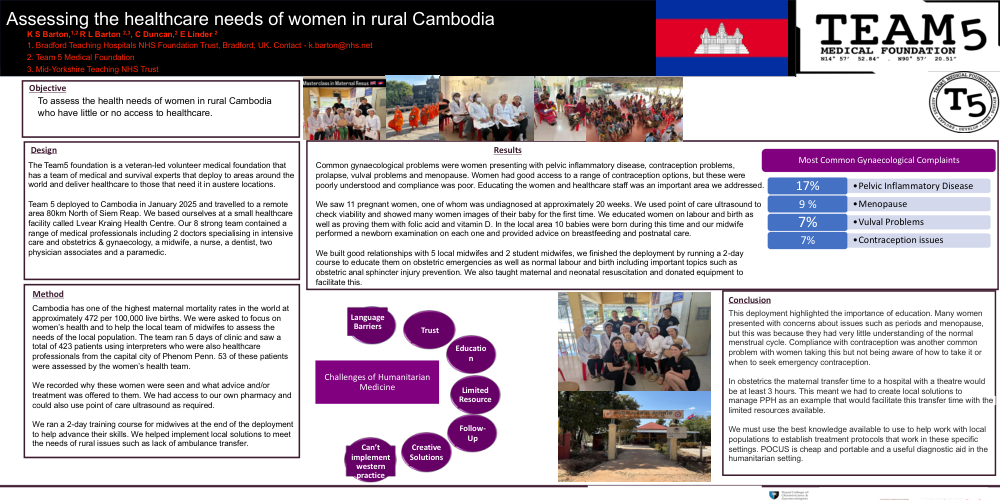
We wanted to assess the health needs of women in rural Cambodia who have little or no access to healthcare. The Team5 foundation is a veteran-led volunteer medical foundation that has a team of medical and survival experts that deploy to areas around the world and deliver healthcare to those that need it in austere locations.
Team 5 deployed to Cambodia in January 2025 and travelled to a remote area 80km North of Siem Reap. We based ourselves at a small healthcare facility called Lvear Kraing Health Center. Our 8 strong team contained a range of medical professionals including 2 doctors specialising in intensive care and obstetrics & gynaecology, a midwife, a nurse, a dentist, two physician associates and a paramedic.
Cambodia has one of the highest maternal mortality rates in the world at approximately 472 per 100,000 live births. We were asked to focus on women’s health and to help the local team of midwifes to assess the needs of the local population. The team ran 5 days of clinic and saw a total of 423 patients using interpreters who were also healthcare professionals from the capital city of Phenom Penn. 53 of these patients were assessed by the women’s health team.
Common gynaecological problems were women presenting with pelvic inflammatory disease, contraception problems, prolapse, vulval problems and menopause. Women had good access to a range of contraception options, but these were poorly understood and compliance was poor. Educating the women and healthcare staff was an important area we addressed.
We saw 11 pregnant women, one of whom was undiagnosed at approximately 20 weeks. We used point of care ultrasound to check viability and show these women images of their baby for the first time. We educated women on labour and birth as well as proving them with folic acid and vitamin D. In the local area 10 babies were born during this time and our midwife performed a newborn examination on each one and provided advice on breastfeeding and postnatal care.
We built good relationships with 5 local midwifes and 2 student midwifes, we finished the mission by running a 2-day course to educate them on obstetric emergencies as well as normal labour and birth including important topics such as obstetric anal sphincter injury prevention. We also taught maternal and neonatal resuscitation and donated equipment to facilitate this.