2,281 posters, 63 videos, 56 audios, 43 topics, 18 sessions, 6,174 authors, 2,323 institutions
ePostersLive by SciGen Technologies S.A. All rights reserved.
RCOG World Congress 2025
June 23 - 25, 2025 | ExCeL London, UK
EP.0662
Domiciliary impact on Menopause experiences of Sub-saharan African women: Knowledge, Attitudes, Prevalence.
Poster Presenter
Part of Topic
Global health/health policy
Domiciliary impact on Menopause experiences of Sub-saharanAfrican women: Knowledge, Attitudes, Prevalence.
T.O. Adedipe¹ˉ², Sanmi-Sule K², Djissi L-A², S.K. Kieghe-Kama³
1. Department of Obstetrics and Gynaecology, HUTH NHS Trust, NHS Humber Health Partnership, Hull, UK
2. Hull York Medical School, Hull, UK
3. SYNT Faculty, RCGP, UK
Context:
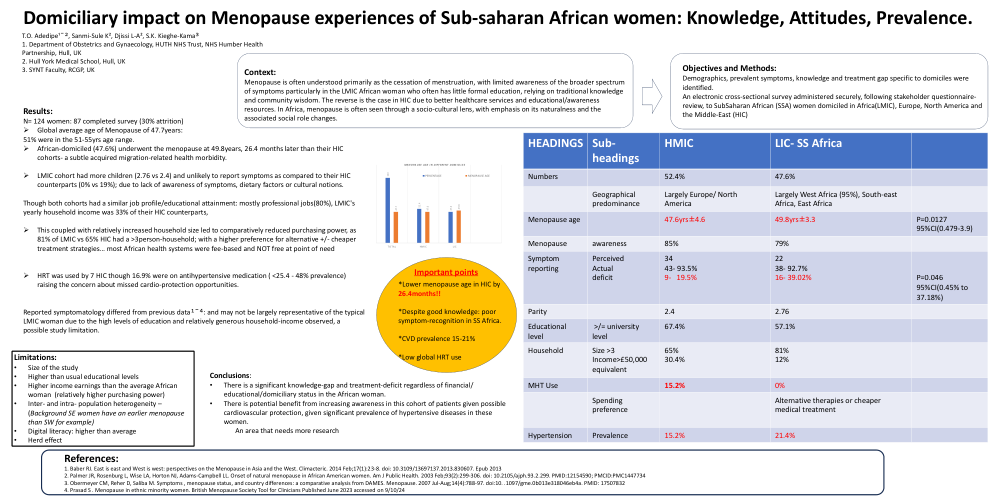
Menopause is often understood primarily as the cessation of menstruation, with limited awareness of the broader spectrum of symptoms particularly in the LMIC African woman who often has little formal education, relying on traditional knowledge and community wisdom. The reverse is the case in HIC due to better healthcare services and educational/awareness resources. In Africa, menopause is often seen through a socio-cultural lens, with emphasis on its naturalness and the associated social role changes.
Objectives and Methods:
Demographics, prevalent symptoms, knowledge and treatment gap specific to domiciles were identified.
An electronic cross-sectional survey administered securely, following stakeholder questionnaire-review, to SubSaharan African (SSA) women domiciled in Africa(LMIC), Europe, North America and the Middle-East (HIC)
Results:
N= 124 women: 87 completed survey (30% attrition)
51% were in the 51-55yrs age range.
Though both cohorts had a similar job profile/educational attainment: mostly professional jobs(80%), LMIC's yearly household income was 33% of their HIC counterparts,
Reported symptomatology differed from previous data¹ˉ⁴: and may not be largely representative of the typical LMIC woman due to the high levels of education and relatively generous household-income observed, a possible study limitation.
*Lower menopause age in HIC by 26.4months!!
*Despite good knowledge: poor symptom-recognition in SS Africa.
*CVD prevalence 15-21%
*Low global HRT use
Important points
Limitations:
Conclusions:
An area that needs more research
References:
1. Baber RJ. East is east and West is west: perspectives on the Menopause in Asia and the West. Climacteric. 2014 Feb;17(1):23-8. doi: 10.3109/13697137.2013.830607. Epub2013
2. Palmer JR, Rosenburg L, Wise LA, Horton NJ, Adams-Campbell LL. Onset of natural menopause in African American women. Am J Public Health. 2003 Feb;93(2):299-306. doi: 10.2105/ajph.93.2.299. PMID:12154590; PMCID:PMC1447734
3. Obermeyer CM, Reher D, Saliba M. Symptoms , menopause status, and country differences: a comparative analysis from DAMES. Menopause. 2007 Jul-Aug;14(4):788-97. doi:10. .1097/gme.0b013e318046eb4a. PMID: 17507832
4. Prasad S . Menopause in ethnic minority women. British Menopause Society Tool for Clinicians Published June 2023 accessed on 9/10/24