2,281 posters, 63 videos, 56 audios, 43 topics, 18 sessions, 6,174 authors, 2,323 institutions
ePostersLive by SciGen Technologies S.A. All rights reserved.
RCOG World Congress 2025
June 23 - 25, 2025 | ExCeL London, UK
EP.0065
Prediction of mode of delivery in laboring patients utilizing artificial intelligence
Poster Presenter
Authors
Affiliations
Part of Topic
AI & digital health
Title: Prediction of mode of delivery in laboring patients utilizing artificial intelligence
Authors: Saadia Sultana, Maham Hira, Muhammad Nadim Akbar Khan
Institute: HOD & Professor of Dept of Obst and Gynae, Islamic International Medical College, Riphah International University, Islamabad
Introduction
Mode of delivery is a critical obstetric decision. Clinical judgment, while vital, is subjective and varies by practitioner. Existing AI models show high predictive accuracy (>90%) using key maternal and foetal data.
Large Language Models (LLMs) like ChatGPT-4.5 show potential in medical reasoning. We investigate its direct application in predicting delivery mode during active labour to augment clinical decisions and improve patient outcomes.
Objective
To assess the capability of an advanced AI language model (ChatGPT-4.5) to accurately predict the mode of delivery (vaginal or caesarean) in women during active labour, using real-time clinical and demographic data.
Methodology
Study Design: Analytical cross-sectional study (March - December 2024) at Pakistan Railway General Hospital.
Population & Sampling: 100 consenting women recruited via simple random sampling under ethical approval.
-
Inclusion Criteria: Singleton pregnancy, full-term (≥36 weeks), in active labour, no major complications.
-
Exclusion Criteria: Prior Caesarean section, obstetric emergencies, contraindications to vaginal delivery.
Process Flow:
-
Patient Recruitment: 100 women recruited via random sampling
-
Data Collection: Parameters extracted from EMR
-
AI Prediction: Data input into ChatGPT-4.5 to predict delivery mode
-
Data Analysis: AI predictions compared to actual outcomes; metrics calculated
Results
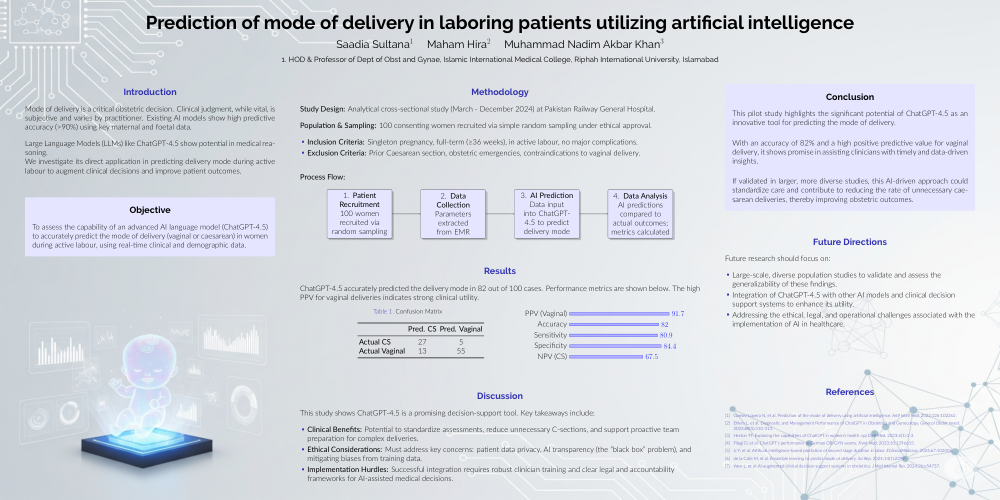
ChatGPT-4.5 accurately predicted the delivery mode in 82 out of 100 cases. Performance metrics are shown below. The high PPV for vaginal deliveries indicates strong clinical utility.
Confusion Matrix:
-
Actual CS / Predicted CS: 27
-
Actual CS / Predicted Vaginal: 5
-
Actual Vaginal / Predicted CS: 13
-
Actual Vaginal / Predicted Vaginal: 55
Performance Metrics:
-
PPV (Vaginal): 91.7%
-
Accuracy: 82.0%
-
Sensitivity: 80.9%
-
Specificity: 84.4%
-
NPV (CS): 67.5%
Discussion
This study shows ChatGPT-4.5 is a promising decision-support tool. Key takeaways include:
-
Clinical Benefits: Potential to standardize assessments, reduce unnecessary C-sections, and support proactive team preparation for complex deliveries.
-
Ethical Considerations: Must address key concerns: patient data privacy, AI transparency (the "black box" problem), and mitigating biases from training data.
-
Implementation Hurdles: Successful integration requires robust clinician training and clear legal and accountability frameworks for AI-assisted medical decisions.
Conclusion
This pilot study highlights the significant potential of ChatGPT-4.5 as an innovative tool for predicting the mode of delivery.
With an accuracy of 82% and a high positive predictive value for vaginal delivery, it shows promise in assisting clinicians with timely and data-driven insights.
If validated in larger, more diverse studies, this AI-driven approach could standardize care and contribute to reducing the rate of unnecessary caesarean deliveries, thereby improving obstetric outcomes.
Future Directions
Future research should focus on:
-
Large-scale, diverse population studies to validate and assess the generalizability of these findings.
-
Integration of ChatGPT-4.5 with other AI models and clinical decision support systems to enhance its utility.
-
Addressing the ethical, legal, and operational challenges associated with the implementation of AI in healthcare.
References
-
Gomez-Lopera N, et al. Prediction of the mode of delivery using artificial intelligence. Artif Intell Med. 2022;126:102262.
-
Ehlers L, et al. Diagnostic and Management Performance of ChatGPT in Obstetrics and Gynecology. Gynecol Obstet Invest. 2023;88(5):310-313.
-
Heston TF. Exploring the capabilities of ChatGPT in women's health. npj Digit Med. 2023;6(1):1-3.
-
Fliegl D, et al. ChatGPT's performance in German OB/GYN exams. Front Med. 2023;10:1296615.
-
Li Y, et al. Artificial intelligence-based prediction of second stage duration in labor. EClinicalMedicine. 2024;67:102006.
-
de la Calle M, et al. Ensemble learning to predict mode of delivery. Sci Rep. 2024;14(1):2299.
-
Wen L, et al. AI-augmented clinical decision support systems in obstetrics. J Med Internet Res. 2024;26:e54737.