2,281 posters, 63 videos, 56 audios, 43 topics, 18 sessions, 6,174 authors, 2,323 institutions
ePostersLive by SciGen Technologies S.A. All rights reserved.
RCOG World Congress 2025
June 23 - 25, 2025 | ExCeL London, UK
EP.0657
Managing Iron Deficiency in Pregnancy: 1500 Man-Years Consensus on Ferric Pyrophosphate combinations
Poster Presenter
Authors
Ambuja Choranur, Ratna Sharma, Siddhartha Chatterjee, Cynthia Alexander, Deepthi Shashidhar, Charu Verma, Anila Nagpal, Komal Jain, Saikat ripathy, Kaustav Chatterjee
Affiliations
C Ambuja Clinic, Aashirvad Nursing Home, Calcutta Fertility Mission, Padma Clinic & Nursing Home, First Care Clinic, Atul-Charu Hospital & Trauma Centre, Nandal Hospital, KJ Memorial Hospital, Motherland Nursing Home, Vivekananda Hospital
Part of Topic
Global health/health policy
Objective
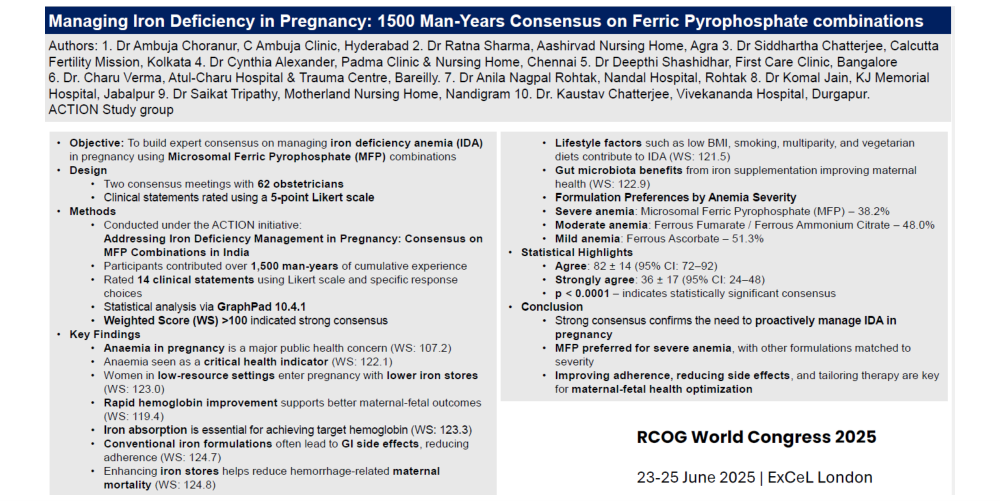
To establish consensus on managing iron deficiency in pregnancy with Microsomal Ferric Pyrophosphate combinations.
Design
Consensus meetings with 62 obstetricians rating clinical statements using a 5-point Likert scale.
Methods
The ACTION (Addressing Iron Deficiency Management in Pregnancy: Consensus on Microsomal Ferric Pyrophosphate Combinations in India), consensus meetings involved 62 obstetricians, across two meetings, with over 1500 man-years of cumulative clinical experience. Participants rated 14 questions related to various clinical statements using a 5-point Likert scale and specific choice response. Statistical analysis was performed using GraphPad 10.4.1, with strong consensus defined as a weighted score greater than 100.
Results
The survey findings reveal a strong consensus on the growing prevalence of anaemia among Indian women, particularly during pregnancy, with 66.7% agreeing and 36.1% strongly agreeing (Weighted Score: 107.2) that it is a significant public health concern. Anaemia is widely recognized as a critical health indicator, (Weighted Score: 122.1). Women in low-resource settings are particularly vulnerable, (Weighted Score: 123.0) that they enter pregnancy with lower iron stores. Rapid hemoglobin improvement is seen as beneficial for maternal and fetal outcomes (Weighted Score: 119.4), and iron absorption is acknowledged as key to improving hemoglobin levels (Weighted Score: 123.3). However, side effects of conventional iron formulations limit adherence (Weighted Score: 124.7). Improving iron stores is crucial for reducing hemorrhage-related mortality and enhancing post-pregnancy health (Weighted Score: 124.8). Lifestyle and dietary factors, such as underweight BMI, multiparity, smoking, and vegetarian diets, are strongly linked to iron deficiency (Weighted Score: 121.5). Additionally, addressing iron deficiency benefits gut microbiota and overall maternal health (Weighted Score: 122.9). The overall mean response scores were: agree: 82±14 (95% CI 72 to 92), strongly agree: 36±17 (95% CI 24 to 48), p<0.0001. Iron formulation preferences vary based on anaemia severity: Micronised Dispersible Ferric Pyrophosphate is most beneficial for severe anemia (38.2%), Ferrous Ascorbate is preferred for mild anemia (51.3%), and both Ferrous Fumarate and Ferrous Ammonium Citrate are most effective for moderate anemia (48.0%).
Conclusion
The ACTION consensus confirms the critical need to address iron deficiency anemia in Indian women, especially during pregnancy. Microsomal Ferric Pyrophosphate emerged as the preferred formulation for severe anemia, while other formulations suit varying severity levels. Improving iron stores is vital for maternal and fetal health, reducing mortality, and mitigating side effects to enhance adherence and outcomes.