2,281 posters, 63 videos, 56 audios, 43 topics, 18 sessions, 6,174 authors, 2,323 institutions
ePostersLive by SciGen Technologies S.A. All rights reserved.
RCOG World Congress 2025
June 23 - 25, 2025 | ExCeL London, UK
EP.0655
Lost in translation- a global challenge for both doctors and patients
Poster Presenter
Part of Topic
Global health/health policy
OBJECTIVES
Language barriers are known to contribute to health inequalities resulting in adverse health outcomes. It is essential that healthcare professionals are equipped with the necessary support and resources to assist women in accessing translating services.
METHODS
To gather our doctors' insights regarding their experiences with translation services, we developed a survey comprising 10 questions: 7 with yes/no responses and 3 designed for open- ended feedback. Conducted confidentially, the survey took under 2 minutes to complete. It was distributed to 40 medical professionals, with 72.5% of participants providing feedback.
RESULTS
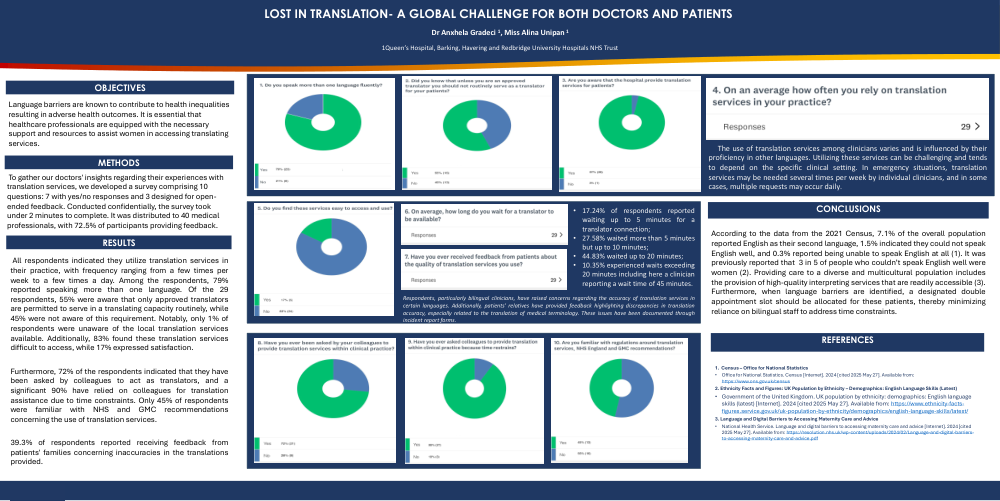
All respondents indicated they utilize translation services in their practice, with frequency ranging from a few times per week to a few times a day. Among the respondents, 79% reported speaking more than one language. Of the 29 respondents, 55% were aware that only approved translators are permitted to serve in a translating capacity routinely, while 45% were not aware of this requirement. Notably, only 1% of respondents were unaware of the local translation services available. Additionally, 83% found these translation services difficult to access, while 17% expressed satisfaction.
Furthermore, 72% of the respondents indicated that they have been asked by colleagues to act as translators, and a significant 90% have relied on colleagues for translation assistance due to time constraints. Only 45% of respondents were familiar with NHS and GMC recommendations concerning the use of translation services.
39.3% of respondents reported receiving feedback from patients' families concerning inaccuracies in the translations provided.
17.24% of respondents reported waiting up to 5 minutes for a translator connection;
27.58% waited more than 5 minutes but up to 10 minutes;
44.83% waited up to 20 minutes;
10.35% experienced waits exceeding 20 minutes including here a clinician reporting a wait time of 45 minutes.
Respondents, particularly bilingual clinicians, have raised concerns regarding the accuracy of translation services in certain languages. Additionally, patients' relatives have provided feedback highlighting discrepancies in translation accuracy, especially related to the translation of medical terminology. These issues have been documented through incident report forms.
The use of translation services among clinicians varies and is influenced by their proficiency in other languages. Utilizing these services can be challenging and tends to depend on the specific clinical setting. In emergency situations, translation services may be needed several times per week by individual clinicians, and in some cases, multiple requests may occur daily.
CONCLUSIONS
According to the data from the 2021 Census, 7.1% of the overall population reported English as their second language, 1.5% indicated they could not speak English well, and 0.3% reported being unable to speak English at all (1). It was previously reported that 3 in 5 of people who couldn’t speak English well were women (2). Providing care to a diverse and multicultural population includes the provision of high-quality interpreting services that are readily accessible (3). Furthermore, when language barriers are identified, a designated double appointment slot should be allocated for these patients, thereby minimizing reliance on bilingual staff to address time constraints.