2,281 posters, 63 videos, 56 audios, 43 topics, 18 sessions, 6,174 authors, 2,323 institutions
ePostersLive by SciGen Technologies S.A. All rights reserved.
RCOG World Congress 2025
June 23 - 25, 2025 | ExCeL London, UK
EP.0645
A review of national induction of labour guidelines – variation across multiple languages
Poster Presenter
Authors
Amar Karia, Rachael Lam, Kirstin Webster, Alissa Frémeaux, Buthaina Ibrahim, George Dunn, Neil Vanes, Muskaan Arora, Anya Hegde, Jan van der Meulen, Asma Khalil, Ipek Gurol-Urganci
Affiliations
University Hospitals Coventry and Warwickshire, Queen Mary University of London, Royal College of Obstetricians and Gynaecologists, St George’s University of London, London School of Hygiene and Tropical Medicine
Part of Topic
Global health/health policy
A review of national induction of labour guidelines – variation across multiple languages
Karia A[A][B], Lam R[C], Webster K [A][D], Frémeaux A[A], Ibrahim B[A], Dunn G, Vanes N[E], Arora M[F], Hegde A[F] Gurol-Urganci I[A][B], Khalil A[A][F][G], van der Meulen J [A][B]
[A] Royal College of Obstetricians and Gynaecologists, [B] London School of Hygiene and Tropical Medicine, [C] Queen Mary University of London [D] University of Leicester, [E] University Hospital Coventry and Warwickshire, [F] St George’s, University of London, [G] Liverpool Women’s Hospital
Background:
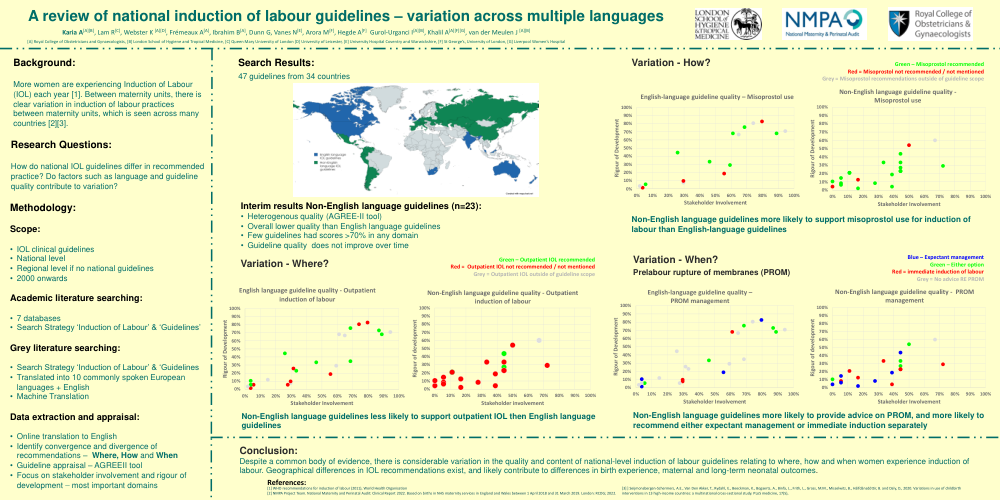
More women are experiencing Induction of Labour (IOL) each year [1]. Between maternity units, there is clear variation in induction of labour practices between maternity units, which is seen across many countries [2][3].
Research Questions:
How do national IOL guidelines differ in recommended practice? Do factors such as language and guideline quality contribute to variation?
Methodology:
Scope:
Academic literature searching:
Grey literature searching:
Data extraction and appraisal:
Search Results:
47 guidelines from 34 countries
Interim results Non-English language guidelines (n=23):
Variation - Where?
Non-English language guidelines less likely to support outpatient IOL then English language guidelines
Variation - How?
Non-English language guidelines more likely to support misoprostol use for induction of labour than English-language guidelines
Variation - When? Prelabour rupture of membranes (PROM)
Non-English language guidelines more likely to provide advice on PROM, and more likely to recommend either expectant management or immediate induction separately
Conclusion:
Despite a common body of evidence, there is considerable variation in the quality and content of national-level induction of labour guidelines relating to where, how and when women experience induction of labour. Geographical differences in IOL recommendations exist, and likely contribute to differences in birth experience, maternal and long-term neonatal outcomes.
References:
[1] WHO recommendations for induction of labour (2011), World Health Organisation
[2] NMPA Project Team. National Maternity and Perinatal Audit: Clinical Report 2022. Based on births in NHS maternity services in England and Wales between 1 April 2018 and 31 March 2019. London: RCOG; 2022.
[3] ] Seijmonsbergen-Schermers, A.E., Van Den Akker, T., Rydahl, E., Beeckman, K., Bogaerts, A., Binfa, L., Frith, L., Gross, M.M., Misselwitz, B., Hálfdánsdóttir, B. and Daly, D., 2020. Variations in use of childbirth interventions in 13 high-income countries: a multinational cross-sectional study. PLoS medicine, 17(5),