2,281 posters, 63 videos, 56 audios, 43 topics, 18 sessions, 6,174 authors, 2,323 institutions
ePostersLive by SciGen Technologies S.A. All rights reserved.
RCOG World Congress 2025
June 23 - 25, 2025 | ExCeL London, UK
PP.0103
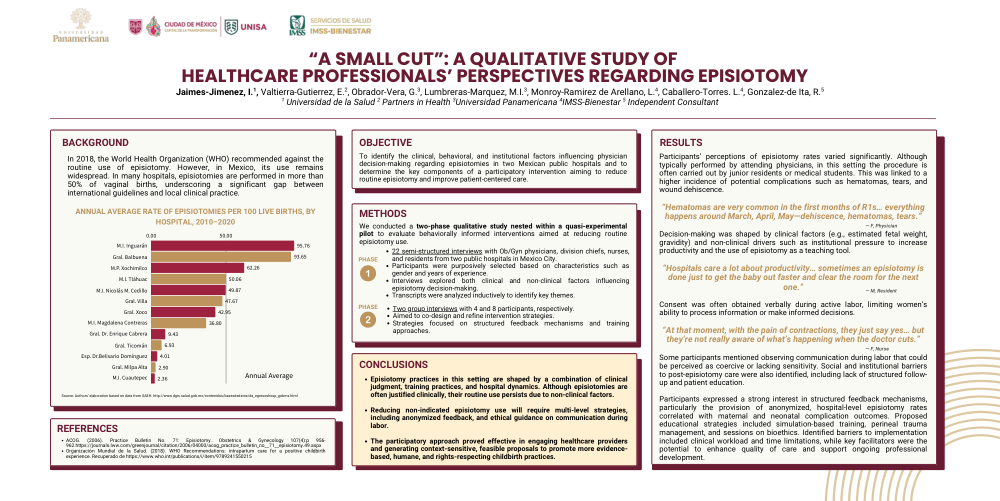
“A small cut”: A Qualitative Study of Healthcare Professionals’ Perspectives regarding Episiotomy
Poster Presenter
Authors
Ithandehui Jaimes-Jiménez, Erika Sofía Valtierra-Gutiérrez, Gregorio T. Obrador-Vera, Mario I. Lumbreras-Marquez, Lilia Elena Monroy-Ramírez de Arellano, Luis Ernesto Caballero-Torres, Rodrigo A. González-de Ita
Affiliations
Universidad de la Salud, Socios En Salud, Universidad Panamericana School of Medicine, IMSS-Bienestar, Independent Consultant
Part of Topic
Global health/health policy
“A SMALL CUT”: A QUALITATIVE STUDY OF HEALTHCARE PROFESSIONALS’ PERSPECTIVES REGARDING EPISIOTOMY
BACKGROUND
In 2018, the World Health Organization (WHO) recommended against the routine use of episiotomy. However, in Mexico, its use remains widespread. In many hospitals, episiotomies are performed in more than 50% of vaginal births, underscoring a significant gap between international guidelines and local clinical practice.
OBJECTIVE
To identify the clinical, behavioral, and institutional factors influencing physician decision-making regarding episiotomies in two Mexican public hospitals and to determine the key components of a participatory intervention aiming to reduce routine episiotomy and improve patient-centered care.
METHODS
We conducted a two-phase qualitative study nested within a quasi-experimental pilot to evaluate behaviorally informed interventions aimed at reducing routine episiotomy use.
22 semi-structured interviews with Ob/Gyn physicians, division chiefs, nurses, and residents from two public hospitals in Mexico City.
Participants were purposively selected based on characteristics such as gender and years of experience.
Interviews explored both clinical and non-clinical factors influencing episiotomy decision-making.
Transcripts were analyzed inductively to identify key themes.
Two group interviews with 4 and 8 participants, respectively.
Aimed to co-design and refine intervention strategies.
Strategies focused on structured feedback mechanisms and training approaches.
RESULTS
Participants’ perceptions of episiotomy rates varied significantly. Although typically performed by attending physicians, in this setting the procedure is often carried out by junior residents or medical students. This was linked to a higher incidence of potential complications such as hematomas, tears, and wound dehiscence.
“Hematomas are very common in the first months of R1s… everything happens around March, April, May—dehiscence, hematomas, tears.” - F, Physician
Decision-making was shaped by clinical factors (e.g., estimated fetal weight, gravidity) and non-clinical drivers such as institutional pressure to increase productivity and the use of episiotomy as a teaching tool.
“Hospitals care a lot about productivity… sometimes an episiotomy is done just to get the baby out faster and clear the room for the next one.” - M, Resident
Consent was often obtained verbally during active labor, limiting women’s ability to process information or make informed decisions.
“At that moment, with the pain of contractions, they just say yes… but they’re not really aware of what’s happening when the doctor cuts.” - F, Nurse
Some participants mentioned observing communication during labor that could be perceived as coercive or lacking sensitivity. Social and institutional barriers to post-episiotomy care were also identified, including lack of structured followup
and patient education.
Participants expressed a strong interest in structured feedback mechanisms, particularly the provision of anonymized, hospital-level episiotomy rates correlated with maternal and neonatal complication outcomes. Proposed educational strategies included simulation-based training, perineal trauma management, and sessions on bioethics. Identified barriers to implementation included clinical workload and time limitations, while key facilitators were the potential to enhance quality of care and support ongoing professional development.
CONCLUSIONS
Episiotomy practices in this setting are shaped by a combination of clinical judgment, training practices, and hospital dynamics. Although episiotomies are often justified clinically, their routine use persists due to non-clinical factors.
Reducing non-indicated episiotomy use will require multi-level strategies, including anonymized feedback, and ethical guidance on communication during labor.
The participatory approach proved effective in engaging healthcare providers and generating context-sensitive, feasible proposals to promote more evidencebased, humane, and rights-respecting childbirth practices.