Loading...

2,281 posters, 63 videos, 56 audios, 43 topics, 18 sessions, 6,174 authors, 2,323 institutions

ePostersLive by SciGen Technologies S.A. All rights reserved.

RCOG World Congress 2025

June 23 - 25, 2025 | ExCeL London, UK

EP.0641

Water Hardness, Air Pollution, and Low Birth Weight in England: Ecological study
Part of Topic

Global health/health policy

Water Hardness, Air Pollution, and Low Birth Weight in England: Ecological study

Eleanor Ross, Prof Ben Wheeler, Dr Jo Garrett

Research Questions:

•What is the association between water hardness level as calcium carbonate concentration and rate of LBW births in England?
•What is the association between PM2.5 concentration exposure and rate of LBW births in England?

Low Birth Weight (LBW) (<2,500g at birth) affected 19.8 million, or 14.7%, of live born infants globally in 2020 (1). A complex interrelationship of factors moderates risk of LBW, and since 50% of deaths from preterm birth are preventable (2), research with the aim of reducing prevalence of LBW targets modifiable risk factors. This study aims to examine the associations of two such factors; air pollution and water hardness, and their effects on prevalence of LBW. The WHO acknowledges associations between air pollution and LBW (3) although evidence is inconsistent.

Particulate Matter (PM2.5: particles ≤2.5 µm in diameter) (4) may increase plasma viscosity and cause arterial vasoconstriction, reducing exchange of oxygen with a foetus thereby reducing growth (5). Drinking water hardness (calcium carbonate concentration) is being measured as a proxy for calcium intake, which modifies parathyroid hormone levels, leading to foetal hypocalcaemia (6), and can modify blood pressure through smooth muscle contraction (7).

This study investigated the associations of two environmental exposures; air pollution (PM2.5 concentration), and drinking water hardness (CaCO3 concentration) through an ecological cross-sectional study design.


•To reduce risk of potential confounding, covariates Index of Multiple Deprivation (IMD), ethnicity, and maternal smoking were used to adjust linear regression models.
•This study employed a novel approach to investigating the relationship between water hardness and LBW using spatial data.
•Data were obtained from publicly available sources: the Office for Health Improvement and Disparities (OHID), the Department for Environment, Food and Rural Affairs (DEFRA), the Drinking Water Inspectorate (DWI), and Public Health England (PHE).
•These were attributed to electoral ward spatial level in a GIS software before statistical analysis; Kendall’s rank correlation and simple and multiple linear regression analysis.
 
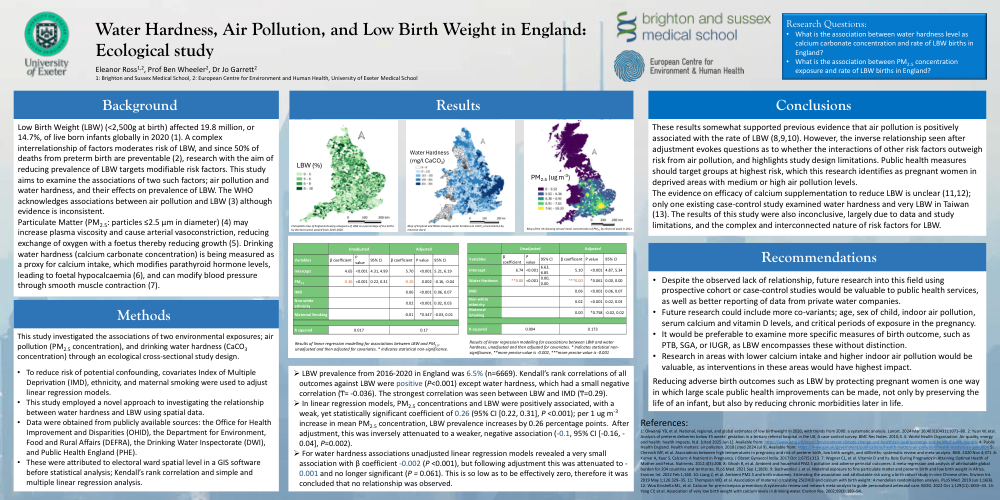
Ø LBW prevalence from 2016-2020 in England was 6.5% (n=6669). Kendall’s rank correlations of all   outcomes against LBW were positive (P<0.001) except water hardness, which had a small negative correlation (Ͳ= -0.036). The strongest correlation was seen between LBW and IMD (Ͳ=0.29). 
Ø In linear regression models, PM2.5 concentrations and LBW were positively associated, with a weak, yet statistically significant coefficient of 0.26 (95% CI [0.22, 0.31], P <0.001); per 1 ug m-3 increase in mean PM2.5 concentration, LBW prevalence increases by 0.26 percentage points.  After adjustment, this was inversely attenuated to a weaker, negative association (-0.1, 95% CI [-0.16, -0.04], P=0.002).
Ø For water hardness associations unadjusted linear regression models revealed a very small association with β coefficient -0.002 (P <0.001), but following adjustment this was attenuated to -0.001 and no longer significant (P = 0.061). This is so low as to be effectively zero, therefore it was concluded that no relationship was observed.
 

These results somewhat supported previous evidence that air pollution is positively associated with the rate of LBW (8,9,10). However, the inverse relationship seen after adjustment evokes questions as to whether the interactions of other risk factors outweigh risk from air pollution, and highlights study design limitations. Public health measures should target groups at highest risk, which this research identifies as pregnant women in deprived areas with medium or high air pollution levels.

The evidence on efficacy of calcium supplementation to reduce LBW is unclear (11,12); only one existing case-control study examined water hardness and very LBW in Taiwan (13). The results of this study were also inconclusive, largely due to data and study limitations, and the complex and interconnected nature of risk factors for LBW.

•Despite the observed lack of relationship, future research into this field using prospective cohort or case-control studies would be valuable to public health services, as well as better reporting of data from private water companies.
•Future research could include more co-variants; age, sex of child, indoor air pollution, serum calcium and vitamin D levels, and critical periods of exposure in the pregnancy.
•It would be preferable to examine more specific measures of birth outcome, such as PTB, SGA, or IUGR, as LBW encompasses these without distinction.
•Research in areas with lower calcium intake and higher indoor air pollution would be valuable, as interventions in these areas would have highest impact.


Reducing adverse birth outcomes such as LBW by protecting pregnant women is one way in which large scale public health improvements can be made, not only by preserving the life of an infant, but also by reducing chronic morbidities later in life.

Copyright © 2015-2026, ePostersLive® SciGen is a registered trademark of SciGen Technologies S.A. Patent pending.

This website and third-party tools we use rely on cookies for the best user experience. By selecting "I agree", you agree to cookie usage as described in our Privacy Policy.