Loading...

2,281 posters, 63 videos, 56 audios, 43 topics, 18 sessions, 6,174 authors, 2,323 institutions

ePostersLive by SciGen Technologies S.A. All rights reserved.

RCOG World Congress 2025

June 23 - 25, 2025 | ExCeL London, UK

EP.0063

Improving Patient Letters in Gynaecology Clinics with the use of Artificial Intelligence
Part of Topic

AI & digital health

Improving Patient Letters in Gynaecology Clinics with the use of Artificial Intelligence

Dr. La Toya Ince-Gittens (MRCOG), Suchita Rana, Miss Kiren Gill (MRCOG), Dr. Jaice Devasia (MRCOG)

The Whittington Hospital


Introduction

•Patient letters are a vital tool for communication, providing patients with key information about their diagnosis and management.

Gaps in clarity, content, and delivery, however, can hinder patient understanding and therefore satisfaction.


Aim

•To improve patient letters in the gynaecology and urogynaecology department.


Design

•This is a Quality Improvement project that used a retrospective observational design along with collection of patient feedback to assess the quality of patient letters in a general gynaecology and urogynaecology clinic. 
•We explored the use of Artificial Intelligence (AI) to improve delivery of information and patient education in a busy healthcare setting to improve our communication in an efficient manner. 


Method

•Patient letters from a two-week period across both clinics were reviewed. 
•Each letter was assessed for presence, diagnosis documentation, use of patient-friendly language, diagnosis explanation, and inclusion of management options. 

•Patients were contacted for feedback on their satisfaction with the content, clarity, and overall quality of their letters, rated on a scale of 1 to 5. 

•Based on findings, we used AI tools such as Chat GPT to efficiently summarise national and international evidence-based resources, patient information leaflets and guidelines including RCOG, BSGE, IUGA and NICE, to summarise information in patient friendly language that explained diagnoses and treatment options. 

•We generated a standardised “Dear Patient” field into our electronic medical records which can be individualised. 
•This field will generate editable patient-friendly explanations of selected diagnoses, alongside management options and links to reliable online resources.
•Re-evaluation will follow implementation to assess improvement.


Results  

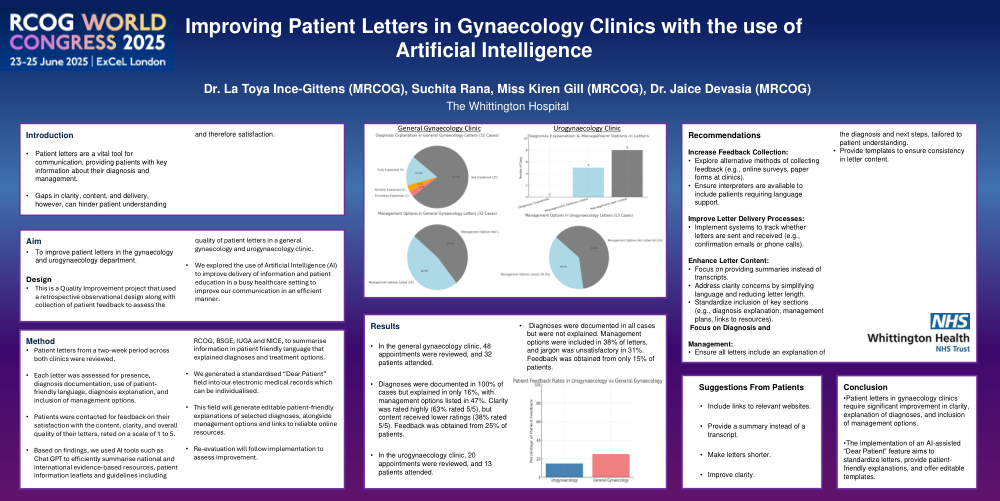
•In the general gynaecology clinic, 48 appointments were reviewed, and 32 patients attended. 
 
•Diagnoses were documented in 100% of cases but explained in only 16%, with management options listed in 47%. Clarity was rated highly (63% rated 5/5), but content received lower ratings (38% rated 5/5). Feedback was obtained from 25% of patients.

•In the urogynaecology clinic, 20 appointments were reviewed, and 13 patients attended.

• Diagnoses were documented in all cases but were not explained. Management options were included in 38% of letters, and jargon was unsatisfactory in 31%. Feedback was obtained from only 15% of patients.


Recommendations

Increase Feedback Collection:

•Explore alternative methods of collecting feedback (e.g., online surveys, paper forms at clinics).
•Ensure interpreters are available to include patients requiring language support.
 
Improve Letter Delivery Processes:
•Implement systems to track whether letters are sent and received (e.g., confirmation emails or phone calls).

Enhance Letter Content:

•Focus on providing summaries instead of transcripts.
•Address clarity concerns by simplifying language and reducing letter length.
•Standardize inclusion of key sections (e.g., diagnosis explanation, management plans, links to resources).

 Focus on Diagnosis and Management:

•Ensure all letters include an explanation of the diagnosis and next steps, tailored to patient understanding.
•Provide templates to ensure consistency in letter content.


Suggestions From Patients

•Include links to relevant websites.

•Provide a summary instead of a transcript.

•Make letters shorter.

•Improve clarity.


Conclusion

•Patient letters in gynaecology clinics require significant improvement in clarity, explanation of diagnoses, and inclusion of management options. 

•The implementation of an AI-assisted “Dear Patient” feature aims to standardize letters, provide patient-friendly explanations, and offer editable templates. 

Copyright © 2015-2026, ePostersLive® SciGen is a registered trademark of SciGen Technologies S.A. Patent pending.

This website and third-party tools we use rely on cookies for the best user experience. By selecting "I agree", you agree to cookie usage as described in our Privacy Policy.