2,281 posters, 63 videos, 56 audios, 43 topics, 18 sessions, 6,174 authors, 2,323 institutions
ePostersLive by SciGen Technologies S.A. All rights reserved.
RCOG World Congress 2025
June 23 - 25, 2025 | ExCeL London, UK
EP.0640
Cost-effectiveness of home alcohol-based hand rub to prevent infant illness and death
Poster Presenter
Authors
Nia Morrish, Andrew Weeks, Francis Okello, Martin Chebet, David Mukunya, Kathy Burgoine, Duolao Wang, Brian Faragher, Amos Odiit, Peter Olupot-Olupot, Ingunn Engebretsen, John Baptist Waniaye, Julius Wandabwa, Antonieta Medina-Lara
Affiliations
University of Liverpool, Ministry of Health, Busitema University, University of Bergen, University of Exeter, Ngora Freda Carr Hospital
Part of Topic
Global health/health policy
Cost-effectiveness of home alcohol-based hand rub to prevent infant illness and death
Morrish N1, Weeks A2, Okello F3, Chebet M4, Mukunya D4, Burgoine K3, Wang D2, Faragher B2, Odiit A5, Olupot-Olupot P4, Engebretsen I3, Waniaye JP6, Wandabwa J4, Medina-Lara A1.
1University of Exeter, Exeter, United Kingdom. 2University of Liverpool, Liverpool, United Kingdom. 3University of Bergen, Bergen, Norway. 4Busitema University, Kampala, Uganda. 5Ngora Freda Carr Hospital, Ngora, Uganda. 6Ministry of Health, Kampala, Uganda
Background:
Hand hygiene is a high priority for the World Health Organisation (WHO), emphasised in their ‘Save Lives: Clean Your Hands’ global campaignReference1. While the WHO backs up the use of alcohol-based hand rub (ABHR), broad scientific evidence supporting this policy remains limited. The BabyGel trial, a Phase 3, open label, parallel assignment, stratified, cluster randomised controlled trial, seeks to address this gap.
The trial recruited women aged over 18 years old (or emancipated minors under 18), who were at least 34 weeks pregnant, live in one of the selected villages (clusters) in the Mbala of Budaka districts, and provided informed consent. All participants received a Maama kit and routine antenatal care and were encouraged to maintain standard handwashing practices. In addition, the intervention group received ABHR, a hand hygiene diagram poster, and training on how to use the ABHR. The primary objective of the BabyGel trial is to determine whether providing ABHR to pregnant and postnatal households reduces severe illness or death in infants during their first three months of life.
Cost-effectiveness objectives
Methods:
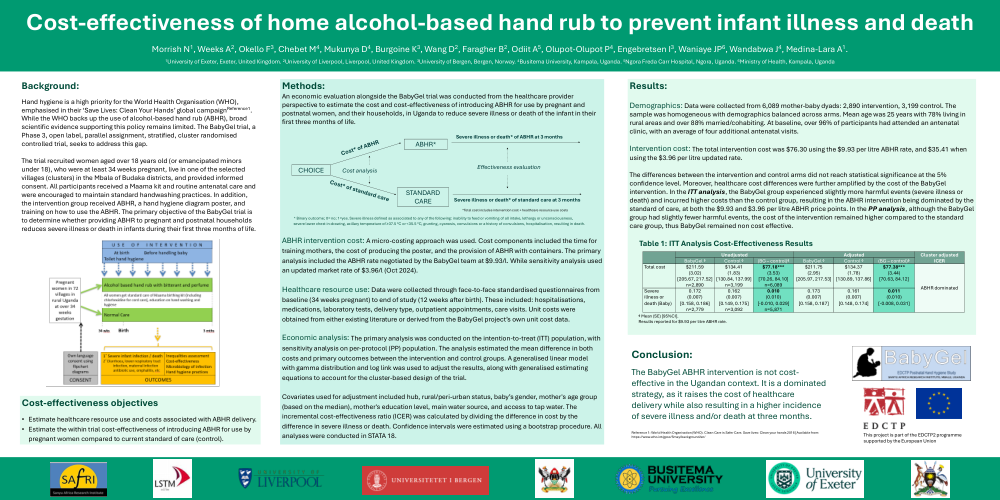
An economic evaluation alongside the BabyGel trial was conducted from the healthcare provider perspective to estimate the cost and cost-effectiveness of introducing ABHR for use by pregnant and postnatal women, and their households, in Uganda to reduce severe illness or death of the infant in their first three months of life.
* Binary outcome; 0= no; 1=yes. Severe illness defined as associated to any of the following: inability to feed or vomiting of all intake, lethargy or unconsciousness, severe lower chest in-drawing, axillary temperature of ≥37.5 °C or <35.5 °C, grunting, cyanosis, convulsions or a history of convulsions, hospitalisation, resulting in death.
ABHR intervention cost: A micro-costing approach was used. Cost components included the time for training mothers, the cost of producing the poster, and the provision of ABHR with containers. The primary analysis included the ABHR rate negotiated by the BabyGel team at $9.93/l. While sensitivity analysis used an updated market rate of $3.96/l (Oct 2024).
Healthcare resource use: Data were collected through face-to-face standardised questionnaires from baseline (34 weeks pregnant) to end of study (12 weeks after birth). These included: hospitalisations, medications, laboratory tests, delivery type, outpatient appointments, care visits. Unit costs were obtained from either existing literature or derived from the BabyGel project’s own unit cost data.
Economic analysis: The primary analysis was conducted on the intention-to-treat (ITT) population, with sensitivity analysis on per-protocol (PP) population. The analysis estimated the mean difference in both costs and primary outcomes between the intervention and control groups. A generalised linear model with gamma distribution and log link was used to adjust the results, along with generalised estimating equations to account for the cluster-based design of the trial.
Covariates used for adjustment included hub, rural/peri-urban status, baby’s gender, mother's age group (based on the median), mother's education level, main water source, and access to tap water. The incremental cost-effectiveness ratio (ICER) was calculated by dividing the difference in cost by the difference in severe illness or death. Confidence intervals were estimated using a bootstrap procedure. All analyses were conducted in STATA 18.
Results:
Demographics: Data were collected from 6,089 mother-baby dyads: 2,890 intervention, 3,199 control. The sample was homogeneous with demographics balanced across arms. Mean age was 25 years with 78% living in rural areas and over 88% married/cohabiting. At baseline, over 96% of participants had attended an antenatal clinic, with an average of four additional antenatal visits.
Intervention cost: The total intervention cost was $76.30 using the $9.93 per litre ABHR rate, and $35.41 when using the $3.96 per litre updated rate.
The differences between the intervention and control arms did not reach statistical significance at the 5% confidence level. Moreover, healthcare cost differences were further amplified by the cost of the BabyGel intervention. In the ITT analysis, the BabyGel group experienced slightly more harmful events (severe illness or death) and incurred higher costs than the control group, resulting in the ABHR intervention being dominated by the standard of care, at both the $9.93 and $3.96 per litre ABHR price points. In the PP analysis, although the BabyGel group had slightly fewer harmful events, the cost of the intervention remained higher compared to the standard care group, thus BabyGel remained non cost effective.
Conclusion:
The BabyGel ABHR intervention is not cost-effective in the Ugandan context. It is a dominated strategy, as it raises the cost of healthcare delivery while also resulting in a higher incidence of severe illness and/or death at three months.
Reference 1: World Health Organisation (WHO). Clean Care is Safer Care. Save lives: Clean your hands 2016 [Available from: https://www.who.int/gpsc/5may/background/en/
This project is part of the EDCTP2 programme supported by the European Union