2,281 posters, 63 videos, 56 audios, 43 topics, 18 sessions, 6,174 authors, 2,323 institutions
ePostersLive by SciGen Technologies S.A. All rights reserved.
RCOG World Congress 2025
June 23 - 25, 2025 | ExCeL London, UK
EP.0634
Ancillary benefits of running a cluster randomised control trial in Eastern Uganda.
Poster Presenter
Authors
Ravi Lad, Ediri O'Brien, David Mukunya, Martin Chebet, Kathy Burgoine, Brian Faragher, Melf-Jakon Kuhl, Ingunn Marie Stadskleiv Engebretsen, Thorkild Tylleskar, Andrew David Weeks
Affiliations
University of Liverpool, Liverpool School of Tropical Medicine, Busitema University, University of Bergen
Part of Topic
Global health/health policy
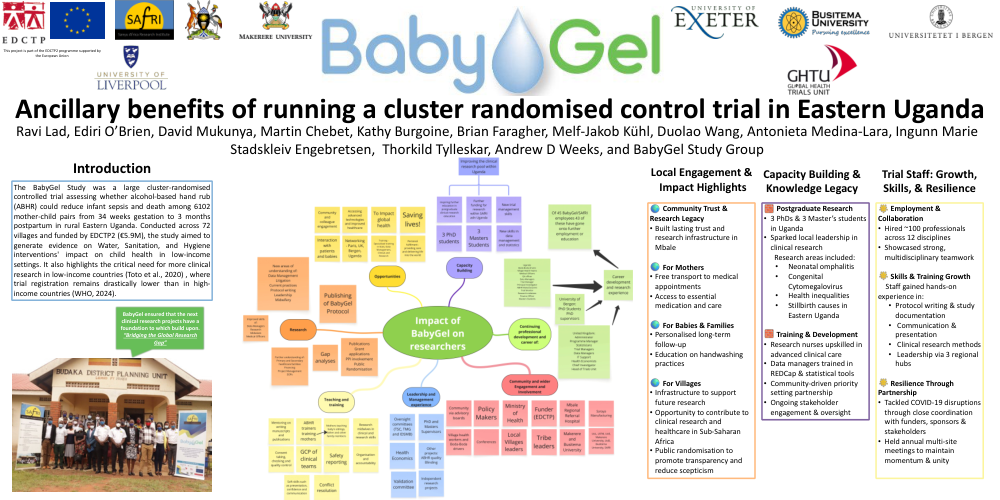
Ancillary benefits of running a cluster randomised control trial in Eastern Uganda
Trial Staff: Growth, Skills, & Resilience
Employment & Collaboration
•Hired ~100 professionals across 12 disciplines
•Showcased strong, multidisciplinary teamwork
Skills & Training Growth Staff gained hands-on experience in:
•Protocol writing & study documentation
• Communication & presentation
• Clinical research methods
• Leadership via 3 regional hubs
Resilience Through Partnership
•Tackled COVID-19 disruptions through close coordination with funders, sponsors & stakeholders
•Held annual multi-site meetings to maintain momentum & unity
Capacity Building & Knowledge Legacy
Postgraduate Research
•3 PhDs & 3 Master’s students in Uganda
•Sparked local leadership in clinical research Research areas included:
•Neonatal omphalitis
•Congenital Cytomegalovirus
•Health inequalities
•Stillbirth causes in Eastern Uganda
Training & Development
•Research nurses upskilled in advanced clinical care
•Data managers trained in REDCap & statistical tools
•Community-driven priority setting partnership
•Ongoing stakeholder engagement & oversight
Local Engagement & Impact Highlights
Community Trust & Research Legacy
•Built lasting trust and research infrastructure in Mbale
For Mothers
•Free transport to medical appointments
•Access to essential medication and care
For Babies & Families
•Personalised long-term follow-up
•Education on handwashing practices
For Villages
•Infrastructure to support future research
•Opportunity to contribute to clinical research and healthcare in Sub-Saharan Africa
•Public randomisation to promote transparency and reduce scepticism
The BabyGel Study was a large cluster-randomised controlled trial assessing whether alcohol-based hand rub (ABHR) could reduce infant sepsis and death among 6102 mother-child pairs from 34 weeks gestation to 3 months postpartum in rural Eastern Uganda. Conducted across 72 villages and funded by EDCTP2 (€5.9M), the study aimed to generate evidence on Water, Sanitation, and Hygiene interventions' impact on child health in low-income settings. It also highlights the critical need for more clinical research in low-income countries (Toto et al., 2020) , where trial registration remains drastically lower than in high-income countries (WHO, 2024).
BabyGel ensured that the next clinical research projects have a foundation to which build upon. “Bridging the Global Research Gap”