2,281 posters, 63 videos, 56 audios, 43 topics, 18 sessions, 6,174 authors, 2,323 institutions
ePostersLive by SciGen Technologies S.A. All rights reserved.
RCOG World Congress 2025
June 23 - 25, 2025 | ExCeL London, UK
EP.0062
The Role of E-Health in Reducing Delay Of Maternal Emergency
Poster Presenter
Part of Topic
AI & digital health
THE ROLE OF E-HEALTH IN REDUCING DELAY OF MATERNAL EMERGENCY
Sella Zenitasari 1,2 , Eugenius Phyowai Ganap ¹
¹Department of Obstetrics and Gynaecology, Faculty of Medicine, Nursing, and Public Health,
Universitas Gadjah Mada, Yogyakarta, Indonesia. ²Faculty of Medicine, Universitas
Pendidikan Indonesia, Bandung, Indonesia
BACKGROUND
METHOD
•Primary evidence from 2014-2024
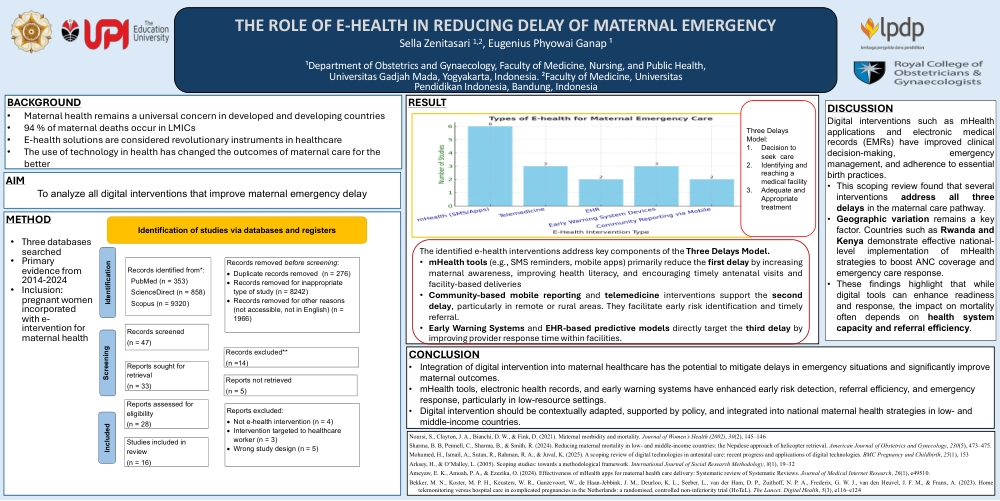
RESULT
The identified e-health interventions address key components of the Three Delays Model.
1. mHealth tools (e.g., SMS reminders, mobile apps) primarily reduce the first delay by increasing maternal awareness, improving health literacy, and encouraging timely antenatal visits and facility-based deliveries
2. Community-based mobile reporting and telemedicine interventions support the second delay, particularly in remote or rural areas. They facilitate early risk identification and timely referral.
DISCUSSION
Digital interventions such as mHealth applications and electronic medical records (EMRs) have improved clinical decision-making, emergency management, and adherence to essential birth practices. This scoping review found that several interventions address all three delays in the maternal care pathway. Geographic variation remains a key factor. Countries such as Rwanda and Kenya demonstrate effective national-level implementation of mHealth strategies to boost ANC coverage and emergency care response.These findings highlight that while digital tools can enhance readiness and response, the impact on mortality often depends on health system capacity and referral efficiency.
CONCLUSION