2,281 posters, 63 videos, 56 audios, 43 topics, 18 sessions, 6,174 authors, 2,323 institutions
ePostersLive by SciGen Technologies S.A. All rights reserved.
RCOG World Congress 2025
June 23 - 25, 2025 | ExCeL London, UK
EP.0061
Assessment of patient comprehension with electronic consenting in multi-ethnic population in Gynaecology
Poster Presenter
Authors
Affiliations
Part of Topic
AI & digital health
Assessment of patient comprehension with electronic consenting in multi-ethnic population in Gynaecology
Background
Electronic consenting (e-consent) has recently been introduced for use within our local hospital.
The population in Leicester is unique as 24.1% of the population do not identify as being from any national identity associated with the UK and 16.2% of Leicester's inhabitants report India as their country of birth (National census 2021).
We wanted to assess patient satisfaction and comprehension using electronic consenting to determine if the use of electronic consenting is appropriate for and meeting the needs of our local patient population.
Objectives
Evaluate the implementation of e-consent and if/how it benefits our patient population.
Ensure e-consenting process is robust and fit for purpose.
Try to address and improve any disparities in healthcare access for our local population.
Methodology
Patients undergoing elective gynaecology surgery, who had completed an electronic consent form were asked to complete the survey.
100 replies were collected between April-May 2024.
The 17 question survey could be accessed via electronic devices or paper forms.
We assessed comprehension by consolidating answers from numerous survey questions:
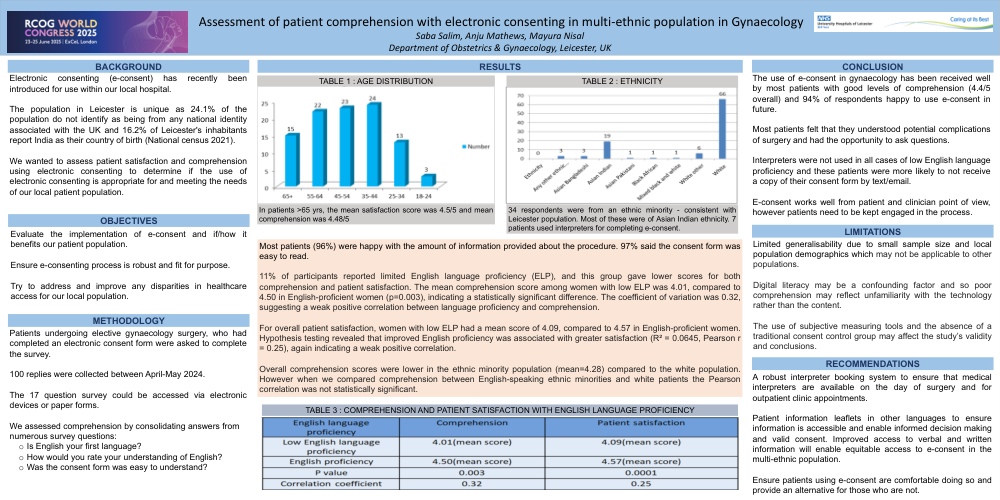
Most patients (96%) were happy with the amount of information provided about the procedure. 97% said the consent form was easy to read
11% of participants reported limited English language proficiency (ELP), and this group gave lower scores for both comprehension and patient satisfaction. The mean comprehension score among women with low ELP was 4.01, compared to 4.50 in English-proficient women (p=0.003), indicating a statistically significant difference. The coefficient of variation was 0.32, suggesting a weak positive correlation between language proficiency and comprehension.
For overall patient satisfaction, women with low ELP had a mean score of 4.09, compared to 4.57 in English-proficient women. Hypothesis testing revealed that improved English proficiency was associated with greater satisfaction (R² = 0.0645, Pearson r = 0.25), again indicating a weak positive correlation.
Overall comprehension scores were lower in the ethnic minority population (mean=4.28) compared to the white population. However when we compared comprehension between English-speaking ethnic minorities and white patients the Pearson correlation was not statistically significant.
Conclusion
The use of e-consent in gynaecology has been received well by most patients with good levels of comprehension (4.4/5 overall) and 94% of respondents happy to use e-consent in future.
Most patients felt that they understood potential complications of surgery and had the opportunity to ask questions.
Interpreters were not used in all cases of low English language proficiency and these patients were more likely to not receive a copy of their consent form by text/email.
E-consent works well from patient and clinician point of view, however patients need to be kept engaged in the process.
Limitations
Limited generalisability due to small sample size and local population demographics which may not be applicable to other populations.
Digital literacy may be a confounding factor and so poor comprehension may reflect unfamiliarity with the technology rather than the content.
The use of subjective measuring tools and the absence of a traditional consent control group may affect the study’s validity and conclusions.
Recommendations
A robust interpreter booking system to ensure that medical interpreters are available on the day of surgery and for outpatient clinic appointments.
Patient information leaflets in other languages to ensure information is accessible and enable informed decision making and valid consent. Improved access to verbal and written information will enable equitable access to e-consent in the multi-ethnic population.
Ensure patients using e-consent are comfortable doing so and provide an alternative for those who are not.