2,281 posters, 63 videos, 56 audios, 43 topics, 18 sessions, 6,174 authors, 2,323 institutions
ePostersLive by SciGen Technologies S.A. All rights reserved.
RCOG World Congress 2025
June 23 - 25, 2025 | ExCeL London, UK
PP.0011
A multi-centre qualitative study on the use of machine learning within obstetrics
Poster Presenter
Part of Topic
AI & digital health
A multi-centre qualitative study on the use of machine learning within obstetrics
Objective
Machine learning (ML) is rapidly evolving and showing great promise. However, there is limited information on opinions of healthcare workers on the use of these technologies within maternity care.
The aim was to understand trust in ML technologies in maternity care, and barriers to their incorporation.
Design
Prospective, multi-centre, qualitative study in Canada, Nigeria, Rwanda and the UK, using semi-structured interviews with healthcare workers.
Method
Purposive and snowball sampling methods were employed to ensure inclusion of a balance of genders, ages and professions within maternity care. Participant interviews, conducted face to face or over Teams, were recorded and transcribed verbatim. Data saturation was monitored at each site, but was only reached once data from all sites was combined. Data saturation was achieved once interview scripts were no longer generating new codes. Initial themes were developed by inductive content analysis of data in an iterative process. Themes were then allowed to emerge and codes grouped. Emerging themes and codes were discussed and agreed by consensus. Transcripts were revisited to ensure codes were exhaustive and complete.
Results
Twenty maternity healthcare workers were interviewed, five at each of the four sites, comprising midwives (5), consultants in Obstetrics and Gynaecology (5), residents in O&G (3) , nurses (2), maternal fetal medicine consultants (2), one radiology registrar, one family doctor who is involved in maternity care and one maternity support worker.
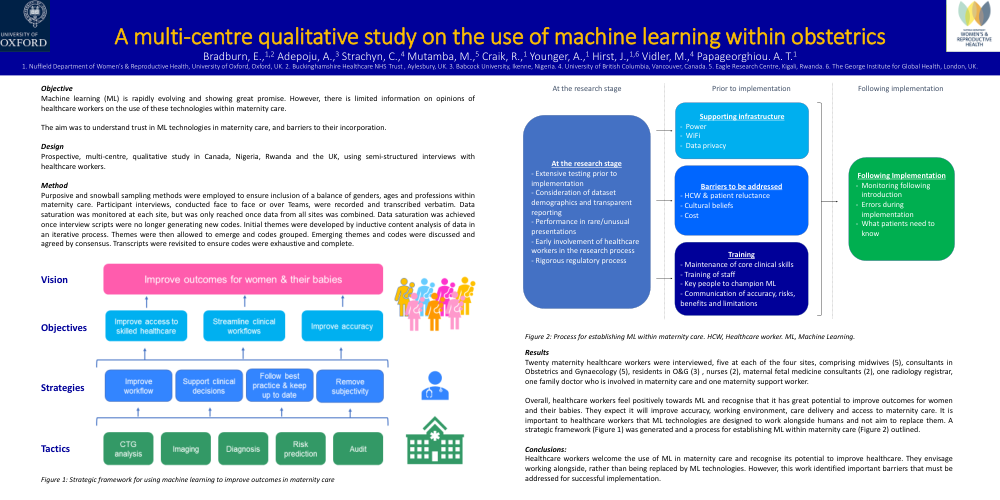
Overall, healthcare workers feel positively towards ML and recognise that it has great potential to improve outcomes for women and their babies. They expect it will improve accuracy, working environment, care delivery and access to maternity care. It is important to healthcare workers that ML technologies are designed to work alongside humans and not aim to replace them. A strategic framework (Figure 1) was generated and a process for establishing ML within maternity care (Figure 2) outlined.
Conclusions:
Healthcare workers welcome the use of ML in maternity care and recognise its potential to improve healthcare. They envisage working alongside, rather than being replaced by ML technologies. However, this work identified important barriers that must be addressed for successful implementation