2,281 posters, 63 videos, 56 audios, 43 topics, 18 sessions, 6,174 authors, 2,323 institutions
ePostersLive by SciGen Technologies S.A. All rights reserved.
RCOG World Congress 2025
June 23 - 25, 2025 | ExCeL London, UK
PP.0010
Automated assessment of fetal head station from transperineal ultrasound volumes in labor.
Poster Presenter
Part of Topic
AI & digital health
Title
Automated assessment of fetal head station from transperineal ultrasound volumes acquired in labour.
Introduction
The angle of progression (AoP) is one of the best-studied sonographic markers of fetal head descent (Figure 1).
There is a barrier to the uptake of intrapartum ultrasound by obstetric caregivers. To bypass the need for training, several automated AoP measurement techniques have been developed, yet only focusing on 2D images.
Identification of the midsagittal plane, i.e., encompassing the centre of the pubic symphysis, can be challenging because of its heterogeneous appearance.
This study aimed to develop and test an artificial intelligence algorithm for automated assessment of the AoP from 3D transperineal ultrasound (TPUS) volumes acquired in labour, bypassing the need for operator-dependent plane detection.
Methods
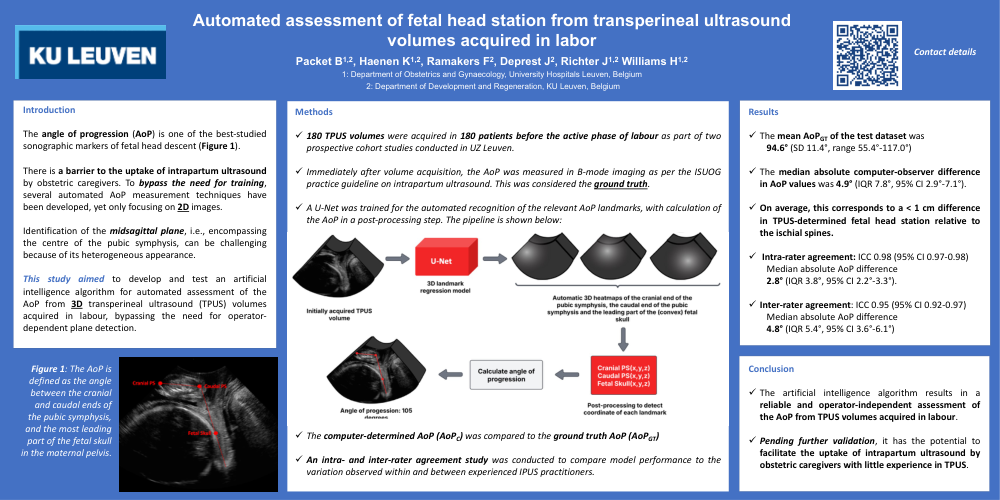
U-Net was trained for the automated recognition of the relevant AoP landmarks, with calculation of the AoP in a post-processing step. The pipeline is shown below.
The median absolute computer-observer difference in AoP values was 4.9° (IQR 7.8°, 95% CI 2.9°-7.1°).
On average, this corresponds to a < 1 cm difference in TPUS-determined fetal head station relative to the ischial spines.
Median absolute AoP difference
2.8° (IQR 3.8°, 95% CI 2.2°-3.3°).
Median absolute AoP difference
4.8° (IQR 5.4°, 95% CI 3.6°-6.1°)
Conclusion
The artificial intelligence algorithm results in a reliable and operator-independent assessment of the AoP from TPUS volumes acquired in labour.