2,281 posters, 63 videos, 56 audios, 43 topics, 18 sessions, 6,174 authors, 2,323 institutions
ePostersLive by SciGen Technologies S.A. All rights reserved.
RCOG World Congress 2025
June 23 - 25, 2025 | ExCeL London, UK
PP.0009
Is interpretable machine learning for preeclampsia prediction better than the standard approach?
Poster Presenter
Part of Topic
AI & digital health
Is Interpretable Machine Learning for Preeclampsia Prediction Better Than the Standard Approach?
Introduction:
Accurate assessment of preeclampsia (PE) risk early in pregnancy has the potential for preventive interventions.
Objectives:
To develop and externally validate an interpretable machine learning (ML) model for prediction of preterm PE (PE with birth at < 37 weeks’ gestation).
To compare the performance of the interpretable ML model with the rules-based approach recommended by the US Preventive Services Task Force (USPSTF).
Methods:
Retrospective study of 158,406 singleton and twin births (20-43 weeks’ gestation) at 20 US hospitals (Jan 2016 –
Dec 2021).
Dec 2021).
111,694 births at 12 hospitals were used as training data, and 46,712 births at 8 different hospitals were used for external validation.
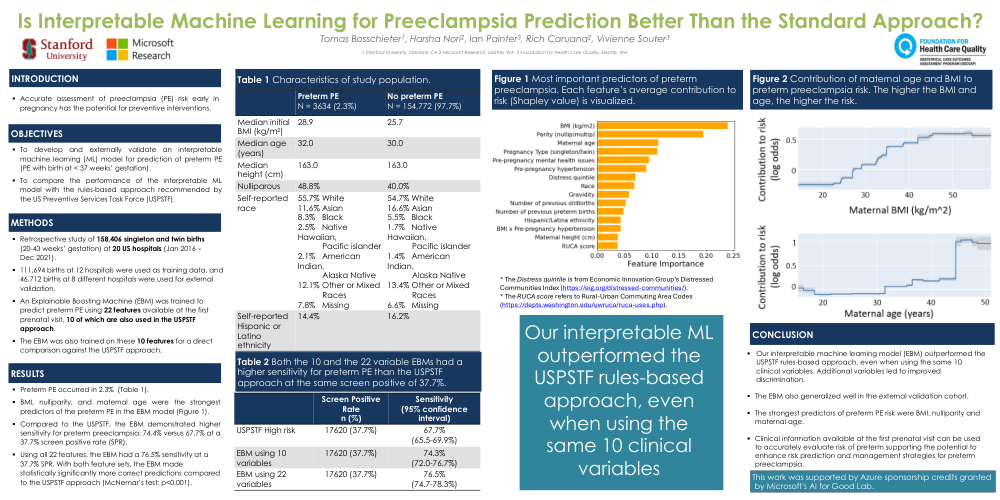
An Explainable Boosting Machine (EBM) was trained to predict preterm PE using 22 features available at the first prenatal visit, 10 of which are also used in the USPSTF approach.
The EBM was also trained on these 10 features for a direct comparison against the USPSTF approach.
Results:
Preterm PE occurred in 2.3% (Table 1).
BMI, nulliparity, and maternal age were the strongest predictors of the preterm PE in the EBM model.
Compared to the USPSTF, the EBM demonstrated higher sensitivity for preterm preeclampsia: 74.4% versus 67.7% at a 37.7% screen positive rate (SPR).
Using all 22 features, the EBM had a 76.5% sensitivity at a 37.7% SPR. With both feature sets, the EBM made statistically significantly more correct predictions compared to the USPSTF approach (McNemar’s test: p<0.001).
Conclusions:
Our interpretable machine learning model (EBM) outperformed the USPSTF rules-based approach, even when using the same 10 clinical variables. Additional variables led to improved discrimination.
The EBM also generalized well in the external validation cohort.
The strongest predictors of preterm PE risk were BMI, nulliparity and maternal age.
Clinical information available at the first prenatal visit can be used to accurately evaluate risk of preterm supporting the potential to enhance risk prediction and management strategies for preterm preeclampsia.