2,281 posters, 63 videos, 56 audios, 43 topics, 18 sessions, 6,174 authors, 2,323 institutions
ePostersLive by SciGen Technologies S.A. All rights reserved.
RCOG World Congress 2025
June 23 - 25, 2025 | ExCeL London, UK
PP.0008
Can Machine Learning Models Outperform the Hadlock Formula in Predicting Fetal Weight?
Part of Topic
AI & digital health
Can Machine Learning Outperform the Hadlock Formula in Predicting Fetal Weight?
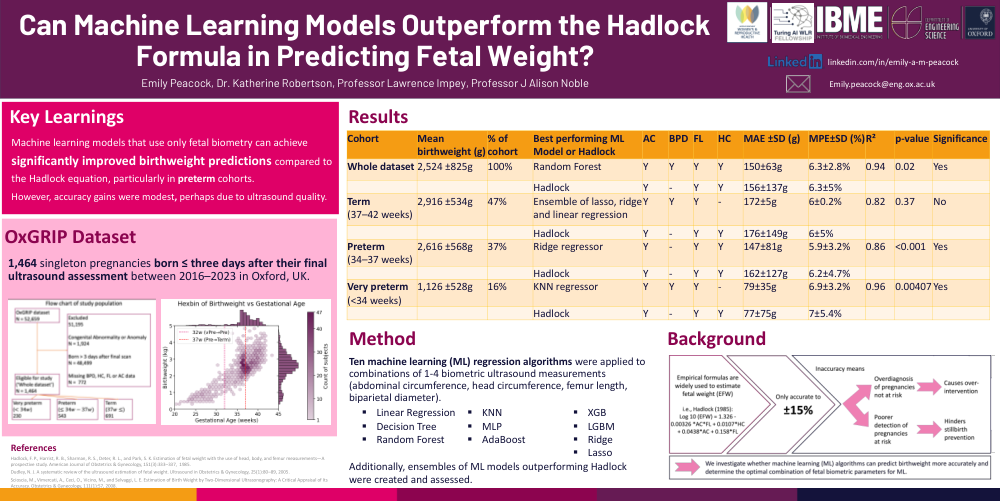
Objective: Empirical formulas, including the three-parameter Hadlock equation, are widely used but only accurate to ±15%. Inaccuracy means poorer detection of pregnancies at risk and overdiagnosis of those not, hindering stillbirth prevention and causing over-intervention. We investigate whether machine learning (ML) algorithms can predict birthweight more accurately and determine the optimal combination of fetal biometric parameters for ML.
Design: Retrospective analysis of 1,464 singleton pregnancies without congenital abnormalities who gave birth ≤ three days after their final ultrasound assessment between 2016–2023 in Oxford, UK.
Method: Ten ML algorithms were applied to combinations of 1-4 biometric ultrasound measurements (abdominal circumference, head circumference, femur length, biparietal diameter). Models were internally validated using 5-fold cross-validation and evaluated by mean absolute error (MAE± standard deviation, grams), mean percentage error (MPE±SD, %) and R². Confidence intervals for MAE and statistical significance (t-tests, p-value<0.05) were calculated. Additionally, ensembles of ML models outperforming Hadlock were created and assessed. Analyses included the whole dataset, very preterm (<34 weeks), preterm (34–37 weeks) and term (>37 weeks) births.
Results: Mean birthweight was 2,523.98±825.01g. There were 15.73% very preterm, 37.41% preterm and 47.13% term-born babies with mean birthweights of 1,126.13±528.09g, 2,616.36±567.94g and 2,916.07±534.21g respectively.
Whole dataset: Random Forest with four biometric measurements was the best performing significant ML model (MAE 150.12±63.16g; 95%CI 2.33-516.65g; MPE 6.30±2.76%; R² 0.94; p-value 0.02, Hadlock: MAE 155.79±136.54g; MPE 6.28±5.01%).
Term: The ensemble of lasso, ridge and linear regression with BPD, FL and AC achieved insignificantly better results than Hadlock (MAE 171.85±5.27g; 95%CI 167.23-176.47g; MPE 5.97±0.17%; R² 0.82; p-value 0.37; Hadlock: MAE 176.45±149.20g; MPE 6.09±5.10%).
Preterm: Ridge regressor using HC, FL and AC was the best model that significantly outperformed Hadlock (MAE 146.99±81.03g; 95%CI 10.22-452.96g; MPE 5.91±3.20%; R² 0.86; p-value<0.001; Hadlock: MAE 161.79±127.20g; MPE 6.22±4.68%). The ensemble model did not achieve lower MAE or MPE but improved CIs compared to independent ML models (Ensemble: MAE 163.54±13.49g; CI 151.71-175.36g; MPE 6.33±0.49%; R² 0.86; p-value 0.07).
Very Preterm: The KNN regressor with BPD, FL and AC significantly outperformed Hadlock (MAE 79.30±34.52g; CI 4.21-301.93g; MPE 6.92±3.17%; R² 0.96; p-value 0.00407; Hadlock: MAE 77.40±74.98g; MPE 6.96±5.40%).
Conclusion: ML models that use only fetal biometry can achieve significantly improved birthweight predictions compared to the Hadlock equation, particularly in preterm cohorts. However, accuracy gains were modest, perhaps due to ultrasound quality.