2,281 posters, 63 videos, 56 audios, 43 topics, 18 sessions, 6,174 authors, 2,323 institutions
ePostersLive by SciGen Technologies S.A. All rights reserved.
RCOG World Congress 2025
June 23 - 25, 2025 | ExCeL London, UK
PP.0005
Vaping significantly alters hormonal profiles: data from 39,110 women
Poster Presenter
Authors
Affiliations
Part of Topic
Hot topics (emerging research/issues) in gynaecology
Vaping significantly alters hormonal profiles: data from 39,110 women
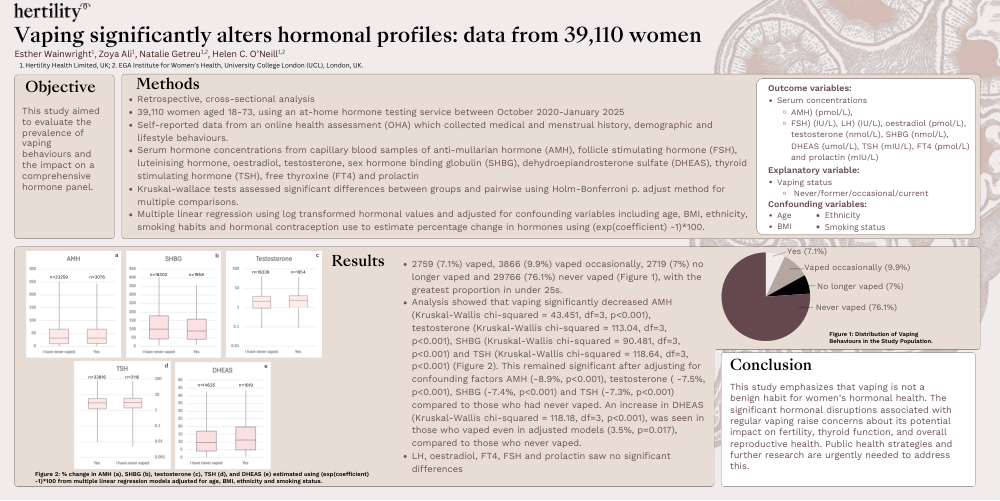
Objective: This study aimed to evaluate the prevalence of vaping behaviours and the impact on a comprehensive hormone panel.
Methods:
- Retrospective, cross-sectional analysis
- 39,110 women aged 18-73, using an at-home hormone testing service between October 2020-January 2025
- Self-reported data from an online health assessment (OHA) which collected medical and menstrual history, demographic and lifestyle behaviours.
- Serum hormone concentrations from capillary blood samples of anti-mullarian hormone (AMH), follicle stimulating hormone (FSH), luteinising hormone, oestradiol, testosterone, sex hormone binding globulin (SHBG), dehydroepiandrosterone sulfate (DHEAS), thyroid stimulating hormone (TSH), free thyroxine (FT4) and prolactin
- Kruskal-wallace tests assessed significant differences between groups and pairwise using Holm-Bonferroni p. adjust method for multiple comparisons.
- Multiple linear regression using log transformed hormonal values and adjusted for confounding variables including age, BMI, ethnicity, smoking habits and hormonal contraception use to estimate percentage change in hormones using (exp(coefficient) -1)*100.
Results:
- 2759 (7.1%) vaped, 3866 (9.9%) vaped occasionally, 2719 (7%) no longer vaped and 29766 (76.1%) never vaped (Figure 1), with the greatest proportion in under 25s.
- Analysis showed that vaping significantly decreased AMH (Kruskal-Wallis chi-squared = 43.451, df=3, p<0.001), testosterone (Kruskal-Wallis chi-squared = 113.04, df=3, p<0.001), SHBG (Kruskal-Wallis chi-squared = 90.481, df=3, p<0.001) and TSH (Kruskal-Wallis chi-squared = 118.64, df=3, p<0.001) (Figure 2). This remained significant after adjusting for confounding factors AMH (-8.9%, p<0.001), testosterone ( -7.5%, p<0.001), SHBG (-7.4%, p<0.001) and TSH (-7.3%, p<0.001) compared to those who had never vaped. An increase in DHEAS (Kruskal-Wallis chi-squared = 118.18, df=3, p<0.001), was seen in those who vaped even in adjusted models (3.5%, p=0.017), compared to those who never vaped.
- LH, oestradiol, FT4, FSH and prolactin saw no significant differences
Conclusions:
This study emphasizes that vaping is not a benign habit for women’s hormonal health. The significant hormonal disruptions associated with regular vaping raise concerns about its potential impact on fertility, thyroid function, and overall reproductive health. Public health strategies and further research are urgently needed to address this.