2,281 posters, 63 videos, 56 audios, 43 topics, 18 sessions, 6,174 authors, 2,323 institutions
ePostersLive by SciGen Technologies S.A. All rights reserved.
RCOG World Congress 2025
June 23 - 25, 2025 | ExCeL London, UK
EP.2276
Exploring and incorporating LGBTQ+ people’s needs in the sexual education curriculum
Poster Presenter
Part of Topic
LGBTQ+
Exploring and incorporating LGBTQ+ people’s needs in the sexual education curriculum
Kokkinou Aikaterina, Antonakou Angeliki
Department of Midwifery, School of Health Sciences, International Hellenic University, Thessaloniki, Greece
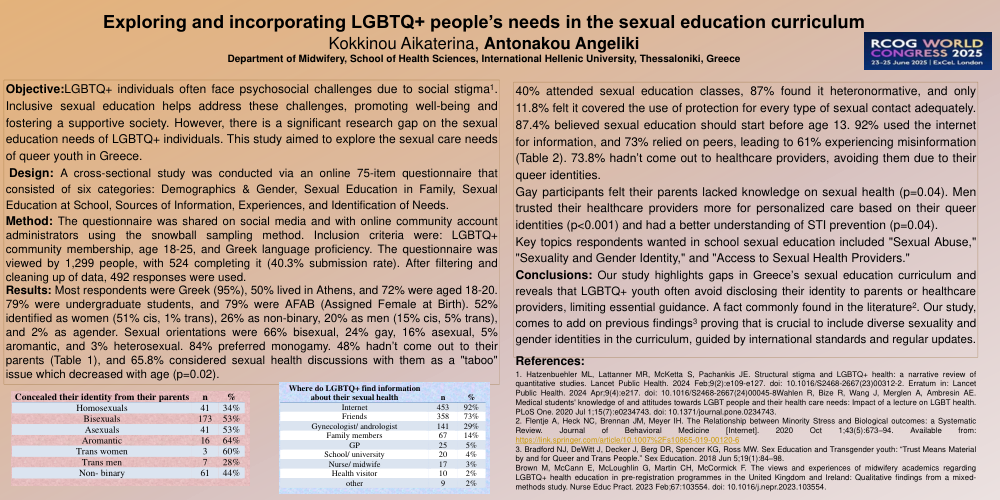
Objective:LGBTQ+ individuals often face psychosocial challenges due to social stigma1. Inclusive sexual education helps address these challenges, promoting well-being and fostering a supportive society. However, there is a significant research gap on the sexual education needs of LGBTQ+ individuals. This study aimed to explore the sexual care needs of queer youth in Greece.
Design: A cross-sectional study was conducted via an online 75-item questionnaire that consisted of six categories: Demographics & Gender, Sexual Education in Family, Sexual Education at School, Sources of Information, Experiences, and Identification of Needs.
Method: The questionnaire was shared on social media and with online community account administrators using the snowball sampling method. Inclusion criteria were: LGBTQ+ community membership, age 18-25, and Greek language proficiency. The questionnaire was viewed by 1,299 people, with 524 completing it (40.3% submission rate). After filtering and cleaning up of data, 492 responses were used.
Results: Most respondents were Greek (95%), 50% lived in Athens, and 72% were aged 18-20. 79% were undergraduate students, and 79% were AFAB (Assigned Female at Birth). 52% identified as women (51% cis, 1% trans), 26% as non-binary, 20% as men (15% cis, 5% trans), and 2% as agender. Sexual orientations were 66% bisexual, 24% gay, 16% asexual, 5% aromantic, and 3% heterosexual. 84% preferred monogamy. 48% hadn’t come out to their parents (Table 1), and 65.8% considered sexual health discussions with them as a "taboo" issue which decreased with age (p=0.02). 40% attended sexual education classes, 87% found it heteronormative, and only 11.8% felt it covered the use of protection for every type of sexual contact adequately. 87.4% believed sexual education should start before age 13. 92% used the internet for information, and 73% relied on peers, leading to 61% experiencing misinformation (Table 2). 73.8% hadn’t come out to healthcare providers, avoiding them due to their queer identities.
Gay participants felt their parents lacked knowledge on sexual health (p=0.04). Men trusted their healthcare providers more for personalized care based on their queer identities (p<0.001) and had a better understanding of STI prevention (p=0.04).
Key topics respondents wanted in school sexual education included "Sexual Abuse," "Sexuality and Gender Identity," and "Access to Sexual Health Providers."
Conclusions: Our study highlights gaps in Greece’s sexual education curriculum and reveals that LGBTQ+ youth often avoid disclosing their identity to parents or healthcare providers, limiting essential guidance. A fact commonly found in the literature2. Our study, comes to add on previous findings3 proving that is crucial to include diverse sexuality and gender identities in the curriculum, guided by international standards and regular updates.
References:
1. Hatzenbuehler ML, Lattanner MR, McKetta S, Pachankis JE. Structural stigma and LGBTQ+ health: a narrative review of quantitative studies. Lancet Public Health. 2024 Feb;9(2):e109-e127. doi: 10.1016/S2468-2667(23)00312-2. Erratum in: Lancet Public Health. 2024 Apr;9(4):e217. doi: 10.1016/S2468-2667(24)00045-8Wahlen R, Bize R, Wang J, Merglen A, Ambresin AE. Medical students' knowledge of and attitudes towards LGBT people and their health care needs: Impact of a lecture on LGBT health. PLoS One. 2020 Jul 1;15(7):e0234743. doi: 10.1371/journal.pone.0234743.
2. Flentje A, Heck NC, Brennan JM, Meyer IH. The Relationship between Minority Stress and Biological outcomes: a Systematic Review. Journal of Behavioral Medicine [Internet]. 2020 Oct 1;43(5):673–94. Available from: https://link.springer.com/article/10.1007%2Fs10865-019-00120-6
3. Bradford NJ, DeWitt J, Decker J, Berg DR, Spencer KG, Ross MW. Sex Education and Transgender youth: “Trust Means Material by and for Queer and Trans People.” Sex Education. 2018 Jun 5;19(1):84–98.
Brown M, McCann E, McLoughlin G, Martin CH, McCormick F. The views and experiences of midwifery academics regarding LGBTQ+ health education in pre-registration programmes in the United Kingdom and Ireland: Qualitative findings from a mixed-methods study. Nurse Educ Pract. 2023 Feb;67:103554. doi: 10.1016/j.nepr.2023.103554.