2,281 posters, 63 videos, 56 audios, 43 topics, 18 sessions, 6,174 authors, 2,323 institutions
ePostersLive by SciGen Technologies S.A. All rights reserved.
RCOG World Congress 2025
June 23 - 25, 2025 | ExCeL London, UK
EP.2274
A method to improve midwives’ knowledge & attitudes on LGTBQ+ health-rights;ATHENA study
Part of Topic
LGBTQ+
A method to improve midwives’ knowledge and attitudes on LGTBQ+health-rights; ATHENA study
Angeliki Antonakou, Vikentia Harizopoulou, Eleni Theodoridou, Kalliope Gkougkousidou
Department of Midwifery, School of Health Sciences, International Hellenic University, Thessaloniki, Greece
Contributions to ATHENA study: Principal Investigator (PI): AA, Research team members VH, ET, KG. Funding Information: This study is part of the ATHENA project, a research initiative supported by the Hellenic Foundation for Research and Innovation (H.F.R.I.) under the "Basic Research Financing” call, which is part of the National Recovery and Resilience Plan “Greece 2.0,” funded by the European Union NextGenerationEU.
Objective: LGBTQ+ individuals face worse health outcomes and significant disparities in healthcare, particularly in sexual and reproductive care1. As awareness of reproductive equality grows, so does the demand for inclusive midwifery care. The ‘ATHENA study’ seeks to promote inclusive societies by addressing knowledge gaps among healthcare professionals in Greece. This project is the first to assess the impact of a structured educational intervention on Greek midwives' understanding and attitudes toward LGBTQ+ health rights.
Design: Our study involves an initial assessment of midwives' knowledge, skills and attitudes, followed by the educational intervention that comprised of a 3-hour small-group training session with a lecture, case-based discussions, and group conversation on gender equality, reproductive rights, and perinatal care for LGBTQ+ individuals. A final assessment was carried out at the workshop's completion to evaluate changes in knowledge and skills.
Method: From July to November 2024, participation invitations were extended to midwives via the nine professional bodies of Greek midwives and the study’s official webpage https://www.athenastudy.gr/. n=87 volunteer midwives attended training sessions held across three venues in November & December 2024. Post-intervention, 70 participants completed the follow-up surveys (response rate= 80.5%). We utilized a validated version of Rowe’s (2017) questionnaire2, adapted for the Greek context, alongside an ad hoc knowledge assessment tool specifically developed to evaluate participants' understanding of the health needs of LGBTQ+ individuals in Greece.
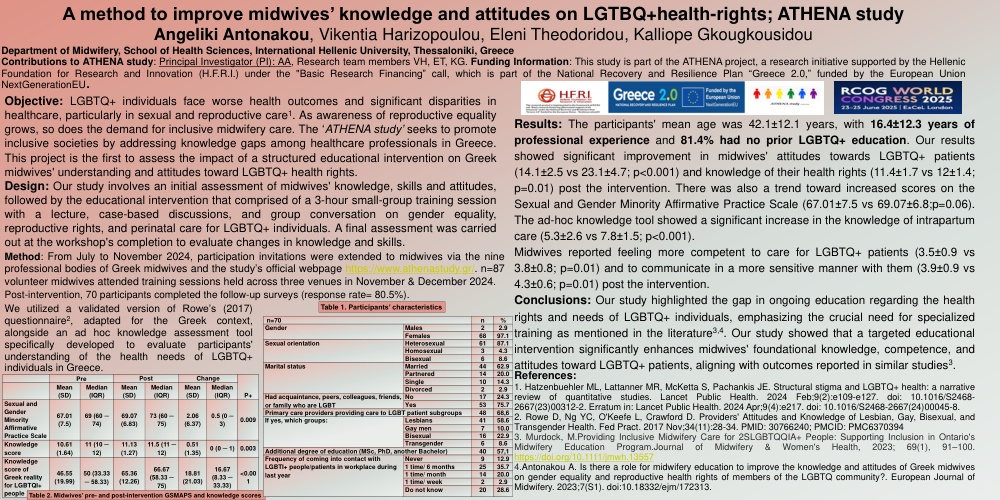
Results: The participants' mean age was 42.1±12.1 years, with 16.4±12.3 years of professional experience and 81.4% had no prior LGBTQ+ education. Our results showed significant improvement in midwives' attitudes towards LGBTQ+ patients (14.1±2.5 vs 23.1±4.7; p<0.001) and knowledge of their health rights (11.4±1.7 vs 12±1.4; p=0.01) post the intervention. There was also a trend toward increased scores on the Sexual and Gender Minority Affirmative Practice Scale (67.01±7.5 vs 69.07±6.8;p=0.06). The ad-hoc knowledge tool showed a significant increase in the knowledge of intrapartum care (5.3±2.6 vs 7.8±1.5; p<0.001).
Midwives reported feeling more competent to care for LGBTQ+ patients (3.5±0.9 vs 3.8±0.8; p=0.01) and to communicate in a more sensitive manner with them (3.9±0.9 vs 4.3±0.6; p=0.01) post the intervention.
Conclusions: Our study highlighted the gap in ongoing education regarding the health rights and needs of LGBTQ+ individuals, emphasizing the crucial need for specialized training as mentioned in the literature3,4. Our study showed that a targeted educational intervention significantly enhances midwives' foundational knowledge, competence, and attitudes toward LGBTQ+ patients, aligning with outcomes reported in similar studies3.
References:
1. Hatzenbuehler ML, Lattanner MR, McKetta S, Pachankis JE. Structural stigma and LGBTQ+ health: a narrative review of quantitative studies. Lancet Public Health. 2024 Feb;9(2):e109-e127. doi: 10.1016/S2468-2667(23)00312-2. Erratum in: Lancet Public Health. 2024 Apr;9(4):e217. doi: 10.1016/S2468-2667(24)00045-8. PMID: 38307678.
2. Rowe D, Ng YC, O'Keefe L, Crawford D. Providers' Attitudes and Knowledge of Lesbian, Gay, Bisexual, and Transgender Health. Fed Pract. 2017 Nov;34(11):28-34. PMID: 30766240; PMCID: PMC6370394
3. Murdock, M. (2023).Providing Inclusive Midwifery Care for 2SLGBTQQIA+ People: Supporting Inclusion in Ontario's Midwifery Education Program.Journal of Midwifery & Women's Health, 69(1), 91–100. https://doi.org/10.1111/jmwh.13557
4.Antonakou A. Is there a role for midwifery education to improve the knowledge and attitudes of Greek midwives on gender equality and reproductive health rights of members of the LGBTQ community?. European Journal of Midwifery. 2023;7(S1). doi:10.18332/ejm/172313.