2,281 posters, 63 videos, 56 audios, 43 topics, 18 sessions, 6,174 authors, 2,323 institutions
ePostersLive by SciGen Technologies S.A. All rights reserved.
RCOG World Congress 2025
June 23 - 25, 2025 | ExCeL London, UK
EP.2074
Lost retrieval-bag in robotic surgery: distancing surgeons from procedures impacts patient safety
Poster Presenter
Authors
Affiliations
Part of Topic
Robotic surgery
Lost retrieval-bag in robotic surgery:
distancing surgeons from procedures impacts patient safety
Authors: 1. Naomi Griffiths ST7 Gynaecology, University Hospital Crosshouse 2. Francis Inyang Consultant Gynaecologist, University Hospital Crosshouse
Objective:
Robotic surgery offers many advantages to both patients and surgeons and is becoming increasingly available. There is, however, emerging evidence of the adverse impact on human factors and potential patient safety issues during robotic procedures (1,2). This case highlights some potential challenges and suggests protocols and training which could prevent future adverse incidents.
Case Report:
A 49-year-old patient with a 9cm septate cyst located centrally within the pelvis underwent planned robotically assisted unilateral oophorectomy.
Background of previous abdominal hysterectomy through transverse incision. Ultrasound examination had been performed for pelvic pain and abdominal bloating. BMI 32. Ca-125 of 7.
Surgical findings included extensive omental adhesions obscuring the pelvis, left ovary containing cyst buried and adherent to left pelvic sidewall. Normal right ovary, upper abdominal viscera and no free fluid.
Adhesiolysis and Oopherectomy were performed using Da Vinci Xi platform with 3 Robotic Arms and an auxiliary port in the left-upper-quadrant (LUQ).
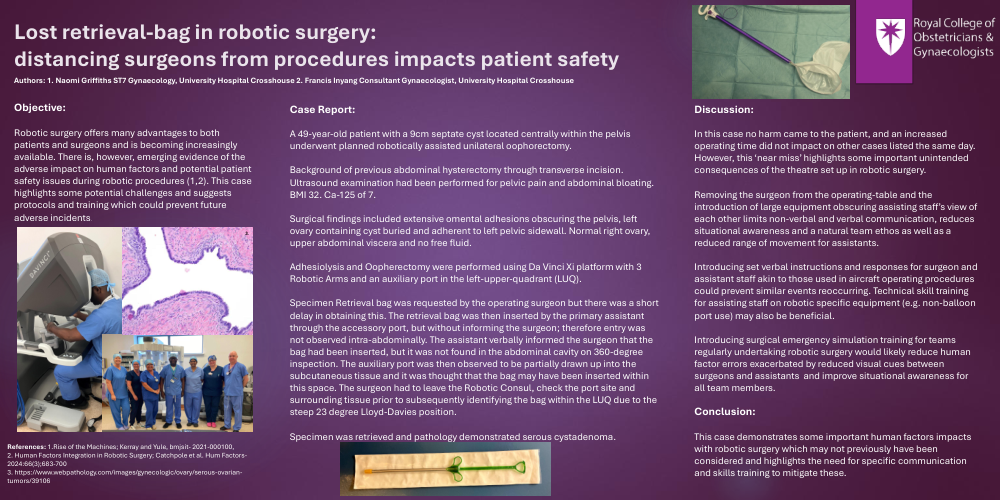
Specimen Retrieval bag was requested by the operating surgeon but there was a short delay in obtaining this. The retrieval bag was then inserted by the primary assistant through the accessory port, but without informing the surgeon; therefore entry was not observed intra-abdominally. The assistant verbally informed the surgeon that the bag had been inserted, but it was not found in the abdominal cavity on 360-degree inspection. The auxiliary port was then observed to be partially drawn up into the subcutaneous tissue and it was thought that the bag may have been inserted within this space. The surgeon had to leave the Robotic Consul, check the port site and surrounding tissue prior to subsequently identifying the bag within the LUQ due to the steep 23 degree Lloyd-Davies position.
Specimen was retrieved and pathology demonstrated serous cystadenoma.
Discussion:
In this case no harm came to the patient, and an increased operating time did not impact on other cases listed the same day. However, this ‘near miss’ highlights some important unintended consequences of the theatre set up in robotic surgery.
Removing the surgeon from the operating-table and the introduction of large equipment obscuring assisting staff’s view of each other limits non-verbal and verbal communication, reduces situational awareness and a natural team ethos as well as a reduced range of movement for assistants.
Introducing set verbal instructions and responses for surgeon and assistant staff akin to those used in aircraft operating procedures could prevent similar events reoccurring. Technical skill training for assisting staff on robotic specific equipment (e.g. non-balloon port use) may also be beneficial.
Introducing surgical emergency simulation training for teams regularly undertaking robotic surgery would likely reduce human factor errors exacerbated by reduced visual cues between surgeons and assistants and improve situational awareness for all team members.
Conclusion:
This case demonstrates some important human factors impacts with robotic surgery which may not previously have been considered and highlights the need for specific communication and skills training to mitigate these.
References: 1.Rise of the Machines; Kerray and Yule, bmjsit- 2021-000100,
2. Human Factors Integration in Robotic Surgery; Catchpole et al. Hum Factors-2024:66(3);683-700
3. https://www.webpathology.com/images/gynecologic/ovary/serous-ovarian-tumors/39106