2,281 posters, 63 videos, 56 audios, 43 topics, 18 sessions, 6,174 authors, 2,323 institutions
ePostersLive by SciGen Technologies S.A. All rights reserved.
RCOG World Congress 2025
June 23 - 25, 2025 | ExCeL London, UK
EP.1503
The Effects of Prenatal Polysubstance Exposure on Neurodevelopmental and Mental Health Outcomes
Poster Presenter
Authors
Affiliations
Part of Topic
Lifestyle medicine in women's health
The Effects of Prenatal Polysubstance Exposure on Neurodevelopmental and Mental Health Outcomes
Introduction
•The impacts of prenatal alcohol exposure (PAE) have been increasingly recognized as important determinants of lifelong physical and mental health.
•Individuals are diagnosed with Fetal Alcohol Spectrum Disorder when they have been exposed to alcohol during pregnancy and have significant impairment in 3 or more brain domains; FASD is a lifelong disability.
•Nearly 40% of women who report alcohol consumption during pregnancy use other substances.
•Prenatal exposure to substances impacts physical and mental health outcomes and, although common, little is understood about their combined effects.
•Data continue to emerge about the importance of harm reduction approaches/supports for women to optimize outcomes in the complicated context of substance use during pregnancy and the long-term effects on neurodevelopment.
The objective of this study was to determine the effect of PAE with or without cannabis or nicotine on neurodevelopment and mental health
Methods
•This was a retrospective cross-sectional study using secondary analysis of data from Canada’s National Database on PAE (N=2,620), a pan-Canadian neurodevelopmental clinical dataset of individuals with prenatal substance exposures.
•Prenatal exposure data was collected for alcohol, nicotine, cannabis, opiates, methamphetamines, cocaine, prescriptions, and “other” drugs.
•Descriptive statistics were used to characterize demographics and rates of prenatal substance exposure.
•Polysubstance exposure was coded dichotomously. Pearson chi-squared tests, ANOVA, and independent samples t-tests were used to analyze differences between those with and without exposure to nicotine and/or cannabis in addition to alcohol.
KEY FINDINGS
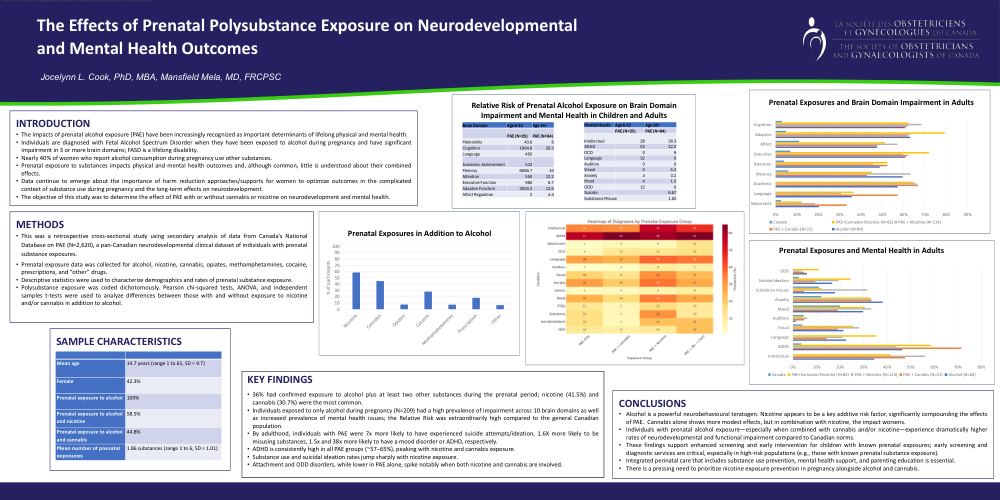
•36% had confirmed exposure to alcohol plus at least two other substances during the prenatal period; nicotine (41.5%) and cannabis (30.7%) were the most common.
•Individuals exposed to only alcohol during pregnancy (N=209) had a high prevalence of impairment across 10 brain domains as well as increased prevalence of mental health issues; the Relative Risk was extraordinarily high compared to the general Canadian population.
•By adulthood, individuals with PAE were 7x more likely to have experienced suicide attempts/ideation, 1.6X more likely to be misusing substances, 1.5x and 38x more likely to have a mood disorder or ADHD, respectively.
•ADHD is consistently high in all PAE groups (~57–65%), peaking with nicotine and cannabis exposure.
•Substance use and suicidal ideation rates jump sharply with nicotine exposure.
•Attachment and ODD disorders, while lower in PAE alone, spike notably when both nicotine and cannabis are involved.
Conclusions
•Alcohol is a powerful neurobehavioural teratogen. Nicotine appears to be a key additive risk factor, significantly compounding the effects of PAE. Cannabis alone shows more modest effects, but in combination with nicotine, the impact worsens.
•Individuals with prenatal alcohol exposure—especially when combined with cannabis and/or nicotine—experience dramatically higher rates of neurodevelopmental and functional impairment compared to Canadian norms.
•These findings support enhanced screening and early intervention for children with known prenatal exposures; early screening and diagnostic services are critical, especially in high-risk populations (e.g., those with known prenatal substance exposure).
•Integrated perinatal care that includes substance use prevention, mental health support, and parenting education is essential.
•There is a pressing need to prioritize nicotine exposure prevention in pregnancy alongside alcohol and cannabis.