2,281 posters, 63 videos, 56 audios, 43 topics, 18 sessions, 6,174 authors, 2,323 institutions
ePostersLive by SciGen Technologies S.A. All rights reserved.
RCOG World Congress 2025
June 23 - 25, 2025 | ExCeL London, UK
EP.1335
Reconstruction of Areolar-Nipple Complex Following Dog Bite: A Case Report
Poster Presenter
Part of Topic
Innovation in obstetrics and gynaecology
Reconstruction of Areolar-Nipple Complex Following Dog Bite: A Case Report
Hana Smida, Hadhami Rouiss, Hichem ElAifi, Nesrine Souayah, Amira Lika(*), Ines Trabelsi(*), Chaouki Mbarki, Hajer Bettaieb
University of Tunis el Manar, Faculty of medicine, Gynecology and Obstetrics department, Ben Arous Regional Hospital, Tunis, Tunisia
(*)University of Tunis el Manar, Faculty of medicine, Department of anesthesiology and reanimation,, Ben Arous Regional Hospital, Tunis, Tunisia
Introduction
Dog bites are a worldwide problem. They often occur in the pediatric population or in adult males(1). This bite can have adverse outcomes , mainly infectious complications, amputations and psychological effects. Body image is a very important psychological component to women, as shown by the frequency of body image disorders after breast surgery(2). In this clinical paper, we report a particular case of a dog bite with amputation of the nipple of an adult female.
Objective
We report a case of areolar-nipple complex (ANC) amputation caused by a dog bite to the left breast, treated surgically with total skin graft reconstruction of the ANC.
Case Report
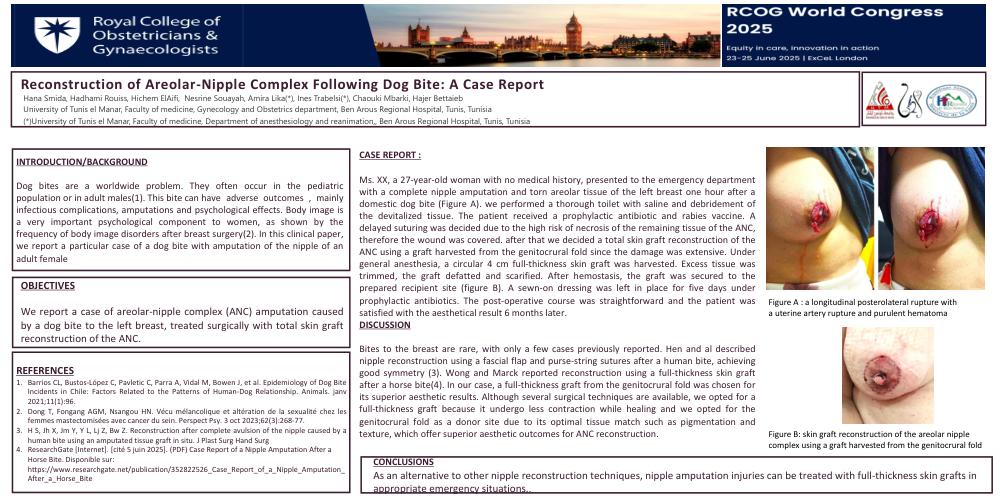
Ms. XX, a 27-year-old woman with no medical history, presented to the emergency department with a complete nipple amputation and torn areolar tissue of the left breast one hour after a domestic dog bite (Figure A). we performed a thorough toilet with saline and debridement of the devitalized tissue. The patient received a prophylacticantibiotic and rabies vaccine. A delayed suturing was decided due to the high risk of necrosis of the remaining tissue of the ANC, therefore the wound was covered. after that we decided a total skin graft reconstruction of the ANC using a graft harvested from the genitocrural fold since the damage was extensive. Under general anesthesia, a circular 4 cm full-thickness skin graft was harvested. Excess tissue was trimmed, the graft defatted and scarified. After hemostasis, the graft was secured to the prepared recipient site (figure B). A sewn-on dressing was left in place for five days under prophylactic antibiotics. The post-operative course was straightforward and the patient was satisfied with the aesthetical result 6 months later.
Discussion
Bites to the breast are rare, with only a few cases previously reported. Hen and al described nipple reconstruction using a fascial flap and purse-string sutures after a human bite, achieving good symmetry (3). Wong and Marck reported reconstruction using a full-thickness skin graft after a horse bite(4). In our case, a full-thickness graft from the genitocrural fold was chosen for its superior aesthetic results. Although several surgical techniques are available, we opted for a full-thickness graft because it undergo less contraction while healing and we opted for the genitocrural fold as a donor site due to its optimal tissue match such as pigmentation and texture, which offer superior aesthetic outcomes for ANC reconstruction.
Conclusion
As an alternative to other nipple reconstruction techniques, nipple amputation injuries can be treated with full-thickness skin grafts in appropriate emergency situations.
References:
1. Barrios CL, Bustos-López C, Pavletic C, Parra A, Vidal M, Bowen J, et al. Epidemiology of Dog Bite Incidents in Chile: Factors Related to the Patterns of Human-Dog Relationship. Animals. janv 2021;11(1):96.
2. Dong T, Fongang AGM, Nsangou HN. Vécu mélancolique et altération de la sexualité chez les femmes mastectomisées avec cancer du sein. Perspect Psy. 3 oct 2023;62(3):268‑77.
3. H S, Jh X, Jm Y, Y L, Lj Z, Bw Z. Reconstruction after complete avulsion of the nipple caused by a human bite using an amputated tissue graft in situ. J Plast Surg Hand Surg [Internet]. déc 2013 [cité 5 juin 2025];47(6). Disponible sur: https://pubmed.ncbi.nlm.nih.gov/23692064/
4. ResearchGate [Internet]. [cité 5 juin 2025]. (PDF) Case Report of a Nipple Amputation After a Horse Bite. Disponible sur: https://www.researchgate.net/publication/352822526_Case_Report_of_a_Nipple_Amputation_After_a_Horse_Bite