2,281 posters, 63 videos, 56 audios, 43 topics, 18 sessions, 6,174 authors, 2,323 institutions
ePostersLive by SciGen Technologies S.A. All rights reserved.
RCOG World Congress 2025
June 23 - 25, 2025 | ExCeL London, UK
EP.1332
ESTABLISHING SIGNAL LOSS THRESHOLDS IN NON-INVASIVE FETAL ECG ACQUIRED HEART RATE RECORDINGS
Poster Presenter
Part of Topic
Innovation in obstetrics and gynaecology
Audio
ESTABLISHING SIGNAL LOSS THRESHOLDS IN NON-INVASIVE FETAL ECG ACQUIRED HEART RATE RECORDINGS
Claire Pegorie1, ChuyenLuong2, Amrish Nair2, BaskyThilaganathan1,3, Amar Bhide1,3
1Fetal Medicine Unit, St George’s University Hospitals NHS Foundation Trust, London, UK, 2Biorithm Pte, Singapore, 1 1 Mandalay Road #16-01,Singapore 308232, 3Vascular Biology Research Centre, Molecular and Clinical Sciences Research Institute, St George’s University of London, London, UK
Disclosure Statement: CP is studying an MD(Res) which is funded by BiorithmPte. CL is Signal Processing Engineer at BiorithmPte. AN is the CEO of BiorithmPte. BT is Medical Director of BiorithmPte. AB holds a research grant from BiorithmPte.
Background:
Fetal Heart rate (FHR) monitoring is the cornerstone of antenatal fetal care. Remote fetal monitoring is possible using non-invasive fetal ECG (NIFECG) Such devices, like Femom®enable more frequent and comfortable monitoring in high and low risk pregnancies.
Commonly accepted threshold for signal loss in FHR monitoring is arbitrarily set at 50% of the entire monitoring session. However, NIFECG recordings are prone to discontinuous signal, and some traces are deemed unacceptable despite long periods of good signal.
Rigid arbitrary criteria based solely on total signal loss may unnecessarily exclude valuable data.
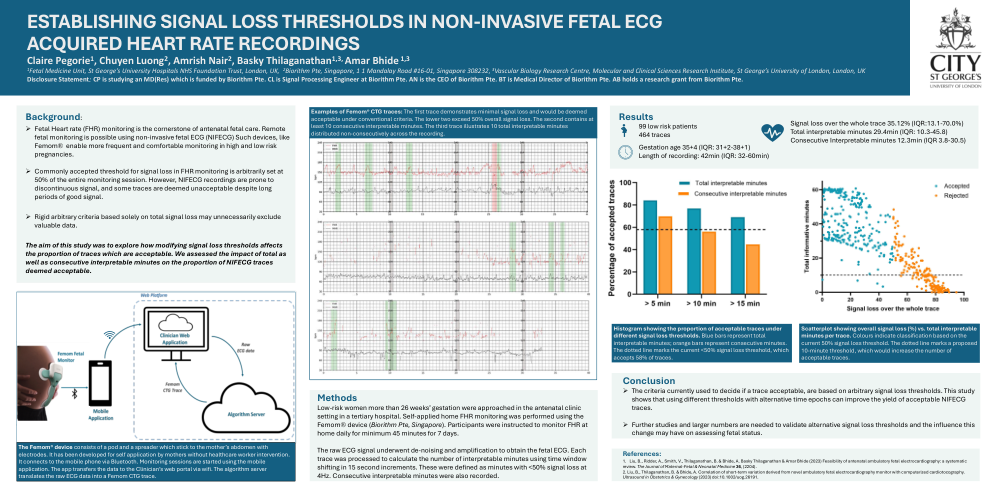
The aim of this study was to explore how modifying signal loss thresholds affects the proportion of traces which are acceptable. We assessed the impact of total as well as consecutive interpretable minutes on the proportion of NIFECG traces deemed acceptable.
Methods
Low-risk women more than 26 weeks' gestation were approached in the antenatal clinic setting in a tertiary hospital. Self-applied home FHR monitoring was performed using the Femom device (Biorithm Pte, Singapore). Participants were instructed to monitor FHR at home daily for minimum 45 minutes for 7 days.
The raw ECG signal underwent de-noising and amplification to obtain the fetal ECG. Each trace was processed to calculate the number of interpretable minutes using time window shifting in 15 second increments. These were defined as
Results
99 low risk patients
464 traces
Gestation age 35+4 (IQR: 31+2-38+1)
Length of recording: 42min (IQR: 32-60min)
Signal loss over the whole trace 35.12% (IQR:13.1-70.0%)
Total interpretable minutes 29.4min (IQR: 10.3-45.8)
Consecutive Interpretable minutes 12.3min (IQR 3.8-30.5)
minutes with <50% signal loss at 4Hz. Consecutive interpretable minutes were also recorded.
Conclusion
The criteria currently used to decide if a trace acceptable, are based on arbitrary signal loss thresholds. This study shows that using different thresholds with alternative time epochs can improve the yield of acceptable NIFECG traces.
Further studies and larger numbers are needed to validate alternative signal loss thresholds and the influence this change may have on assessing fetal status.