2,281 posters, 63 videos, 56 audios, 43 topics, 18 sessions, 6,174 authors, 2,323 institutions
ePostersLive by SciGen Technologies S.A. All rights reserved.
RCOG World Congress 2025
June 23 - 25, 2025 | ExCeL London, UK
EP.1331
Smart Menstrual Health Monitoring Patch: A non-invasive AI-driven Solution for Cycle tracing
Poster Presenter
Authors
Affiliations
Part of Topic
Innovation in obstetrics and gynaecology
|
Smart Menstrual Health Monitoring Patch: A non-invasive AI-driven Solution for Cycle tracing Tinatin Kutchukidze 1,2 |
|
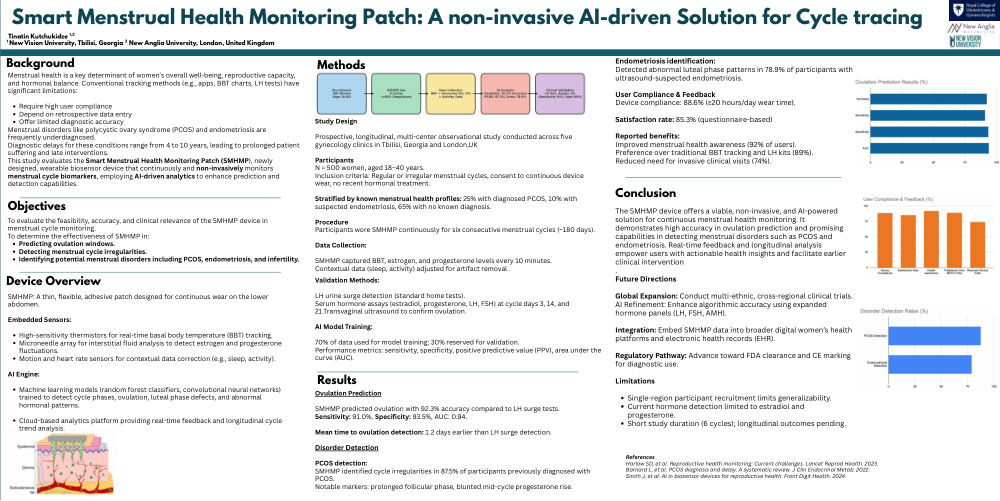
Background Menstrual health is a key determinant of women’s overall well-being, reproductive capacity, and hormonal balance. Conventional tracking methods (e.g., apps, BBT charts, LH tests) have significant limitations: Require high user compliance Depend on retrospective data entry Offer limited diagnostic accuracy Menstrual disorders like polycystic ovary syndrome (PCOS) and endometriosis are frequently underdiagnosed. This study evaluates the Smart Menstrual Health Monitoring Patch (SMHMP), newly designed, wearable biosensor device that continuously and non-invasively monitors menstrual cycle biomarkers, employing AI-driven analytics to enhance prediction and detection capabilities. Objectives To evaluate the feasibility, accuracy, and clinical relevance of the SMHMP device in menstrual cycle monitoring. Predicting ovulation windows. Methods Study Design Prospective, longitudinal, multi-center observational study conducted across five gynecology clinics in Tbilisi, Georgia and London,UK Participants N = 500 women, aged 18–40 years. Stratified by known menstrual health profiles: 25% with diagnosed PCOS, 10% with suspected endometriosis, 65% with no known diagnosis. Procedure Participants wore SMHMP continuously for six consecutive menstrual cycles (~180 days). Data Collection: SMHMP captured BBT, estrogen, and progesterone levels every 10 minutes. Contextual data (sleep, activity) adjusted for artifact removal. Validation Methods: LH urine surge detection (standard home tests). AI Model Training: 70% of data used for model training; 30% reserved for validation. Results Ovulation Prediction SMHMP predicted ovulation with 92.3% accuracy compared to LH surge tests. Sensitivity: 91.0%, Specificity: 93.5%, AUC: 0.94. Mean time to ovulation detection: 1.2 days earlier than LH surge detection. Disorder Detection PCOS detection: SMHMP identified cycle irregularities in 87.5% of participants previously diagnosed with PCOS. Endometriosis identification: Detected abnormal luteal phase patterns in 78.9% of participants with ultrasound-suspected endometriosis. User Compliance & Feedback Device compliance: 88.6% (≥20 hours/day wear time). Satisfaction rate: 85.3% (questionnaire-based) Reported benefits: Improved menstrual health awareness (92% of users). Preference over traditional BBT tracking and LH kits (89%). Reduced need for invasive clinical visits (74%). Conclusion The SMHMP device offers a viable, non-invasive, and AI-powered solution for continuous menstrual health monitoring. It demonstrates high accuracy in ovulation prediction and promising capabilities in detecting menstrual disorders such as PCOS and endometriosis. Real-time feedback and longitudinal analysis empower users with actionable health insights and facilitate earlier clinical intervention .Future Directions AI Refinement: Enhance algorithmic accuracy using expanded hormone panels (LH, FSH, AMH). Integration: Embed SMHMP data into broader digital women’s health platforms and electronic health records (EHR). Regulatory Pathway: Advance toward FDA clearance and CE marking for diagnostic use. Limitations Single-region participant recruitment limits generalizability. Current hormone detection limited to estradiol and progesterone. References Harlow SD, et al. Reproductive health monitoring: Current challenges. Lancet Reprod Health. 2023. Barnard L, et al. PCOS diagnosis and delay: A systematic review. J Clin Endocrinol Metab. 2022. Smith J, et al. AI in biosensor devices for reproductive health. Front Digit Health. 2024. Device Overview SMHMP: A thin, flexible, adhesive patch designed for continuous wear on the lower abdomen. Embedded Sensors: High-sensitivity thermistors for real-time basal body temperature (BBT) tracking. Microneedle array for interstitial fluid analysis to detect estrogen and progesterone fluctuations. AI Engine: Machine learning models (random forest classifiers, convolutional neural networks) trained to detect cycle phases, ovulation, luteal phase defects, and abnormal hormonal patterns. Cloud-based analytics platform providing real-time feedback and longitudinal cycle trend analysis. |