2,281 posters, 63 videos, 56 audios, 43 topics, 18 sessions, 6,174 authors, 2,323 institutions
ePostersLive by SciGen Technologies S.A. All rights reserved.
RCOG World Congress 2025
June 23 - 25, 2025 | ExCeL London, UK
EP.1330
Novel approaches for treating female infertility: A role for Mesenchymal Stem Cells
Poster Presenter
Authors
Affiliations
Part of Topic
Innovation in obstetrics and gynaecology
Novel approaches for treating female infertility caused by primary ovarian insufficiency: A role for Mesenchymal Stem Cells
Introduction
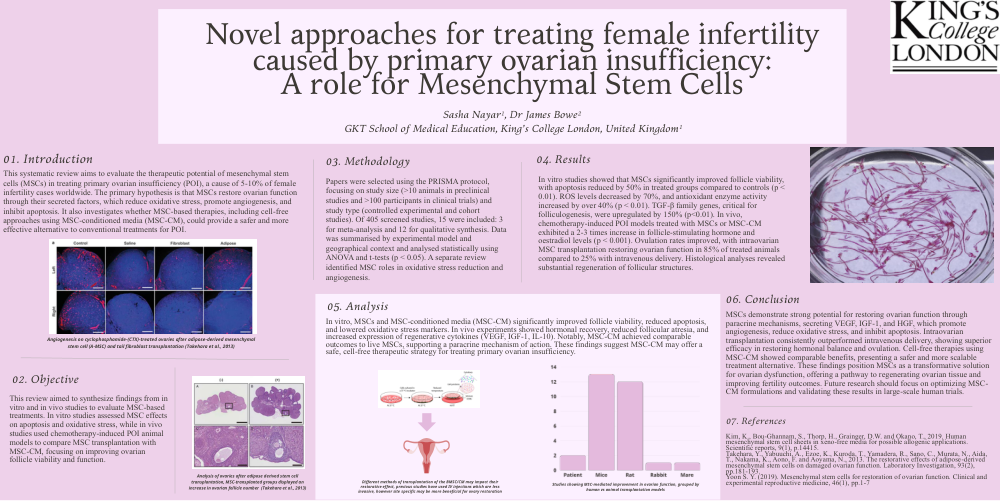
This systematic review aims to evaluate the therapeutic potential of mesenchymal stem cells (MSCs) in treating primary ovarian insufficiency (POI), a cause of 5-10% of female infertility cases worldwide. The primary hypothesis is that MSCs restore ovarian function through their secreted factors, which reduce oxidative stress, promote angiogenesis, and inhibit apoptosis. It also investigates whether MSC-based therapies, including cell-free approaches using MSC-conditioned media (MSC-CM), could provide a safer and more effective alternative to conventional treatments for POI.
Aims
This review aimed to synthesize findings from in vitro and in vivo studies to evaluate MSC-based treatments. In vitro studies assessed MSC effects on apoptosis and oxidative stress, while in vivo studies used chemotherapy-induced POI animal models to compare MSC transplantation with MSC-CM, focusing on improving ovarian follicle viability and function.
Methods
Papers were selected using the PRISMA protocol, focusing on study size (>10 animals in preclinical studies and >100 participants in clinical trials) and study type (controlled experimental and cohort studies). Of 405 screened studies, 15 were included: 3 for meta-analysis and 12 for qualitative synthesis. Data was summarised by experimental model and geographical context and analysed statistically using ANOVA and t-tests (p < 0.05). A separate review identified MSC roles in oxidative stress reduction and angiogenesis.
Analysis
In vitro studies showed that MSCs significantly improved follicle viability, with apoptosis reduced by 50% in treated groups compared to controls (p < 0.01). ROS levels decreased by 70%, and antioxidant enzyme activity increased by over 40% (p < 0.01). TGF-β family genes, critical for folliculogenesis, were upregulated by 150% (p<0.01). In vivo, chemotherapy-induced POI models treated with MSCs or MSC-CM exhibited a 2-3 times increase in follicle-stimulating hormone and oestradiol levels (p < 0.001). Ovulation rates improved, with intraovarian MSC transplantation restoring ovarian function in 85% of treated animals compared to 25% with intravenous delivery. Histological analyses revealed substantial regeneration of follicular structures.
Results
In vitro, MSCs and MSC-conditioned media (MSC-CM) significantly improved follicle viability, reduced apoptosis, and lowered oxidative stress markers. In vivo experiments showed hormonal recovery, reduced follicular atresia, and increased expression of regenerative cytokines (VEGF, IGF-1, IL-10). Notably, MSC-CM achieved comparable outcomes to live MSCs, supporting a paracrine mechanism of action. These findings suggest MSC-CM may offer a safe, cell-free therapeutic strategy for treating primary ovarian insufficiency.
Conclusion
MSCs demonstrate strong potential for restoring ovarian function through paracrine mechanisms, secreting VEGF, IGF-1, and HGF, which promote angiogenesis, reduce oxidative stress, and inhibit apoptosis. Intraovarian transplantation consistently outperformed intravenous delivery, showing superior efficacy in restoring hormonal balance and ovulation. Cell-free therapies using MSC-CM showed comparable benefits, presenting a safer and more scalable treatment alternative. These findings position MSCs as a transformative solution for ovarian dysfunction, offering a pathway to regenerating ovarian tissue and improving fertility outcomes. Future research should focus on optimizing MSC-CM formulations and validating these results in large-scale human trials.
References
Takehara, Y., Yabuuchi, A., Ezoe, K., Kuroda, T., Yamadera, R., Sano, C., Murata, N., Aida, T., Nakama, K., Aono, F. and Aoyama, N., 2013. The restorative effects of adipose-derived mesenchymal stem cells on damaged ovarian function. Laboratory Investigation, 93(2), pp.181-193.
Kim, K., Bou-Ghannam, S., Thorp, H., Grainger, D.W. and Okano, T., 2019. Human mesenchymal stem cell sheets in xeno-free media for possible allogenic applications. Scientific reports, 9(1), p.14415.
Yoon S. Y. (2019). Mesenchymal stem cells for restoration of ovarian function. Clinical and experimental reproductive medicine, 46(1), pp.1-7