2,281 posters, 63 videos, 56 audios, 43 topics, 18 sessions, 6,174 authors, 2,323 institutions
ePostersLive by SciGen Technologies S.A. All rights reserved.
RCOG World Congress 2025
June 23 - 25, 2025 | ExCeL London, UK
EP.1320
Establishing true infection rates post Caesarean section using innovation and collaboration.
Part of Topic
Innovation in obstetrics and gynaecology
Surgical site infection (SSI) is one of the most common complications after Caesarean Birth (CB), with an incidence of between 3-15% (1).
Surgical site infection is defined as an infection occurring in the 30 days after a surgical procedure affecting the incision or deep tissues at the operative site.(2) SSI after CB is associated with prolonged inpatient stay, return to theatre, requirement for antibiotics, impacts on breast feeding and bonding and return to normal function as well as increased cost.(3, 4) Rates have historically been difficult to establish and are under-reported, as 85% occur in the community.
Therefore, establishing accurate SSI rates and risk factors for the development of SSI is imperative to reduce likelihood of these complications and improve maternal healthcare.
Aims
- Identify SSI rates up to 30 days post caesarean birth, using the UK Health Security Agency Wound Healing Questionnaire, across five NHS trusts in the West of England
- Determine risk factors associated with SSI in this patient group
Methods
Collaboration with a digital company resulted in digitalization of the UK Health Security Agency Wound Healing Questionnaire. Between November 2022 to January 2025, this was sent to all mothers following caesarean birth across 5 trusts, 30 days post-delivery via email or text.
Risk factors were determined by analysis of the data extract developed by trust business intelligence units following information governance approval, as well as ethnicity and inequality characteristics.
Results
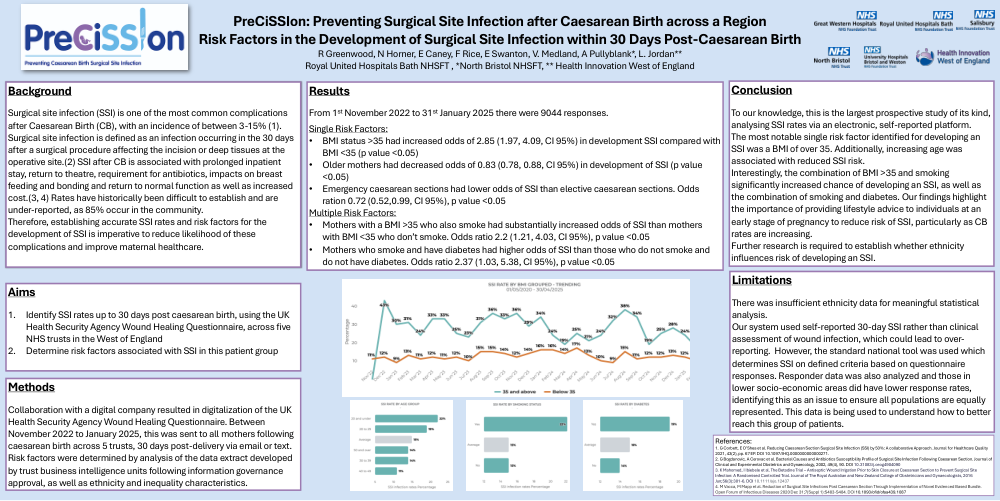
From 1st November 2022 to 31st January 2025 there were 9044 responses.
Single Risk Factors:
BMI status >35 had increased odds of 2.85 (1.97, 4.09, CI 95%) in development SSI compared with BMI <35 (p value <0.05)
Older mothers had decreased odds of 0.83 (0.78, 0.88, CI 95%) in development of SSI (p value <0.05)
Emergency caesarean sections had lower odds of SSI than elective caesarean sections. Odds ration 0.72 (0.52,0.99, CI 95%), p value <0.05
Conclusion
To our knowledge, this is the largest prospective study of its kind, analysing SSI rates via an electronic, self-reported platform.
The most notable single risk factor identified for developing an SSI was a BMI of over 35. Additionally, increasing age was associated with reduced SSI risk.
Interestingly, the combination of BMI >35 and smoking significantly increased chance of developing an SSI, as well as the combination of smoking and diabetes. Our findings highlight the importance of providing lifestyle advice to individuals at an early stage of pregnancy to reduce risk of SSI, particularly as CB rates are increasing.
Further research is required to establish whether ethnicity influences risk of developing an SSI.
Limitations
There was insufficient ethnicity data for meaningful statistical analysis.
Our system used self-reported 30-day SSI rather than clinical assessment of wound infection, which could lead to over-reporting. However, the standard national tool was used which determines SSI on defined criteria based on questionnaire responses. Responder data was also analyzed and those in lower socio-economic areas did have lower response rates, identifying this as an issue to ensure all populations are equally represented. This data is being used to understand how to better reach this group of patients.
References:
1. G Corbett, E O’Shea et al. Reducing Caesarean Section Surgical Site Infection (SSI) by 50%: A collaborative Approach. Journal for Healthcare
Multiple Risk Factors:
Mothers with a BMI >35 who also smoke had substantially increased odds of SSI than mothers with BMI <35 who don’t smoke. Odds ratio 2.2 (1.21, 4.03, CI 95%), p value <0.05
Mothers who smoke and have diabetes had higher odds of SSI than those who do not smoke and do not have diabetes. Odds ratio 2.37 (1.03, 5.38, CI 95%), p value <0.05